Grifting Nepo-Babies In Trump Admin 2.0?


Please consider $upporting GDPolitics by scanning the QR code below or clicking on this link

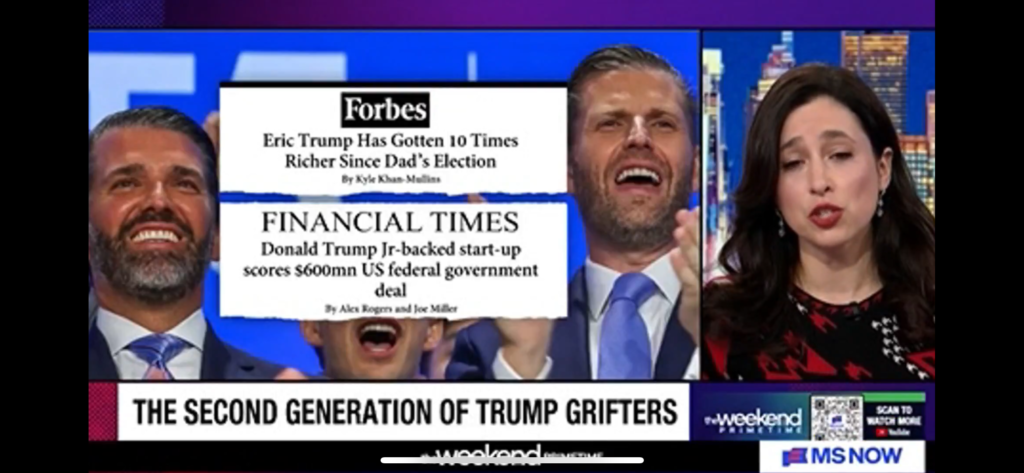
An interesting segment on MSNOW’s Weekend Primetime show delved into the staggering corruption emerging in Trump administration 2.0 — even coining the phrase “Grifting Nepo-Babies” to capture the growing concern about the financial windfalls reportedly enjoyed by the children of several senior Trump–era officials. Co-host Catherine Rampell laid out what she called a pattern of politically connected offspring cashing in during the second Trump presidency. According to the segment, Secretary of Commerce Howard Lutnick’s sons were among those observers have flagged as benefiting enormously from their father’s presence in government — and in their case, the benefits come via the Wall Street powerhouse their father built, Cantor Fitzgerald.

Specifically: when Lutnick stepped into the Cabinet, ownership and control of Cantor Fitzgerald were formally transferred to his two oldest sons, Brandon Lutnick (now Chairman & CEO) and Kyle Lutnick (Executive Vice-Chairman). Under their leadership, the firm is on track for a 2025 revenue haul that reportedly represents its most profitable year ever — a jump of more than a quarter over last year. Much of that windfall stems from Cantor’s aggressive crypto-investment banking, SPAC dealmaking, stablecoin custody and other high-risk, high-reward operations that the firm has doubled down on since the crypto boom took off. Critics argue that this close alignment between a senior Cabinet official and a high-performing Wall Street firm controlled by his children constitutes a textbook example of revolving-door conflicts of interest — especially given the firm’s deep involvement in sectors (like crypto) where regulatory and trade policy decisions may directly affect their bottom line. The optics are stark: a firm once headed by the Commerce Secretary is now raking in record profits under the leadership of his sons, just as policies that shape global trade and regulation are being decided by that same Secretary.

The segment also highlighted another striking example beyond the Lutnicks: Alex Witkoff, the son of Steve Witkoff — himself appointed by Trump as a Middle East envoy. According to multiple recent reports, Alex has aggressively pursued large-scale investments from sovereign‐wealth funds and Gulf-state investors. In 2024 he pitched a $4 billion U.S. real-estate credit fund to the Qatar Investment Authority, promising returns and sizeable management fees; while Qatar reportedly declined, sources say Alex continued courting investors from Qatar, the United Arab Emirates, and Kuwait through at least August 2025. As his father negotiated cease-fire and hostage-release deals across the Middle East under the auspices of the Trump administration, Alex was quietly soliciting money — a convergence of diplomacy and real-estate finance that ethics experts argue raises serious conflict-of-interest concerns. Indeed, GULF-state investment vehicles have already backed several properties owned or developed by the family firm (known as the Witkoff Group), including major assets in New York and Florida. While a spokesperson for the firm has since claimed the specific real-estate fund proposal was “preliminary” and will not move forward, critics maintain that even the attempt — coming alongside high-stakes diplomatic negotiations — exemplifies the growing problem of political power being leveraged for private enrichment.

Rampell then pivoted to Trump’s own children, where the accusations grow louder and the optics far more politically potent. She cited a Forbes report claiming Eric Trump’s wealth has increased dramatically since his father returned to office — with critics arguing that this level of enrichment while a parent is in the White House reflects the same ethical vulnerabilities that plagued Trump’s first term. She also referenced reporting about a startup associated with Donald Trump Jr. that has reportedly secured a major Pentagon-related deal — figures like the oft-circulated “$600 million” have fueled alarm among ethics experts and bipartisan government watchdogs who argue that such arrangements warrant far more transparency. And even Trump’s youngest son, Barron Trump — normally kept out of the political spotlight — was mentioned in the segment due to media chatter about alleged lucrative cryptocurrency-related ventures linked indirectly to his name, though these claims remain murky and largely unverified, further contributing to the perception of a sprawling and loosely monitored financial ecosystem orbiting around the Trump family.

Rampell also revisited the long-running controversies around Trump’s son-in-law Jared Kushner, whose massive financial gains following Trump’s first term — including high-profile investments from foreign sovereign funds — continue to be held up by critics as one of the most glaring examples of blurred ethical boundaries. His ongoing business expansions during Trump’s second presidency only reinforce concerns among ethics observers who argue that the revolving door between political power and personal enrichment is now swinging more freely than ever.

The larger point the MSNOW hosts made was that corruption — whether alleged, implied or documented — has quickly become a defining theme of Trump 2.0. Democrats are already gearing up to make it a core message for the 2026 midterms, framing the administration as a government increasingly captured by the financial ambitions of the president’s inner circle and their families. But what may pose a more immediate threat to Trump is that even portions of his MAGA base are beginning to grumble. Online circles that once defended every decision of the Trump family have begun to express frustration at what they see as blatant self-dealing — especially as the administration continues to sideline issues that energized Trump’s grassroots supporters in the first place: lower prices, avoiding new foreign conflicts, demands for release of the Epstein files, and promises of “draining the swamp.” For some longtime loyalists, the contrast between those unmet commitments and the constant headlines about politically connected children becoming wealthier has begun to feel impossible to ignore.

How this discontent evolves could have real consequences in the 2026 midterms. If the corruption narrative continues to grow, and if MAGA voters feel increasingly alienated or taken for granted, Republicans could find themselves facing a demoralized base at the very moment Democrats are preparing to campaign on a simple, sharp message: that Trump 2.0 has become a family business masquerading as a government. The question heading into 2026 is not just whether Democrats can capitalize on this narrative, but whether the erosion of enthusiasm among core Trump supporters will quietly do the job for them.

The History Of Lies Preceeding Findings Of War Crimes

Please consider $upporting GDPolitics by scanning the QR code below or clicking on this link

An interesting segment on MSNBC’s Last Word dug into what it described as a familiar pattern in U.S. military history: deny wrongdoing first, then slowly acknowledge pieces of the truth once outside evidence becomes impossible to dismiss. Lawrence O’Donnell used the current controversy surrounding Defense Secretary Pete Hegseth’s alleged “boat strikes” in the Caribbean as his launching point, arguing that the initial denials and evasions coming from the Pentagon echo earlier moments when U.S. officials misled the public about military actions that later proved indefensible. O’Donnell’s implication was unmistakable—that when the dust settles, investigators may conclude not only that the strikes were unlawful, but that Hegseth or those operating under his authority initially misrepresented what happened.

O’Donnell’s framing draws on a long and painful history. From the My Lai massacre in Vietnam, to the Pentagon’s early false account of Pat Tillman’s death, to the denials surrounding the Kunduz hospital airstrike in Afghanistan, the United States military has repeatedly issued confident, categorical explanations that later unraveled. The pattern is not merely that the military gets things wrong; it is that it often knows its initial explanations are incomplete or misleading. In the Kunduz case, commanders first claimed that the deadly strike on the Doctors Without Borders hospital was an accident caused by bad intelligence. Later investigations revealed systematic procedural violations and inconsistencies in the official story. In other incidents, the military has been accused of cleaning up sites, withholding footage, or pressuring witnesses—all in the name of preserving institutional credibility. These reversals feed the larger concern O’Donnell was highlighting: when allegations of war crimes arise, the public’s first encounter with them is often a narrative shaped to minimize responsibility.

That context matters in the current debate over the so-called “double tap” strikes. The term refers to a practice—widely condemned by human rights groups—where an initial strike is followed minutes later by a second one timed to hit rescuers rushing to help the wounded. International law experts have long argued that the tactic constitutes a war crime because it intentionally targets medics, civilians, or anyone giving aid. According to MSNBC’s reporting, the controversy swirling around Hegseth includes allegations that at least some of the Caribbean boat strikes may have followed this pattern. Early statements from Defense Department officials reportedly downplayed or denied this, but as often happens, additional footage and testimony have begun to contradict the earliest claims. O’Donnell suggested that even Hegseth’s own language has shifted—initially presenting the strikes as precise, justified, and unambiguous, while later remarks seem more cautious, as if acknowledging that the official story may not hold under scrutiny. Critics note that this rhetorical drift mirrors earlier cases where U.S. officials’ first instinct was to shield themselves rather than openly confront what occurred.

The pressure is not only coming from television pundits. MSNBC has also reported that the family of a Colombian fisherman killed in one of the “narco-terrorist” drone strikes has filed a formal complaint with a Washington, D.C.–based human rights organization. The filing seeks monetary compensation but also demands an end to the drone campaign altogether. More significantly, it accuses Secretary Hegseth of authorizing extrajudicial killing—an allegation that, if taken up by international bodies, could draw the attention of the International Criminal Court or other tribunals. While the ICC rarely targets officials from powerful nations, a complaint of this nature can still generate diplomatic headaches, congressional scrutiny, and sustained media investigation.

What stands out even more is that, despite the deep polarization in Washington, these boat strikes have triggered bipartisan unease. Lawmakers in both parties have struggled to accept the administration’s rationale that small vessels thousands of miles from U.S. shores pose such a grave and imminent threat that the only viable response is to blow them out of the water. Even some Republicans—normally inclined to defend a Republican administration reflexively—are questioning whether the intelligence behind the strikes is as airtight as officials claim. The complaint filed by the fisherman’s family underscores the fragility of the administration’s narrative; if one case unravels, others may follow, and with them the assertion that all strikes have been lawful counter-narco operations rather than disproportionate uses of force.

The open question is whether Secretary Hegseth will adjust course. Will he dial back the strike policy to accommodate bipartisan concerns, or will he press forward under the belief that forceful action now will be vindicated later? The political calculus is complicated by the reality that former President Trump, as a former head of state, will almost certainly remain shielded from any serious war-crimes prosecution; the ICC has historically avoided pursuing former U.S. presidents, and legal scholars widely agree it is unlikely to break that precedent. Hegseth, however, does not enjoy the same protective aura. Officials below the level of head of state have faced international legal jeopardy before, and those in the Trump administration who assume they are untouchable may discover that this confidence is misplaced.

Whether the unfolding controversy becomes another entry in the long ledger of U.S. military denials followed by partial admissions—or something more legally consequential—remains to be seen. But as O’Donnell’s segment underscored, history has taught observers to pay close attention not only to what officials say at the beginning of these crises, but how their stories change once the evidence emerges and the truth becomes harder to hide.

Is Trump’s Beef With Venezuela Just A Distraction From Epstein Files?

Please consider $upporting GDPolitics by scanning the QR code below or clicking on this link

On the December 3, 2025 edition of MSNOW’s Last Word, host Lawrence O’Donnell made a striking allegation: that President Trump’s recent moves toward a potential conflict with Venezuela are part of a deliberate effort to divert public attention from what has become the most politically explosive vulnerability of his administration—the Epstein files. As dramatic as that claim sounds, the idea that a president might reach for military action to overshadow damaging domestic troubles is far from unprecedented in American politics.

History offers several examples of presidents facing crises at home while initiating or escalating military operations abroad. In 1999, as the Monica Lewinsky scandal and impeachment fight threatened his presidency, Bill Clinton authorized U.S. and NATO airstrikes in Kosovo. While the Kosovo intervention had legitimate humanitarian and geopolitical motivations, critics at the time argued that its timing conveniently shifted the national focus away from the turmoil engulfing Clinton in Washington. Similarly, George W. Bush’s 2003 invasion of Iraq—authorized with congressional approval and publicly justified as a necessary step to eliminate weapons of mass destruction—has long been viewed by some political observers as a campaign that also helped neutralize criticism of the administration’s intelligence failures surrounding 9/11 and other mounting domestic issues. In both cases, military action absorbed media bandwidth, elevated presidential authority, and stirred a sense of national unity that could blunt domestic scrutiny.

The pattern, then, is an old one: foreign conflict can serve as a political reset button, even if the strategic and humanitarian stakes are genuinely complex. It is also a risky gamble, because wars rarely unfold according to plan. setbacks can deepen public dissatisfaction instead of alleviating it, and the use of military force for political cover remains one of the most controversial charges that can be leveled against any commander in chief.

Against this backdrop, if President Trump were to sidestep Congress and launch a military operation in Venezuela under the banner of fighting “narco-terrorists,” it would not emerge in a historical vacuum. It would more closely resemble a familiar—and troubling—pattern in presidential behavior. Yet recognizing a pattern does not mean the public should accept it as inevitable. Trump campaigned in 2024 on promises of “no more foreign wars” and “no more regime change,” commitments that resonated deeply with voters weary of costly, open-ended U.S. interventions. Many of his supporters viewed him as the candidate who would finally break the cycle of manufactured or opportunistic foreign entanglements that so often coincide with moments of domestic political stress.

That alone should give the president pause. If he truly intends to differentiate himself from past administrations, he must resist the temptation to use military force as a political distraction. The public—and especially the voters who backed him on the promise of a different foreign-policy era—deserve a leader who resists the cynical logic of war as domestic cover, not one who repeats it.