Senior Official At Trump’s Interior Department Accused Of Corruption

The January 5, 2026 edition of MSNOW’s Rachel Maddow Show devoted a lengthy segment to corruption allegations involving Karen Budd-Falen, a powerful but little-known figure who served as the number three official at Donald Trump’s Department of the Interior and previously held senior posts there during Trump’s first term. Maddow framed the story as emblematic of a familiar pattern from the Trump years: public office intersecting uncomfortably with private financial interests, and the ethical guardrails that normally prevent that collision appearing either weakened or ignored.

Maddow opened with a sardonic observation that Budd-Falen may have been an unintended beneficiary of Trump’s dramatic weekend escalation involving Venezuela, which dominated headlines just as The New York Times was preparing a major investigative report on Budd-Falen. The international crisis effectively crowded out what might otherwise have been a front-page political scandal, buying time and quiet for a senior Interior Department official facing serious scrutiny.

At the center of the allegations is Budd-Falen’s role at Interior, where she wielded substantial influence over land use, water rights, and energy development—particularly in the West. Before and during her government service, Budd-Falen was well known as a lawyer representing ranchers, mining interests, and extractive industries, often in disputes against federal regulators and environmental protections. That background made her appointment controversial from the start, as critics argued she was now overseeing, from inside the government, policy areas that directly overlapped with her prior clients and personal interests.

According to reporting discussed on Maddow’s show, Budd-Falen and her husband own a ranch in Nevada that became strategically important to investors seeking to build a lithium processing facility nearby. Lithium, a critical mineral for electric vehicle batteries and energy storage, has been the subject of intense political and economic interest, and Interior Department approvals can make or break such projects. The investors allegedly offered the Budd-Falens $3.5 million for the ranch’s water rights—a staggering sum in itself—but the payment was reportedly contingent on the Interior Department approving the lithium plant. As Maddow summarized it, the deal appeared to hinge on a simple but troubling condition: no approval, no money.

What deepens the ethical concerns is the timeline. Maddow reported that Budd-Falen met with the investors for lunch in the Interior Department cafeteria during Trump’s first term. Not long afterward, the department gave the lithium project the green light. Even more striking, the project was reportedly fast-tracked, allowing it to bypass layers of environmental and regulatory review that similar projects typically face. Critics argue that this accelerated process reduced the chances that internal watchdogs or career civil servants would flag the apparent conflict of interest between a senior official’s personal financial stake and her department’s decision-making.

From an ethics standpoint, the issue is not merely whether Budd-Falen personally signed off on the approval, but whether her position and influence created an environment in which subordinates understood what outcome was desired. Federal ethics rules are designed to prevent even the appearance of such impropriety, precisely because public trust erodes when officials stand to gain financially from decisions made by their agencies.

At the same time, Maddow emphasized that Budd-Falen and the lithium investors deny any wrongdoing. A potential defense is that the water rights transaction was a private land deal negotiated at arm’s length, and that Interior Department approvals followed standard procedures driven by policy priorities rather than personal enrichment. Budd-Falen could also argue that she formally recused herself from decisions directly involving the project, or that career staff—not political appointees—made the ultimate determinations. Without full documentation and testimony, those claims remain unresolved, and they underscore why independent investigations, rather than television segments or partisan talking points, are essential to establishing the facts.

Still, the optics are undeniably damaging, particularly when viewed against the broader backdrop of corruption and ethics scandals that repeatedly engulfed Trump’s senior officials. From former Interior Secretary Ryan Zinke’s real estate dealings, to EPA Administrator Scott Pruitt’s resignation amid revelations of lavish perks and secret meetings with lobbyists, to Cabinet members like Tom Price and Wilbur Ross facing scrutiny over private travel and undisclosed financial ties, the Trump administration developed a reputation for blurring the line between public service and private gain. Even figures outside the Cabinet, such as Jared Kushner, drew sustained criticism for foreign financial entanglements that appeared to follow directly from their government roles. More recently, other high-profile Trump allies and officials, including Kristi Noem, have faced their own waves of controversy and ethical questions, reinforcing the sense that these were not isolated incidents but part of a recurring pattern.

Whether Karen Budd-Falen ultimately becomes another confirmed example of that pattern remains to be seen. What is clear is that the allegations strike at the heart of public trust in government: the expectation that officials act in the public interest, not their own financial self-interest. For now, Budd-Falen’s case sits in an uneasy limbo between denial and suspicion, with unanswered questions about influence, transparency, and accountability. As Maddow suggested, time—and thorough investigation—will determine whether these allegations collapse under scrutiny or become yet another entry in the long ledger of Trump-era corruption scandals.

Corruption Becoming A Central Theme In Trump Admin 2.0

Please consider $upporting GDPolitics by scanning the QR code below or clicking on this link

On the 12/22/25 edition of MSNBC’s Rachel Maddow Show, Maddow zeroed in on what is rapidly emerging as a defining feature of Trump administration 2.0: corruption. There is a bitter irony here. Trump first rode to power on the promise to “drain the swamp,” arguing that his personal wealth insulated him from influence peddling and that his outsider status would free Washington from its culture of self-dealing. Instead, one year into his second term, corruption is no longer a peripheral criticism of Trump’s presidency — it is becoming the central storyline.

Maddow opened the segment not in Washington, but in Bulgaria. There, a government recently collapsed under sustained public pressure over endemic corruption. Maddow’s choice was deliberate. By beginning abroad, she framed corruption not as an abstract moral failing, but as a destabilizing force capable of toppling governments when it becomes too blatant to ignore. The lesson was implicit but unmistakable: corruption has political consequences, and no democracy is immune. Only after establishing that broader context did she pivot back to the United States — and to Trump administration 2.0.

What followed was a catalogue of ethically dubious dealings that, taken together, have led many observers to already label this administration as the most corrupt in modern American history. Maddow focused first on Donald Trump Jr., whose proximity to power appears to be translating directly into extraordinary financial opportunities. One case involves a little-known drone company that placed Trump Jr. on its board and awarded him company shares, only to subsequently land a $15 million Pentagon contract. The timing alone raises obvious questions, and Maddow bluntly asked the one many Americans are already asking: was the contract awarded on merit, or because the president’s son now sat inside the company’s boardroom?

That deal, troubling as it is, appears to be only part of a much larger pattern. Maddow reported that another company tied to Trump Jr. received a staggering $620 million loan or contract from the Pentagon — the largest loan ever issued by the Department of Defense. The scale of that award, coupled with Trump Jr.’s personal financial stake, moves the story beyond appearances and into territory that looks like textbook influence trading. Even by Washington’s historically lax standards, this is extraordinary.

The corruption narrative does not stop with the president’s family. Maddow also revisited the case of Tom Homan, now serving as Trump’s Border Czar. Before assuming his current role, Homan reportedly accepted $50,000 in cash — money allegedly intended to influence how DHS contracts would be steered once he reentered government. What makes the episode particularly striking is the level of foresight involved. Both Homan and those paying him appeared confident not only that Trump would return to power, but that Homan would land in a specific, strategically valuable position within the administration. It suggests corruption that is not opportunistic, but premeditated — a system anticipating power and positioning itself to exploit it.

Department of Homeland Security Secretary Kristi Noem has also found herself at the center of corruption allegations. Maddow detailed how DHS steered lucrative advertising contracts to a little-known firm with longstanding political ties to Noem, dating back well before her appointment as secretary. The pattern again feels familiar: public money flowing toward private entities connected to powerful figures, with little transparency and even less accountability. These are not isolated incidents; they form a mosaic of governance that treats the federal government as an extension of a political and personal network.

Hovering over all of this is the unresolved legacy of Jared Kushner. His dealings during the first Trump administration — particularly his post-White House financial windfall tied to foreign governments — were never fully reckoned with. Now, Maddow noted, Kushner is once again positioned to profit, this time through involvement in discussions surrounding the rebuilding of Gaza. The reemergence of Kushner in a role adjacent to foreign policy and massive reconstruction funding reinforces the sense that Trumpworld never truly left its transactional mindset behind. It simply paused, regrouped, and returned more emboldened.

All of this is unfolding as the country barrels toward the 2026 midterm elections. Historically, corruption has been one of the few issues capable of cutting through partisan loyalty, particularly when it becomes this overt and this personal. Democrats are clearly betting that the accumulation of these scandals — not one, but many — will erode public trust and mobilize voters who may be exhausted by chaos but still responsive to clear abuses of power. For Republicans, the question is whether they can continue to normalize or deflect these stories without paying an electoral price.

The Bulgarian example Maddow opened with now feels less like a foreign curiosity and more like a cautionary tale. Corruption, when left unchecked, does not merely stain reputations — it destabilizes governments and reshapes political futures. Whether Trump administration 2.0 faces similar consequences will be decided not just in courtrooms or congressional hearings, but at the ballot box in November 2026.

Grifting Nepo-Babies In Trump Admin 2.0?


Please consider $upporting GDPolitics by scanning the QR code below or clicking on this link

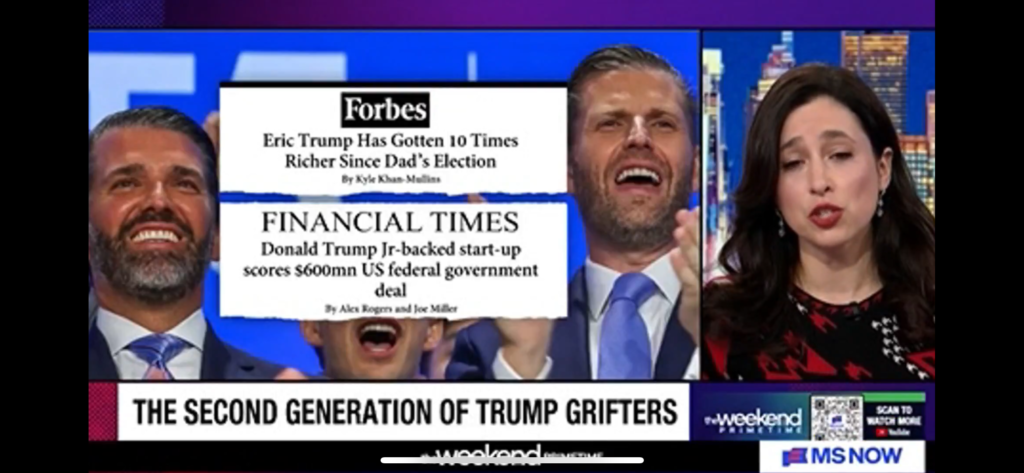
An interesting segment on MSNOW’s Weekend Primetime show delved into the staggering corruption emerging in Trump administration 2.0 — even coining the phrase “Grifting Nepo-Babies” to capture the growing concern about the financial windfalls reportedly enjoyed by the children of several senior Trump–era officials. Co-host Catherine Rampell laid out what she called a pattern of politically connected offspring cashing in during the second Trump presidency. According to the segment, Secretary of Commerce Howard Lutnick’s sons were among those observers have flagged as benefiting enormously from their father’s presence in government — and in their case, the benefits come via the Wall Street powerhouse their father built, Cantor Fitzgerald.

Specifically: when Lutnick stepped into the Cabinet, ownership and control of Cantor Fitzgerald were formally transferred to his two oldest sons, Brandon Lutnick (now Chairman & CEO) and Kyle Lutnick (Executive Vice-Chairman). Under their leadership, the firm is on track for a 2025 revenue haul that reportedly represents its most profitable year ever — a jump of more than a quarter over last year. Much of that windfall stems from Cantor’s aggressive crypto-investment banking, SPAC dealmaking, stablecoin custody and other high-risk, high-reward operations that the firm has doubled down on since the crypto boom took off. Critics argue that this close alignment between a senior Cabinet official and a high-performing Wall Street firm controlled by his children constitutes a textbook example of revolving-door conflicts of interest — especially given the firm’s deep involvement in sectors (like crypto) where regulatory and trade policy decisions may directly affect their bottom line. The optics are stark: a firm once headed by the Commerce Secretary is now raking in record profits under the leadership of his sons, just as policies that shape global trade and regulation are being decided by that same Secretary.

The segment also highlighted another striking example beyond the Lutnicks: Alex Witkoff, the son of Steve Witkoff — himself appointed by Trump as a Middle East envoy. According to multiple recent reports, Alex has aggressively pursued large-scale investments from sovereign‐wealth funds and Gulf-state investors. In 2024 he pitched a $4 billion U.S. real-estate credit fund to the Qatar Investment Authority, promising returns and sizeable management fees; while Qatar reportedly declined, sources say Alex continued courting investors from Qatar, the United Arab Emirates, and Kuwait through at least August 2025. As his father negotiated cease-fire and hostage-release deals across the Middle East under the auspices of the Trump administration, Alex was quietly soliciting money — a convergence of diplomacy and real-estate finance that ethics experts argue raises serious conflict-of-interest concerns. Indeed, GULF-state investment vehicles have already backed several properties owned or developed by the family firm (known as the Witkoff Group), including major assets in New York and Florida. While a spokesperson for the firm has since claimed the specific real-estate fund proposal was “preliminary” and will not move forward, critics maintain that even the attempt — coming alongside high-stakes diplomatic negotiations — exemplifies the growing problem of political power being leveraged for private enrichment.

Rampell then pivoted to Trump’s own children, where the accusations grow louder and the optics far more politically potent. She cited a Forbes report claiming Eric Trump’s wealth has increased dramatically since his father returned to office — with critics arguing that this level of enrichment while a parent is in the White House reflects the same ethical vulnerabilities that plagued Trump’s first term. She also referenced reporting about a startup associated with Donald Trump Jr. that has reportedly secured a major Pentagon-related deal — figures like the oft-circulated “$600 million” have fueled alarm among ethics experts and bipartisan government watchdogs who argue that such arrangements warrant far more transparency. And even Trump’s youngest son, Barron Trump — normally kept out of the political spotlight — was mentioned in the segment due to media chatter about alleged lucrative cryptocurrency-related ventures linked indirectly to his name, though these claims remain murky and largely unverified, further contributing to the perception of a sprawling and loosely monitored financial ecosystem orbiting around the Trump family.

Rampell also revisited the long-running controversies around Trump’s son-in-law Jared Kushner, whose massive financial gains following Trump’s first term — including high-profile investments from foreign sovereign funds — continue to be held up by critics as one of the most glaring examples of blurred ethical boundaries. His ongoing business expansions during Trump’s second presidency only reinforce concerns among ethics observers who argue that the revolving door between political power and personal enrichment is now swinging more freely than ever.

The larger point the MSNOW hosts made was that corruption — whether alleged, implied or documented — has quickly become a defining theme of Trump 2.0. Democrats are already gearing up to make it a core message for the 2026 midterms, framing the administration as a government increasingly captured by the financial ambitions of the president’s inner circle and their families. But what may pose a more immediate threat to Trump is that even portions of his MAGA base are beginning to grumble. Online circles that once defended every decision of the Trump family have begun to express frustration at what they see as blatant self-dealing — especially as the administration continues to sideline issues that energized Trump’s grassroots supporters in the first place: lower prices, avoiding new foreign conflicts, demands for release of the Epstein files, and promises of “draining the swamp.” For some longtime loyalists, the contrast between those unmet commitments and the constant headlines about politically connected children becoming wealthier has begun to feel impossible to ignore.

How this discontent evolves could have real consequences in the 2026 midterms. If the corruption narrative continues to grow, and if MAGA voters feel increasingly alienated or taken for granted, Republicans could find themselves facing a demoralized base at the very moment Democrats are preparing to campaign on a simple, sharp message: that Trump 2.0 has become a family business masquerading as a government. The question heading into 2026 is not just whether Democrats can capitalize on this narrative, but whether the erosion of enthusiasm among core Trump supporters will quietly do the job for them.

Homeland Security’s $220 Million Ad Controversy: An Objective Look at the Noem Connections

Please consider $upporting GDPolitics by scanning the QR code below or clicking on this link

A series of recent investigative reports, first published by ProPublica and later picked up by major outlets including MSNBC, has drawn substantial attention to a large Department of Homeland Security (DHS) advertising campaign and its connections to Secretary Kristi Noem’s political circle. Although the DHS has defended its decisions and denies any improper influence, the scope of the contract, the speed at which funds were awarded, and the involvement of individuals tied to Noem have generated intense public scrutiny. What follows is a fact-based, balanced overview of what is known, what is contested, and why the episode continues to raise questions.

The controversy began with DHS’s launch of a national and international ad campaign intended to deter illegal immigration. According to ProPublica, the campaign totals approximately $220 million and includes television, digital, radio, and social-media placements. DHS has stated that the campaign is aimed at discouraging unauthorized crossings by emphasizing tougher enforcement policies and consequences. One of the signature ads features Secretary Noem at Mount Rushmore delivering a tough-on-immigration message that DHS characterizes as a public service announcement rather than a political communication. DHS has consistently argued that the campaign is justified by pressing national security needs and that it reflects policy objectives rather than partisan motives.

The financial and procedural details surrounding this campaign, however, prompted wider concerns. DHS invoked a “national emergency” at the border to bypass the traditional competitive bidding process, fast-tracking the ad contracts. While legal, this mechanism is typically used for time-sensitive, high-risk situations rather than large-scale media campaigns. Critics argue that employing emergency powers for a communications initiative undermines normal procurement safeguards designed to prevent favoritism and ensure transparency. DHS counters that career procurement officials oversaw the process and that all actions complied with federal law.

The most scrutinized element of the spending is the decision to direct $143 million of the campaign funds to a newly formed Delaware company called Safe America Media. The firm was incorporated only days before receiving the contract, an unusually rapid timeline for a high-value federal agreement. Public contracting databases provide little information about how Safe America Media has allocated its funds or whom it subcontracted. This lack of documentation has fueled questions about the nature of the company, who ultimately benefited from the funds, and why the government selected an entity with virtually no track record.

Those questions intensified when investigators identified personal and professional connections between DHS leadership and political consultants aligned with Noem. Safe America Media’s listed address is linked to Republican operative Michael McElwain, and reporting has highlighted the involvement of the Strategy Group, a Republican consulting firm that played a large role in Noem’s South Dakota gubernatorial campaigns. The firm is led by Benjamin Yoho, who is married to Tricia McLaughlin, DHS’s Assistant Secretary for Public Affairs. That office, which McLaughlin leads, is the same DHS division responsible for funding the ad campaign. This nexus of relationships has raised concerns from ethics experts and watchdog groups, who argue that—even if no laws were broken—the appearance of a conflict of interest is substantial.

Critics, including former federal contracting officials, contend that the overlap between Noem’s political network and the firms connected to the DHS campaign creates significant risk of improper influence. They argue that the lack of publicly available subcontractor information prevents the public from knowing whether politically connected firms benefited from taxpayer funds. Some experts have described the arrangement as highly irregular, and organizations have called for oversight investigations by congressional committees or the DHS Inspector General. Others have pointed out that the political tone of some of the ads, particularly those referencing Trump-era border policies, may blur the line between public service messaging and partisan promotion, although DHS maintains the messaging is policy-driven.

Defenders of Noem and DHS present a different picture. They note that DHS officials, not political appointees, handled the contracting and that emergency procurement authority exists precisely to allow rapid responses to urgent national issues. McLaughlin has publicly stated that she fully recused herself from decisions related to these contracts, emphasizing that professional ethics protocols were followed. Supporters also argue that the intent of the campaign is clear: to deter migration through communication, a tool that has been used by multiple administrations. They also point out that no concrete evidence has surfaced proving that any funds were intentionally steered to Noem’s allies for political purposes.

Despite those defenses, the situation remains complicated. The unusual contracting timeline, the lack of transparency surrounding subcontractors, and the close personal ties between DHS leadership and outside political consultants make the story difficult to dismiss. Even if every action taken was technically compliant with procurement rules, the optics invite skepticism. In matters of public spending—especially on such a large scale—appearance alone can erode public trust, particularly when political figures and their associates are involved. At a minimum, the episode underscores the importance of transparent procurement processes, clear public reporting on subcontractors, and robust safeguards to prevent even the perception of conflicts of interest.

Ultimately, the controversy exposes a broader tension at the intersection of government communication, national security policy, and political influence. DHS insists the campaign is essential to its mission and was executed properly. Critics argue that the process lacked the transparency and arm’s-length separation needed to ensure public confidence. As calls for additional oversight continue, the resolution of this issue may set important precedents for how federal agencies handle large-scale communications campaigns—especially when those campaigns intersect with the political networks of their leaders.

GOP’s Long History Of Threatening Prosecutors Into Submission

$upport via Cash App

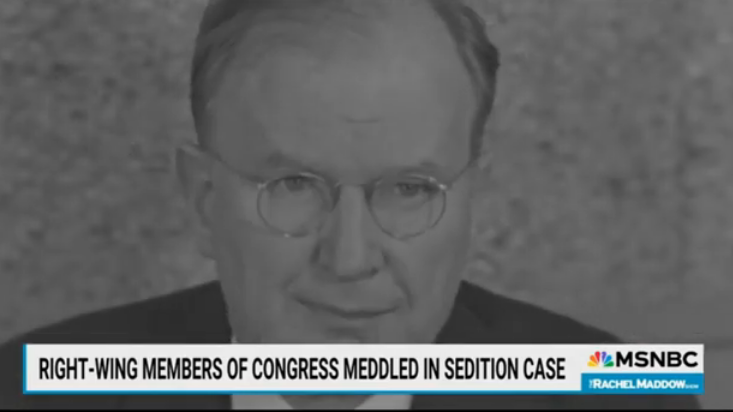
A bombshell segment on the 05/20/24 edition of The Rachel Maddow Show (TRMS) delved into the GOP’s long history of using political pressure to scuttle criminal investigations and prosecutions targeting them.

Maddow’s intent was to bring attention to the Republican political attacks currently being leveled against Fulton County DA Fani Willis, as she tries to hold former President Trump accountable for trying to overturn the results of the 2020 presidential elections in Georgia.

It is widely assumed by many, that the political attacks currently playing out against DA Willis are somehow novel, or totally unheard of in America, when as Maddow clearly illustrates, there is a very long and sordid history of Republican politicians successfully employing similar tactics in the past.

The full Maddow segment (YouTube) is available here for context, but my posts on X(formerly Twitter) get to the crux of her argument, and that is, the Republican attacks on Fulton County DA Fani Willis are nothing knew. Republicans have been doing these political pressure campaigns against prosecutors dating as far back as the 1940s. Such pressure campaigns have largely evaded media scrutiny because as she puts it, they make the country and all the stakeholders look bad.

As Maddow correctly points out, it’s incumbent upon any democracy-loving individual, to step up and defend DA Fani Willis, or any other similarly situated prosecutor, against such political pressure campaigns. They are antithetical to a free and democratic society.

For those of you very happy with @Emolclause’s activism don’t shy away from the “tip jar” below on your way out. You may also Cash App

Email author at admin@grassrootsdempolitics.com

Become an Octapharma Plasma donor. Make up to $200 in one week and help save lives too! Learn More

Russia Behind GOP’s Opposition To Ukraine Funding

$upport via Cash App

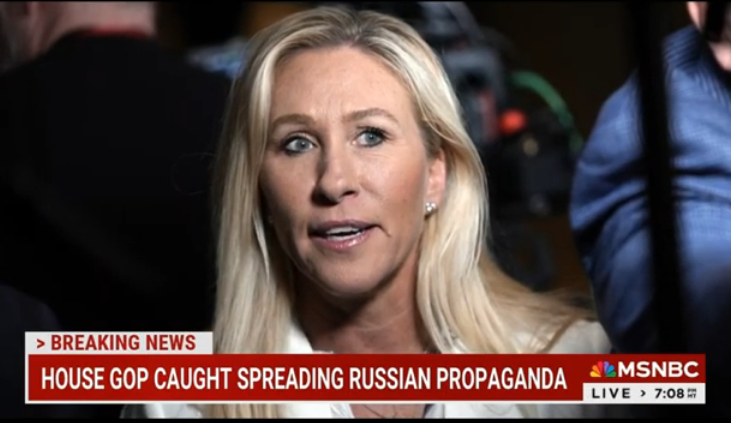
Rep Marjorie Taylor-Greene(R-GA), the loudest opponent to Ukraine funding

A bombshell segment on Alex Wagner Tonight show (04/17/24), citing a Washington Post piece, confirmed what we’ve suspected all along, and that is, Putin’s Russia is behind the Republican Party’s opposition to efforts by Congress to provide funding for Ukraine, as it defends itself against a Russian invasion. The bombshell report essentially says that Rep Marjorie Taylor-Greene(R-GA), aptly nicknamed “Moscow Marge”, and other congressional Republicans currently opposed to Ukraine funding, are either willing or unwilling participants in Vladimir Putins propaganda campaign–a sad state of affairs indeed.

Host Alex Wagner(5:43): “…Ukraine and the vote for Ukraine funding has become a leverage point for Russia. The Washington Post has some explosive reporting…on newly revealed documents from inside Vladimir Putin’s government, documents which show how Russia is seeking to subvert western support for Ukraine and disrupt the domestic politics of the United States and European countries through propaganda campaigns and supporting isolationist and extremist policies. Russia is formenting division over Ukraine because it wants to weaken America’s role in the world. In particular, one Russian policy expert cited in one of these documents, specifically calls on Russia to continue to facilitate the coming to power of isolationist right-wing forces in America.”

Host Wagner then got very specific, adding, “Russia very much wants the Marjorie Taylor Greene’s to continue doing exactly what they are doing, because it serves Russia’s interests.”

Bottom line folks, host Alex Wagner and the Washington Post are absolutely correct. Trump GOP’s opposition to Ukraine funding is not rooted in some legitimate conservative ideology as they would like the public to believe. Instead, it is a shameless assist to Russia’s strongman Vladimir Putin, who they are banking on to help them win Congress and possibly the White House in 2024. You read that right, a win for Trump in 2024 is a win for Vladimir Putin.

For those of you very happy with @Emolclause’s activism don’t shy away from the “tip jar” below on your way out. You may also Cash App

Email author at admin@grassrootsdempolitics.com

Become an Octapharma Plasma donor. Make up to $200 in one week and help save lives too! Learn More

Monies Raised By Trump’s PACs Are Being Spent On His Legal Fees

$upport via Cash App

Turns out, per bombshell segment on CNN‘s NewNight Show (01/30/24) that political action committees (PACs) supporting former President Donald Trump are using the $50 million they have raised, to offset Trump’s personal legal bills. As NewsNight host Abby Phillips hastily points out, as shady as this may appear to the general public, it is apparently totally legal.

One would understand why the public would struggle with the legality of this action by Trump’s PACs, given the myriad news stories out there, of people being criminally prosecuted for starting GoFundMe campaigns to ostensibly raise funds for medical bills, only to turn around and use those funds for personal items like new vehicles, rent, jewellery, etc. If that is illegal, then why should it be perfectly legal for a PAC, which ostensibly raises money for Trump’s campaign for the presidency in 2024, to turn around and use the raised funds to offset his personal legal bills?

Host Abby Phillip (0:15): “Sources tell CNN that $50 million, is how much the PACs supporting Trump, have raised and then donated to the cause of keeping Trump out of jail. Now, mind you, this is all legal, but a spokesman for one of those PACs insists tonight to the New York Times, that every dollar being raised by MAGA Inc is going directly to defeating Joe Biden in November. But at least some of those dollars and cents are as of this moment, being siphoned off for courtroom costs.”

Bottom line folks, reasonable people will agree that there is no difference between the financial fraud that GoFundMe scammers are rightly criminally prosecuted for, and what these Trump PACs are engaged in. Simply put, rather than just throwing up our hands in the air and accepting this cheating by Trump’s PACs as “totally legal”, maybe some legal eagle should embark on a novel federal lawsuit arguing that Trump’s PACs are defrauding their donors, and are in essence, no different than the criminal GoFundMe scammers. While this may not fix the issue during this 2024 election cycle, maybe, just maybe, it may spur members of Congress to come up with a legislative fix for these and other PAC loopholes, for future elections.

For those of you very happy with @Emolclause’s activism don’t shy away from the “tip jar” below on your way out. You may also Cash App

Email author at admin@grassrootsdempolitics.com

Become an Octapharma Plasma donor. Make up to $200 in one week and help save lives too! Learn More

Michael Moore Slams Michigan Officials For Zero Criminal Prosecutions Over Flint Water Scandal

$upport via Cash App

Film Producer and Activist Michael Moore appeared on MSNBC’s Politics Nation show (11/04/23) to discuss among other things, the ongoing Israel-Palestine conflict. Moore’s home state is Michigan, which is home to the largest Arab-American population in the United States. Later in the interview, the discussion moved on to another disaster that Moore got intricately involved in as an activist, and that is, the Flint water scandal, which caused lead poisoning of poor (primarily Black) families in Flint Michigan. Moore expressed frustration that to date, no Michigan state official has been criminally held responsible for the poisoning.

Here’s what Michael Moore told host Al Sharpton regarding the decision by the Michigan Attorney General to end the investigation into Flint without any criminal prosecution (8:38): “It’s so disgusting, appalling, and again, sad…Here we are, talking really about…an ethnic cleansing of a majority Black city, where the state of Michigan in order to save some money, took the city off the clean water supply from Lake Huron, and made the people of Flint, Michigan, majority Black, drink from the Flint River, a massively polluted river, for decades, and what it did was, it poisoned nearly 10,000 children. Any lead poisoning, if you’re…six years and younger, you will have permanent brain damage…And the Governor, and his people, once they knew what was going on, they tried to cover it up…and they got away with it…If this was a White town in Michigan…you never would have seen this. This is going on for seven years, and nobody convicted, nobody having to be responsible for what they knew what was going on, they knew what was going to happen…”

Moore then went on to subtly call out the current Michigan Attorney General Dana Nessel, a Democrat, for not criminally prosecuting the people responsible for the Flint water poisoning. To be clear, AG Nessel assumed office in 2019, long after the Flint water scandal broke (2014-2016). She was not the state’s AG as the crisis was playing out. Any reasonable person would conclude however, judging from Moore’s tone, that he is terribly disappointed with AG Nessel for the lack of criminal prosecutions.

Bottom line folks, unless and until we start holding public officials criminally responsible for atrocities such as Flint and many others that have happened before (MKULTRA, Cointelpro etc), atrocities that cause irreparable harm to unsuspecting citizens, we will continue to see them happen again in the future. It’s really that plain and simple.

For those of you very happy with @Emolclause’s activism don’t shy away from the “tip jar” below on your way out. You may also Cash

Email author at admin@grassrootsdempolitics.com

Become an Octapharma Plasma donor. Make up to $200 in one week and help save lives too! Learn More

NYT’s Maggie Haberman Ensnared In Feud Over Trump Inaugural Funds

$upport via Cash App

Melania Trump with Stephanie Winston Wolkoff

In case you missed it, the Trump inaugural saga has taken a new, and very interesting twist lately, with now Twitter-active Stephanie Winston Wolkoff taking a direct shot at Maggie Haberman and Ken Vogel of the New York Times(NYT), as being part of the plot to throw her under the bus.

You’ll remember that after the bombshell revelation that a staggering $40 million of Trump’s inaugural funds had mysteriously disappeared, there was an effort by Trump’s allies to pin the blame on then First Lady Melania Trump’s Senior Advisor Stephanie Winston Wolkoff. Stephanie Wolkoff talked about this effort to throw her under the bus at an appearance on MSNBC’s Rachel Maddow show on September 1, 2020.

In the interview, a visibly upset Stephanie Wolkoff told host Maddow, that then First Lady Melania Trump basically told her she had to be the fall person for the Trump inaugural scandal. Wolkoff specifically said, “Melania and the [Trump]White House had accused me of criminal activity, then publicly shamed and fired me, and made me their scapegoat. At that moment in time, that’s when I pressed record. She was no longer my friend, and she was willing to let them take me down, and she told me herself, that this is the way it has to be. She was advised by the attorneys at the White House that there was no other choice because there was a possible investigation into the presidential inauguration committee….At first I really did think maybe she would come to my aid? Maybe she would tell the truth? She turned her back, she did. She folded like a deck of cards., and I’m shocked she did it.”

This 05/23/2021 tweet however, shows that Stephanie Wolkoff is not only going after Trump and his allies in her effort to set the record straight regarding Trump’s inaugural, she’s also calling out NYT’s Maggie Haberman and Ken Vogel, as being part of the plot to destroy her. This, if proven, could turn out to be a huge scandal unto itself, given the fact that many liberals still blame the New York Times for Trump’s ascension to the White House. Specifically, many liberals believe NYT’s excessive coverage of the “email scandal”, weakened Hillary Clinton’s campaign during the final stretch of the 2016 campaign.

There’s no other way any reasonable person can interpret Stephanie Wolkoff’s tweet other than NYT’s Haberman and Vogel were doing Trump’s bidding when they wrote the referenced piece. This is especially so considering Wolkoff’s invocation of “SETUP. COVERUP. TAKEDOWN” in her tweet. For the record, accusations of “access journalism” against then White House reporter for the New York Times, Maggie Haberman, persisted throughout Trump’s presidency. Stephanie Wolkoff is not the first person drawing that inference.

Bottom line folks, Yours Truly is not accusing Maggie Haberman or Ken Vogel of any wrongdoing. By all accounts, these are serious journalists, who exhibit a high level of professionalism(my personal opinion). What Yours Truly is simply pointing out, is what any reasonable person presented with Stephanie Wolkoff’s recent tweet would conclude, and that is, Haberman and Vogel were in on the plot by Trump’s allies to throw her under the bus. It would be in everybody’s interest, especially Wolkoff who suffered greatly as a result of the Trump inaugural saga, if Haberman, Vogel or even the New York Times management, addressed this issue.

For those of you very happy with @Emolclause’s activism don’t shy away from the “tip jar” below on your way out. You may also Cash App

Email author at admin@grassrootsdempolitics.com

Become an Octapharma Plasma donor. Make up to $200 in one week and help save lives too! Learn More

Is Trump’s GOP A Criminal Enterprise?

$upport via Cash App

Ever since Trump was elected U.S. President in November 2016, many Americans have wrestled with the question as to whether he is being unduly influenced by Russia’s President Vladimir Putin. The question of Russia’s influence over Trump grew into a crescendo prompting the launching of a formal investigation (Mueller probe) to look into whether Trump’s campaign colluded with Russia in 2016.

Even though the official finding of the Mueller probe was that there was not enough evidence to prove that TeamTrump colluded with Russia, questions about Trump’s ties to Russia have persisted, partly because Mueller never completely shut that door. Remember, Mueller never concluded that TeamTrump never colluded with Russia. What he said was that he never collected enough evidence to prove it. One of the key witnesses he had relied on to prove his case, Paul Manafort, totally stonewalled his investigation.

Beyond Trump’s strange ties to Russia, a lot of Americans have also been confounded by the extreme measures congressional Republicans have taken and continue to take, all in an effort to shield President Trump from any congressional oversight. This has led a lot of people to validly speculate that congressional Republicans are privy to some wrongdoings (potentially criminal) by Trump, and have made a conscious decision to hide this from the public–which has given rise to this notion that Trump’s GOP is a criminal enterprise.

Yours Truly raised this very question way back in August 2018 in a blog post titled Proof That Congressional Republicans Have Become A Criminal Enterprise, a post which you probably summarily dismissed as “yet another conspiracy theory” pushed by “radical liberal @Emolclause.” The blog post was based on an August 27, 2018 piece by Jonathan Chait of the Intelligencer, which made the bombshell revelation that congressional Republicans had essentially sworn to shield from any oversight, a list of things they figured would be harmful to Trump’s presidency. Some of the items in GOP’s shield-at-all-costs list included surprise surprise, Trump’s tax returns, Trump’s family business, White house clearances, and shockingly, issues dealing with election security/Russians hacking our elections.

Any reasonable person reading this bombshell Intelligencer piece would have concluded as Yours Truly did, that congressional Republicans had not only become a criminal enterprise, but that they were certainly not working in the interests of the American people.

A lot has transpired since August 2018 and what many of you summarily dismissed as “wild conspiracy theories by radical @Emolclause” is now playing out right in front of our very eyes. It has become impossible to continue assuming that congressional Republicans are just naively defending Trump. Many are now starting to to state publicly that Trump’s GOP has indeed become a criminal enterprise.

There are many reasons as to why people have become more comfortable in publicly calling Trump’s GOP a criminal enterprise but the best reason by far is the shocking conduct we witnessed during the recent impeachment hearings, when Republican members of congress, in an effort to defend Trump, kept repeating a debunked conspiracy theory pushed by Russian intelligence officials, that it was Ukraine who interfered with our 2016 elections. This shocking behavior by congressional Republicans drew sharp rebuke from Trump’s former adviser on Russia, Dr Fiona Hill, who castigated them to their faces, telling them they were doing Putin’s work.

Senator and Democratic Presidential candidate Kamala Harris(CA) is no longer biting her tongue either regarding this topic and recently called Republicans a “criminal enterprise” on CBS’ Steven Colbert show, an assertion she gladly repeated on her Twitter account.

For the record, neither the Intelligencer nor Yours Truly were the first to start labelling Trump’s GOP a criminal enterprise. Shining lights like Author Sarah Kendzior were already warning about this right after Trump won the election–an assertion many in the mainstream media dismissed. Just today the aforementioned Sarah Kendzior stopped by MSNBC’s AMJoy show where she dropped this bombshell totally in keeping with her previous warnings.

Bottom line folks, we cannot keep kicking the can down the road over the very serious queston as to whether sitting Republican members of congress are engaged in some kind of criminal conspiracy with a hostile foreign power(Russia). There’s enough smoke at this juncture for Democrats and indeed the mainstream media to start publicly asking the question Speaker Nancy Pelosi recently posed to President Trump and that is, why all Trump’s/GOP’s roads seem to lead to Russia, and more importantly, what is so rotten with their Russia dealings that they are terrified of the public finding out?

For those of you very happy with @Emolclause’s activism don’t shy away from the “tip jar” below on your way out. You may also Cash App

Email author at admin@grassrootsdempolitics.com

Become an Octapharma Plasma donor. Make up to $200 in one week and help save lives too! Learn More