A Deployment, A Detention, and the Collision Between Law and Compassion

MSNBC’s The Rachel Maddow Show recently highlighted a jarring and deeply human story—one that, on its face, feels almost impossible to reconcile with the image many Americans have of how the system is supposed to work. A 23-year-old U.S. Army staff sergeant, Matthew Blank, preparing for yet another overseas deployment, marries the woman he loves, a young college student with no criminal record and a future in biochemistry ahead of her. Days later, instead of settling into military family life, he watches as his new wife, Annie Ramos, is handcuffed by ICE agents when they show up for what should have been a routine step—getting her military spouse ID.

As Maddow framed it, the optics are staggering: a soldier who has already served multiple deployments is effectively punished on the home front, his family life disrupted at the very moment the country is asking him to serve again. Ramos, by all accounts, does not fit the political rhetoric often used to justify aggressive immigration enforcement. She has lived in the United States since she was a toddler, has no criminal record, and was reportedly just months away from earning a degree in biochemistry.  The emotional force of that narrative is undeniable, and it is precisely why the segment has resonated so strongly.

But as is often the case with immigration enforcement stories, the legal backdrop—frequently omitted or minimized in television coverage—complicates the picture in important ways. According to multiple reports, Ramos had a final order of removal dating back to 2005, issued when her family failed to appear at an immigration hearing.  That detail matters. In immigration law, a final removal order is not a minor administrative issue; it is a legally binding determination that the individual is subject to deportation. From ICE’s standpoint, that alone can provide sufficient legal justification to detain someone once they are encountered by authorities, regardless of personal equities like marriage or lack of criminal history.

In other words, this was not a case where ICE randomly targeted someone with no legal vulnerability. Ramos was, technically speaking, already on the books for removal—even if that order originated when she was a 22-month-old child and had no control over her circumstances.  That distinction is crucial if one is trying to fairly assess whether ICE acted within its authority. Legally, they likely did.

And yet, legality does not settle the broader question of whether this was the right exercise of that authority. Historically, administrations of both parties have used discretion in cases involving military families, often allowing spouses like Ramos to remain in the country while pursuing legal status through marriage. Programs and policies—formal and informal—recognized that targeting the immediate family members of active-duty service members could undermine morale, recruitment, and basic notions of fairness.  In that context, what makes this case feel so “shocking,” as Maddow put it, is not just that ICE enforced the law, but that it did so in a way that departed from prior norms.

There is also a timing and setting element that heightens the sense of dissonance. This was not an arrest at a traffic stop or a workplace raid. It occurred on a U.S. military base, during a process meant to formalize a soldier’s family life before deployment. The symbolism is hard to ignore: the same government preparing to send a young man overseas simultaneously dismantling his household at home.

To be fair to ICE, the agency does not create immigration law; it enforces it. A standing removal order places an individual in a category where enforcement is not only permitted but expected. If ICE agents encounter such a person—especially after being alerted by officials, as appears to have happened here—they are operating within a system that prioritizes execution of those orders. From a strict rule-of-law perspective, choosing not to act could itself be seen as selective enforcement.

But that is precisely where policy, discretion, and humanity are supposed to intersect with law. Immigration enforcement has never been purely mechanical. Every administration decides, implicitly or explicitly, who becomes a priority and who is given space to regularize their status. Ramos and Blank believed they were “doing everything the right way,” hiring a lawyer and preparing to file for a green card through marriage.  The abrupt detention suggests a system less interested in facilitating that process than in asserting enforcement authority.

The result is a story that resists easy categorization. It is not simply an abuse of power, nor is it merely routine enforcement. It is a collision between two truths: ICE likely had a valid legal basis to detain Ramos, and yet the manner and context in which it did so raise serious questions about priorities, judgment, and the broader message being sent to those who serve.

For Staff Sergeant Blank, the issue is no longer abstract. It is immediate and personal. As he prepares to deploy, the uncertainty surrounding his wife’s fate becomes part of the burden he carries. And for the country watching, the case forces a difficult question—whether a system that can justify this outcome is functioning exactly as intended, or whether something essential has been lost in the gap between law and justice.


Birthright Citizenship and the Constitution’s Bright Line

What Ali Velshi is getting at goes beyond a simple policy disagreement—it’s a clash over whether the meaning of citizenship in the United States is fixed by the Constitution or open to reinterpretation by political power. His framing roots the debate where it actually belongs: in the historical rupture created by the Fourteenth Amendment after one of the darkest chapters in American legal history, the Dred Scott decision. That ruling didn’t just deny citizenship to Black Americans; it asserted that an entire class of people could be permanently excluded from the political community, regardless of birthplace. The 14th Amendment was designed as a direct, unequivocal rejection of that idea. It didn’t leave room for ambiguity or shifting political winds—it established a constitutional baseline: if you are born on American soil and subject to its laws, you are a citizen.

Velshi’s argument is powerful because it highlights that this wasn’t just a legal tweak; it was a structural safeguard. Before the amendment, states—and by extension, political actors—could decide who counted and who didn’t. That meant citizenship could expand or contract based on prejudice, economics, or political expediency. The framers of the 14th Amendment deliberately removed that discretion. By constitutionalizing birthright citizenship, they created a bright-line rule that would prevent future generations from relitigating who belongs. In that sense, the amendment is not just about inclusion; it’s about stability. It ensures that citizenship is not something that can be negotiated away or narrowed through executive action or shifting interpretations.

From this perspective, any attempt by the Trump administration to end or limit birthright citizenship through executive action runs directly into that constitutional wall. Velshi’s point that the amendment placed citizenship “beyond the reach” of presidents is not rhetorical flourish—it reflects a core principle of constitutional law: the executive branch cannot override a constitutional guarantee. The language of the amendment—“All persons born or naturalized in the United States, and subject to the jurisdiction thereof, are citizens”—has long been understood, including by the Supreme Court, to apply broadly. The landmark 1898 case United States v. Wong Kim Ark reinforced that interpretation, affirming that birth on U.S. soil confers citizenship regardless of parental nationality, with narrow exceptions like children of diplomats. Velshi’s argument aligns with over a century of legal precedent and constitutional understanding.

At the same time, to fully grapple with the issue, it’s important to acknowledge the counterarguments that supporters of former President Donald Trump might raise. Their central claim often hinges on the phrase “subject to the jurisdiction thereof.” They argue that this language was never intended to include everyone born on U.S. soil, particularly children of individuals who are in the country unlawfully. In their view, being “subject to the jurisdiction” implies a more complete political allegiance than mere physical presence. They may point to historical debates suggesting that the amendment’s framers were primarily concerned with formerly enslaved people and not modern questions of immigration, and they argue that the current interpretation stretches the original intent beyond recognition.

Additionally, Trump administration defenders might frame the issue less as a constitutional rollback and more as a policy correction. They could argue that birthright citizenship, as currently applied, creates incentives for unauthorized immigration and “birth tourism,” and that reinterpreting the amendment is necessary to align citizenship with contemporary realities. From this standpoint, they may claim that courts have not fully revisited the scope of the 14th Amendment in light of modern immigration systems, leaving room for executive or legislative clarification.

Still, these counterarguments face significant hurdles. The historical record, while complex, largely supports a broad understanding of birthright citizenship, and Supreme Court precedent has consistently reinforced that view. More importantly, Velshi’s underlying point remains difficult to escape: the 14th Amendment was designed precisely to prevent the kind of selective inclusion that these arguments could enable. Once citizenship becomes contingent—on parental status, legal technicalities, or shifting interpretations—it risks returning to a system where belonging is conditional rather than guaranteed.

In the end, the debate is not just about immigration policy; it’s about whether the Constitution sets firm boundaries that protect fundamental rights or whether those boundaries can be reinterpreted by those in power. Velshi’s argument insists that the line drawn by the 14th Amendment is intentional, durable, and essential to the American identity. The counterarguments, while not without legal nuance, ultimately ask whether that line should be moved. And that is a question that goes to the heart of what the Constitution is meant to do: not merely reflect the will of the moment, but to restrain it.

Minneapolis ICE Shooting Deepens the Trump Administration’s Credibility Crisis

Please consider $upporting GDPolitics by scanning the QR code below or clicking on this link

The fatal shooting of a 37-year-old American woman in Minneapolis by an ICE agent has once again thrown a harsh spotlight on a problem that has increasingly defined Trump administration 2.0: a deepening credibility crisis. What began as a disturbing law-enforcement encounter quickly metastasized into something larger—another episode in which the public was asked to accept an official account that appeared to conflict with what many people could see with their own eyes.

This credibility gap did not emerge overnight. Over the past year, Americans have grown increasingly skeptical of information coming from the administration, including economic data once treated as authoritative, public-health guidance from HHS, representations made in court filings, and on-the-record statements from senior officials. Americans have always practiced a degree of “trust but verify” when it comes to government pronouncements, but the level of doubt now surrounding official statements is markedly different—more pervasive, more reflexive, and more corrosive.

In the Minneapolis case, video of the encounter circulated quickly on social media, allowing the public to assess the incident independently. To many observers, the footage appeared to show a verbal confrontation between the woman and ICE agents, followed by her attempt to leave the scene in her vehicle. Based on the available video, critics argued that the use of deadly force was unnecessary and disproportionate, raising immediate questions about judgment, training, and accountability.

Those questions intensified when DHS Secretary Kristi Noem addressed the incident publicly. Her description of events sharply diverged from what many believed the video showed. She claimed the woman had “run over” an ICE agent, sending him to the hospital, and went further by characterizing the incident as an act of domestic terrorism. These assertions were widely challenged and fueled accusations that the administration was misrepresenting the facts rather than awaiting a full investigation. President Trump later echoed the secretary’s account on social media, amplifying a narrative that many Americans had already begun to doubt.

While the president relied on information provided by his cabinet, the responsibility for accuracy rested squarely with the Department of Homeland Security. It is the job of senior officials to verify facts from agents on the ground before presenting a definitive account to the public—particularly in cases involving lethal force. When that process fails, the damage extends far beyond a single incident.

As a result, what might have remained a grave but contained use-of-force controversy instead became another data point in the administration’s broader credibility problem. MSNBC contributor Eddie Glaude captured this sentiment on Deadline: White House, noting that the administration now faces a public conditioned to doubt its word. Minnesota Governor Tim Walz echoed similar concerns, emphasizing the importance of transparency and factual accuracy as the situation unfolded.

If this were an isolated misstatement—an early briefing that later required correction—the public might have been more forgiving. But because the Minneapolis shooting followed a series of prior episodes in which official accounts were revised, contradicted, or quietly abandoned, skepticism hardened almost instantly. Each incident compounds the last, reinforcing a perception that truth is being shaped to fit political needs rather than facts.

In a democratic society, credibility is not a cosmetic asset; it is foundational. When government officials lose the public’s trust, even accurate statements are greeted with suspicion, and accountability becomes harder to achieve. The Minneapolis shooting underscores how urgently the Trump administration must confront this problem. Leveling with the public is not optional—it is essential to restoring confidence in institutions meant to serve, protect, and answer to the people.

Trump Wants To Reinstate Eisenhower’s Infamous “Operation Wetback” Immigration Policy

$upport via Cash App

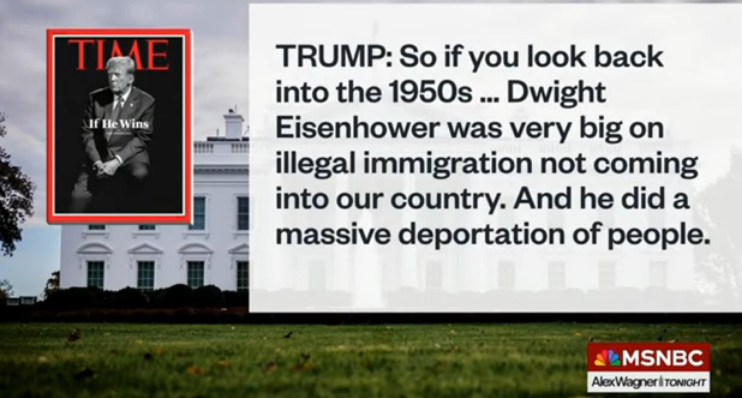
A bombshell segment on MSNBC’s Alex Wagner Tonight show (04/30/24) delved into a recent interview Republican presidential candidate Donald Trump had with Time Magazine. As host Alex Wagner correctly pointed out, the biggest bombshell from the Time interview was Trump’s admission that if elected president again, he would be open to a draconian immigration policy that mirrors former President Eisenhower’s infamous “Operation Wetback.”

Time Magazine’s Eric Cortellessa(2:35): “You’ve said you’re gonna do this massive deportation operation. I want to know specifically how you plan to do that.”

Trump: “So, if you look back to the 1950s, [President] Dwight Eisenhower was very big on illegal immigration not coming to our country. And he did a massive deportation of people.”

Any reasonable person presented with Trump’s response would conclude, as host Alex Wagner did, that if elected president again, Trump intends to craft a draconian immigration policy that mirrors Eisenhower’s “Operation Wetback”.

It will be interesting to see how Hispanics, who Trump has successfully peeled off from the “reliable Democrats” tent, will react to this bombshell revelation. As host Wagner correctly pointed out, a lot of U.S. citizens of Mexican descent also got swept up in Eisenhower’s militarized “Operation Wetback” raids, and got deported illegally to Mexico.

Will a potential “Operation Wetback 2.0” be a game-changer with MAGA Hispanics in 2024, making them pull the lever for Biden? Hmm, as Trump famously says, “We’ll see what happens.”

I’d be remiss if I didn’t point out the fact that in the interview, Trump also appeared eager to expand law enforcement’s “qualified immunity” to a point where it is practically “absolute immunity”. This would dramatically roll back progress that has been made–and there has been progress–in the fight against police brutality, especially as it pertains to Black and Brown communities. Will this be a game-changer for the so-called BlacksForTrump? Hmm, we shall see.

For those of you very happy with @Emolclause’s activism don’t shy away from the “tip jar” below on your way out. You may also Cash App

Email author at admin@grassrootsdempolitics.com

Become an Octapharma Plasma donor. Make up to $200 in one week and help save lives too! Learn More