Machado Leaves No Doubt This Has Always Been About Regime Change

Maria Corina Machadoโ€™s appearance on CBSโ€™ Face The Nation all but confirmed what many Americans have suspected as President Trump escalates pressure on Venezuela: regime change, not narcotics enforcement, is the true objective. While the administration continues to frame its military buildup and aggressive posture as a necessary response to so-called โ€œnarco-terrorists,โ€ Machadoโ€™s own words exposed that justification as little more than political cover.

For months, President Trump has insisted that his actions toward Venezuela are narrowly focused on combating drug trafficking networks that he claims threaten U.S. national security. The administrationโ€™s repeated use of the term โ€œnarco-terrorismโ€ is meant to evoke urgency and legitimacy, suggesting a defensive posture rather than an interventionist one. Yet this explanation has always strained credulity, particularly given Venezuelaโ€™s vast oil reserves and strategic importance. Those realities have inevitably fueled skepticism that Washingtonโ€™s true aim is to remove Nicolรกs Maduro and install a government far more amenable to U.S. economic and geopolitical interests.

That skepticism has only grown sharper because Trump himself campaigned aggressively in 2024 on a โ€œno regime changeโ€ platform. It was a message designed to reassure a war-weary electorate and an America First base deeply suspicious of foreign entanglements. Many of those same supporters are now openly questioning how a military buildup, veiled threats, and constant escalation toward Caracas square with the promises they were sold. The administrationโ€™s narco-terrorism rationale has functioned as a convenient way to bridge that contradictionโ€”until Machado spoke plainly.

During her interview with Margaret Brennan, Machado did not merely criticize Maduro or call for international pressure. She openly discussed preparations for governance after his removal. In doing so, she revealed that plans are already in place for what comes once Maduro is toppled. That single admission dismantled the White Houseโ€™s stated rationale. You do not develop detailed post-Maduro contingencies unless regime change is not only desired, but anticipated and actively pursued.

Brennan never had to explicitly ask whether the Trump administration is seeking regime change because Machado answered the question unprompted. She spoke about how a future Venezuelan government would manage destabilization efforts by foreign powers such as Russia and Chinaโ€”an extraordinary acknowledgment that she views Maduroโ€™s fall not as hypothetical, but as imminent. That kind of forward-looking strategizing does not occur in a vacuum. It only makes sense if Washington has signaled, implicitly or explicitly, that removing the current regime is the goal.

Machadoโ€™s remarks effectively stripped away the last fig leaf of the narco-terrorism argument. If the mission were truly limited to drug interdiction, the discussion would center on law enforcement cooperation, intelligence sharing, and regional partnerships. Instead, what emerged was a clear blueprint for political transition. Her interview made it obvious that the Trump administrationโ€™s posture toward Venezuela has never been about drugs alone, and certainly not about restraint.

As this saga unfolds, the political consequences may prove just as significant as the geopolitical ones. Republicans who loudly embraced the โ€œno regime changeโ€ mantra in 2024 will soon face voters again in the 2026 midterms. Machadoโ€™s candid interview has made it far harder for them to reconcile their past rhetoric with present reality. What was once denied outright is now being openly discussed by the very opposition leader the U.S. appears poised to empower.

In the end, Face The Nation did more than host an interviewโ€”it pulled back the curtain. And what was revealed leaves little room for doubt: regime change in Venezuela is not a byproduct of Trumpโ€™s policy. It is the policy.

Grifting Nepo-Babies In Trump Admin 2.0?


Please consider $upporting GDPolitics by scanning the QR code below or clicking on this link

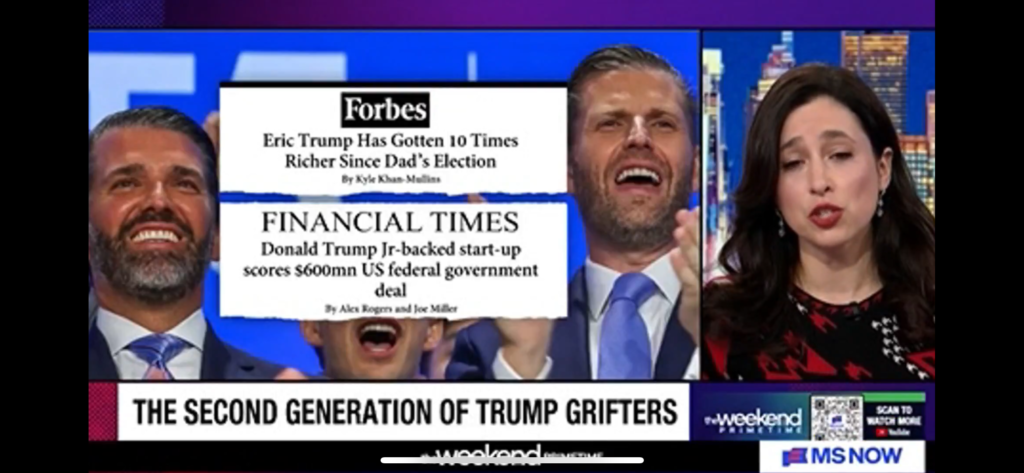
An interesting segment on MSNOWโ€™s Weekend Primetime show delved into the staggering corruption emerging in Trump administration 2.0 โ€” even coining the phrase โ€œGrifting Nepo-Babiesโ€ to capture the growing concern about the financial windfalls reportedly enjoyed by the children of several senior Trumpโ€“era officials. Co-host Catherine Rampell laid out what she called a pattern of politically connected offspring cashing in during the second Trump presidency. According to the segment, Secretary of Commerce Howard Lutnickโ€™s sons were among those observers have flagged as benefiting enormously from their fatherโ€™s presence in government โ€” and in their case, the benefits come via the Wall Street powerhouse their father built, Cantor Fitzgerald.

Specifically: when Lutnick stepped into the Cabinet, ownership and control of Cantor Fitzgerald were formally transferred to his two oldest sons, Brandon Lutnick (now Chairman & CEO) and Kyle Lutnick (Executive Vice-Chairman). Under their leadership, the firm is on track for a 2025 revenue haul that reportedly represents its most profitable year ever โ€” a jump of more than a quarter over last year. Much of that windfall stems from Cantorโ€™s aggressive crypto-investment banking, SPAC dealmaking, stablecoin custody and other high-risk, high-reward operations that the firm has doubled down on since the crypto boom took off. Critics argue that this close alignment between a senior Cabinet official and a high-performing Wall Street firm controlled by his children constitutes a textbook example of revolving-door conflicts of interest โ€” especially given the firmโ€™s deep involvement in sectors (like crypto) where regulatory and trade policy decisions may directly affect their bottom line. The optics are stark: a firm once headed by the Commerce Secretary is now raking in record profits under the leadership of his sons, just as policies that shape global trade and regulation are being decided by that same Secretary.

The segment also highlighted another striking example beyond the Lutnicks: Alex Witkoff, the son of Steve Witkoff โ€” himself appointed by Trump as a Middle East envoy. According to multiple recent reports, Alex has aggressively pursued large-scale investments from sovereignโ€wealth funds and Gulf-state investors. In 2024 he pitched a $4 billion U.S. real-estate credit fund to the Qatar Investment Authority, promising returns and sizeable management fees; while Qatar reportedly declined, sources say Alex continued courting investors from Qatar, the United Arab Emirates, and Kuwait through at least August 2025. As his father negotiated cease-fire and hostage-release deals across the Middle East under the auspices of the Trump administration, Alex was quietly soliciting money โ€” a convergence of diplomacy and real-estate finance that ethics experts argue raises serious conflict-of-interest concerns. Indeed, GULF-state investment vehicles have already backed several properties owned or developed by the family firm (known as the Witkoff Group), including major assets in New York and Florida. While a spokesperson for the firm has since claimed the specific real-estate fund proposal was โ€œpreliminaryโ€ and will not move forward, critics maintain that even the attempt โ€” coming alongside high-stakes diplomatic negotiations โ€” exemplifies the growing problem of political power being leveraged for private enrichment.

Rampell then pivoted to Trumpโ€™s own children, where the accusations grow louder and the optics far more politically potent. She cited a Forbes report claiming Eric Trumpโ€™s wealth has increased dramatically since his father returned to office โ€” with critics arguing that this level of enrichment while a parent is in the White House reflects the same ethical vulnerabilities that plagued Trumpโ€™s first term. She also referenced reporting about a startup associated with Donald Trump Jr. that has reportedly secured a major Pentagon-related deal โ€” figures like the oft-circulated โ€œ$600 millionโ€ have fueled alarm among ethics experts and bipartisan government watchdogs who argue that such arrangements warrant far more transparency. And even Trumpโ€™s youngest son, Barron Trump โ€” normally kept out of the political spotlight โ€” was mentioned in the segment due to media chatter about alleged lucrative cryptocurrency-related ventures linked indirectly to his name, though these claims remain murky and largely unverified, further contributing to the perception of a sprawling and loosely monitored financial ecosystem orbiting around the Trump family.

Rampell also revisited the long-running controversies around Trumpโ€™s son-in-law Jared Kushner, whose massive financial gains following Trumpโ€™s first term โ€” including high-profile investments from foreign sovereign funds โ€” continue to be held up by critics as one of the most glaring examples of blurred ethical boundaries. His ongoing business expansions during Trumpโ€™s second presidency only reinforce concerns among ethics observers who argue that the revolving door between political power and personal enrichment is now swinging more freely than ever.

The larger point the MSNOW hosts made was that corruption โ€” whether alleged, implied or documented โ€” has quickly become a defining theme of Trump 2.0. Democrats are already gearing up to make it a core message for the 2026 midterms, framing the administration as a government increasingly captured by the financial ambitions of the presidentโ€™s inner circle and their families. But what may pose a more immediate threat to Trump is that even portions of his MAGA base are beginning to grumble. Online circles that once defended every decision of the Trump family have begun to express frustration at what they see as blatant self-dealing โ€” especially as the administration continues to sideline issues that energized Trumpโ€™s grassroots supporters in the first place: lower prices, avoiding new foreign conflicts, demands for release of the Epstein files, and promises of โ€œdraining the swamp.โ€ For some longtime loyalists, the contrast between those unmet commitments and the constant headlines about politically connected children becoming wealthier has begun to feel impossible to ignore.

How this discontent evolves could have real consequences in the 2026 midterms. If the corruption narrative continues to grow, and if MAGA voters feel increasingly alienated or taken for granted, Republicans could find themselves facing a demoralized base at the very moment Democrats are preparing to campaign on a simple, sharp message: that Trump 2.0 has become a family business masquerading as a government. The question heading into 2026 is not just whether Democrats can capitalize on this narrative, but whether the erosion of enthusiasm among core Trump supporters will quietly do the job for them.

The History Of Lies Preceeding Findings Of War Crimes

Please consider $upporting GDPolitics by scanning the QR code below or clicking on this link

An interesting segment on MSNBCโ€™s Last Word dug into what it described as a familiar pattern in U.S. military history: deny wrongdoing first, then slowly acknowledge pieces of the truth once outside evidence becomes impossible to dismiss. Lawrence Oโ€™Donnell used the current controversy surrounding Defense Secretary Pete Hegsethโ€™s alleged โ€œboat strikesโ€ in the Caribbean as his launching point, arguing that the initial denials and evasions coming from the Pentagon echo earlier moments when U.S. officials misled the public about military actions that later proved indefensible. Oโ€™Donnellโ€™s implication was unmistakableโ€”that when the dust settles, investigators may conclude not only that the strikes were unlawful, but that Hegseth or those operating under his authority initially misrepresented what happened.

Oโ€™Donnellโ€™s framing draws on a long and painful history. From the My Lai massacre in Vietnam, to the Pentagonโ€™s early false account of Pat Tillmanโ€™s death, to the denials surrounding the Kunduz hospital airstrike in Afghanistan, the United States military has repeatedly issued confident, categorical explanations that later unraveled. The pattern is not merely that the military gets things wrong; it is that it often knows its initial explanations are incomplete or misleading. In the Kunduz case, commanders first claimed that the deadly strike on the Doctors Without Borders hospital was an accident caused by bad intelligence. Later investigations revealed systematic procedural violations and inconsistencies in the official story. In other incidents, the military has been accused of cleaning up sites, withholding footage, or pressuring witnessesโ€”all in the name of preserving institutional credibility. These reversals feed the larger concern Oโ€™Donnell was highlighting: when allegations of war crimes arise, the publicโ€™s first encounter with them is often a narrative shaped to minimize responsibility.

That context matters in the current debate over the so-called โ€œdouble tapโ€ strikes. The term refers to a practiceโ€”widely condemned by human rights groupsโ€”where an initial strike is followed minutes later by a second one timed to hit rescuers rushing to help the wounded. International law experts have long argued that the tactic constitutes a war crime because it intentionally targets medics, civilians, or anyone giving aid. According to MSNBCโ€™s reporting, the controversy swirling around Hegseth includes allegations that at least some of the Caribbean boat strikes may have followed this pattern. Early statements from Defense Department officials reportedly downplayed or denied this, but as often happens, additional footage and testimony have begun to contradict the earliest claims. Oโ€™Donnell suggested that even Hegsethโ€™s own language has shiftedโ€”initially presenting the strikes as precise, justified, and unambiguous, while later remarks seem more cautious, as if acknowledging that the official story may not hold under scrutiny. Critics note that this rhetorical drift mirrors earlier cases where U.S. officialsโ€™ first instinct was to shield themselves rather than openly confront what occurred.

The pressure is not only coming from television pundits. MSNBC has also reported that the family of a Colombian fisherman killed in one of the โ€œnarco-terroristโ€ drone strikes has filed a formal complaint with a Washington, D.C.โ€“based human rights organization. The filing seeks monetary compensation but also demands an end to the drone campaign altogether. More significantly, it accuses Secretary Hegseth of authorizing extrajudicial killingโ€”an allegation that, if taken up by international bodies, could draw the attention of the International Criminal Court or other tribunals. While the ICC rarely targets officials from powerful nations, a complaint of this nature can still generate diplomatic headaches, congressional scrutiny, and sustained media investigation.

What stands out even more is that, despite the deep polarization in Washington, these boat strikes have triggered bipartisan unease. Lawmakers in both parties have struggled to accept the administrationโ€™s rationale that small vessels thousands of miles from U.S. shores pose such a grave and imminent threat that the only viable response is to blow them out of the water. Even some Republicansโ€”normally inclined to defend a Republican administration reflexivelyโ€”are questioning whether the intelligence behind the strikes is as airtight as officials claim. The complaint filed by the fishermanโ€™s family underscores the fragility of the administrationโ€™s narrative; if one case unravels, others may follow, and with them the assertion that all strikes have been lawful counter-narco operations rather than disproportionate uses of force.

The open question is whether Secretary Hegseth will adjust course. Will he dial back the strike policy to accommodate bipartisan concerns, or will he press forward under the belief that forceful action now will be vindicated later? The political calculus is complicated by the reality that former President Trump, as a former head of state, will almost certainly remain shielded from any serious war-crimes prosecution; the ICC has historically avoided pursuing former U.S. presidents, and legal scholars widely agree it is unlikely to break that precedent. Hegseth, however, does not enjoy the same protective aura. Officials below the level of head of state have faced international legal jeopardy before, and those in the Trump administration who assume they are untouchable may discover that this confidence is misplaced.

Whether the unfolding controversy becomes another entry in the long ledger of U.S. military denials followed by partial admissionsโ€”or something more legally consequentialโ€”remains to be seen. But as Oโ€™Donnellโ€™s segment underscored, history has taught observers to pay close attention not only to what officials say at the beginning of these crises, but how their stories change once the evidence emerges and the truth becomes harder to hide.

Is Trumpโ€™s Beef With Venezuela Just A Distraction From Epstein Files?

Please consider $upporting GDPolitics by scanning the QR code below or clicking on this link

On the December 3, 2025 edition of MSNOWโ€™s Last Word, host Lawrence Oโ€™Donnell made a striking allegation: that President Trumpโ€™s recent moves toward a potential conflict with Venezuela are part of a deliberate effort to divert public attention from what has become the most politically explosive vulnerability of his administrationโ€”the Epstein files. As dramatic as that claim sounds, the idea that a president might reach for military action to overshadow damaging domestic troubles is far from unprecedented in American politics.

History offers several examples of presidents facing crises at home while initiating or escalating military operations abroad. In 1999, as the Monica Lewinsky scandal and impeachment fight threatened his presidency, Bill Clinton authorized U.S. and NATO airstrikes in Kosovo. While the Kosovo intervention had legitimate humanitarian and geopolitical motivations, critics at the time argued that its timing conveniently shifted the national focus away from the turmoil engulfing Clinton in Washington. Similarly, George W. Bushโ€™s 2003 invasion of Iraqโ€”authorized with congressional approval and publicly justified as a necessary step to eliminate weapons of mass destructionโ€”has long been viewed by some political observers as a campaign that also helped neutralize criticism of the administrationโ€™s intelligence failures surrounding 9/11 and other mounting domestic issues. In both cases, military action absorbed media bandwidth, elevated presidential authority, and stirred a sense of national unity that could blunt domestic scrutiny.

The pattern, then, is an old one: foreign conflict can serve as a political reset button, even if the strategic and humanitarian stakes are genuinely complex. It is also a risky gamble, because wars rarely unfold according to plan. setbacks can deepen public dissatisfaction instead of alleviating it, and the use of military force for political cover remains one of the most controversial charges that can be leveled against any commander in chief.

Against this backdrop, if President Trump were to sidestep Congress and launch a military operation in Venezuela under the banner of fighting โ€œnarco-terrorists,โ€ it would not emerge in a historical vacuum. It would more closely resemble a familiarโ€”and troublingโ€”pattern in presidential behavior. Yet recognizing a pattern does not mean the public should accept it as inevitable. Trump campaigned in 2024 on promises of โ€œno more foreign warsโ€ and โ€œno more regime change,โ€ commitments that resonated deeply with voters weary of costly, open-ended U.S. interventions. Many of his supporters viewed him as the candidate who would finally break the cycle of manufactured or opportunistic foreign entanglements that so often coincide with moments of domestic political stress.

That alone should give the president pause. If he truly intends to differentiate himself from past administrations, he must resist the temptation to use military force as a political distraction. The publicโ€”and especially the voters who backed him on the promise of a different foreign-policy eraโ€”deserve a leader who resists the cynical logic of war as domestic cover, not one who repeats it.

USAID Funding Cuts Already Proving Lethal

Please consider $upporting GDPolitics by scanning the QR code below or clicking on this link

A recent segment on MSNBCโ€™s The Last Word with Lawrence Oโ€™Donnell sparked intense debate by suggesting that the Trump-era Department of Government Efficiency (DOGE)โ€”until recently led by Elon Musk before the agency was disbanded this monthโ€”has triggered devastating humanitarian consequences through its rapid cuts to USAID programs. The report cited estimatesโ€”hotly disputed by DOGE supporters and independent analysts alikeโ€”that hundreds of thousands of Africans, many of them children, could die or may already have died as a result of withdrawing funding from health and nutrition programs that had long relied on U.S. support. Whether these figures represent confirmed deaths, worst-case projections, or something in between has become central to the wider political and moral argument.

Critics of DOGE argue that even the lowest plausible estimates of harm would constitute a profound moral failure by the United States. They contend that the speed and scope of the cuts all but guaranteed instability in regions where U.S.-backed programs had become essential to basic survival. From this viewpoint, fixating on the precision of the numbers risks missing the larger point: that preventable sufferingโ€”even at a fraction of the projections mentioned on airโ€”would still be catastrophic and vastly outweigh any budgetary savings DOGE hoped to achieve.

Supporters of the cuts offer a very different narrative. They argue that the United States cannot indefinitely shoulder the burden of funding core public-health systems across developing nations while grappling with its own severe fiscal challenges. They also question the reliability of the projections referenced in cable-news segments, noting that models built on incomplete data often produce dramatic but speculative results. To them, MSNBCโ€™s framing is an example of worst-case scenarios being treated as established fact, while years of inefficiency, redundancy, and poor oversight within USAIDโ€™s global operations go unaddressed. Critics respond that this fiscal-responsibility argument is undermined by the Trump administrationโ€™s willingness to approve major financial packages elsewhereโ€”such as the recent $40-billion bailout for Argentinaโ€”which suggests that affordability may be less a constraint than political preference.

Overlaying all of this is an uncomfortable personal dimension involving Elon Musk himself. Born and raised in South Africa during the apartheid era, Muskโ€™s early life and the advantages associated with that system have long been scrutinized in discussions of race, privilege, and inequality. For many Africans, the symbolism of an African-born billionaireโ€”one whose family benefited from a racially stratified societyโ€”having overseen cuts that disproportionately harmed the continent is hard to ignore. Even though DOGE is now dissolved and Musk no longer holds that position, the optics remain deeply fraught, and skepticism among African observers is understandable.

Despite these tensions, nearly everyone agrees on one central point: USAID has indeed faced problems with waste, inefficiency, and poorly evaluated programming. But acknowledging these flaws does not require dismantling the lifesaving work that competent aid can deliver. With thoughtful reforms, stronger accountability, and better targeting of resources, the United States could address the systemโ€™s shortcomings without abandoning vulnerable populations who depend on these services. The real challenge lies in balancing fiscal discipline with global humanitarian leadershipโ€”while keeping the human consequences, not just the spreadsheets, at the center of the conversation.

Is Mike Johnson The Weakest Speaker Of All Time?

Please consider $upporting GDPolitics by scanning the QR code below or clicking on this link

House Speaker Mike Johnson (R-LA) increasingly looks like a man who has surrendered not only the institutional muscle of the speakership but even the pretense of independence from the president of his own party. The speakership historically has been an office defined by its willingness to challenge the White House when necessaryโ€”Sam Rayburn, Tip Oโ€™Neill, Newt Gingrich, Nancy Pelosi, and even John Boehner all asserted the Houseโ€™s prerogatives when they believed a president, Democrat or Republican, had crossed a line. The job demands that a Speaker defend the House as a coequal branch of government, not serve as an extension of the Oval Office. Johnsonโ€™s conduct has prompted growing skepticism that he understands, or even values, that obligation.

Lawrence Oโ€™Donnell seized on this erosion of authority during a blistering segment on The Last Word, calling Johnson โ€œpatheticโ€ for repeatedly lowering the speakership to the status of Trumpโ€™s legislative errand boy. Oโ€™Donnellโ€™s critique did not rest on ideology but on the abandonment of basic separation-of-powers expectationsโ€”what he framed as Johnsonโ€™s refusal to act like the leader of an independent branch of government. When the Speaker of the House wonโ€™t defend the Houseโ€™s own jurisdiction and moral authority, Oโ€™Donnell argued, the institution itself becomes weaker, and Johnson seems almost proud to preside over its diminishment.

The latest and clearest example came with Johnsonโ€™s handling of the Epstein files, a matter where moral clarity should have superseded political loyalty. Many House Republicans, echoing survivors and transparency advocates, pushed for the full release of the unredacted files. Yet, according to multiple reports, the Trump team made it clear that it did not want that transparency, and Johnson dutifully complied. Instead of defending the bipartisan House vote for disclosure, he attempted to pressure Senate Republicans into adding anti-transparency amendmentsโ€”effectively rewriting a unanimously passed House measure to align with Trumpโ€™s wishes. This was precisely the moment when a strong Speaker would have demonstrated independence, asserting that the Houseโ€™s overwhelming vote reflected a moral imperative that transcended the presidentโ€™s concerns.

What happened next exposed the extent of Johnsonโ€™s weakness. Senate Republicans, including Senate Majority Leader John Thune, refused to go along. Thune brushed off Johnsonโ€™s push and let the bipartisan transparency bill stand as written. The moment was striking not only because Senate Republicans broke with Johnson, but because they did so with such ease. It showed how little weight Johnsonโ€™s requests carry even within his own partyโ€™s congressional leadership. It was the kind of public sidelining that previous Speakers would never have tolerated because they would never have allowed themselves to be put in that position to begin with.

Johnson, embarrassed by the rebuff, then claimed that Democratsโ€”specifically Senate Minority Leader Chuck Schumerโ€”had somehow duped Thune into ignoring Johnsonโ€™s demands. It was an explanation that strained credibility. The idea that seasoned Senate Republicans were outmaneuvered by Schumer into doing the morally obvious thing, rather than following Johnson down the rabbit hole of suppressing sensitive documents, only underscored how deeply unserious Johnsonโ€™s defense was. This evasiveness was precisely what triggered Oโ€™Donnellโ€™s sharpest criticism: that a Speaker reduced to blaming phantom Democratic trickery to justify his own impotence has forfeited the dignity of his office.

Seen in this light, Johnsonโ€™s speakership increasingly appears not merely weak but historically weakโ€”a surrender of institutional power at exactly the moment when Congress should be asserting its independence. The Founders designed the legislative branch to check the executive, not to take instructions from it; the Speaker of the House, more than any other congressional figure, embodies that constitutional balance. By repeatedly deferring to Trump, even on issues where morality, transparency, and bipartisan consensus align against him, Johnson is not just weakening himself. He is weakening the House of Representatives. And that is why the charge that he may be the weakest Speaker of all time can no longer be dismissed as hyperbole. It is becoming a plausible assessment of a man who seems unwilling to use the authority of an office that demands far more than passive obedience to presidential preference.

Homeland Securityโ€™s $220 Million Ad Controversy: An Objective Look at the Noem Connections

Please consider $upporting GDPolitics by scanning the QR code below or clicking on this link

A series of recent investigative reports, first published by ProPublica and later picked up by major outlets including MSNBC, has drawn substantial attention to a large Department of Homeland Security (DHS) advertising campaign and its connections to Secretary Kristi Noemโ€™s political circle. Although the DHS has defended its decisions and denies any improper influence, the scope of the contract, the speed at which funds were awarded, and the involvement of individuals tied to Noem have generated intense public scrutiny. What follows is a fact-based, balanced overview of what is known, what is contested, and why the episode continues to raise questions.

The controversy began with DHSโ€™s launch of a national and international ad campaign intended to deter illegal immigration. According to ProPublica, the campaign totals approximately $220 million and includes television, digital, radio, and social-media placements. DHS has stated that the campaign is aimed at discouraging unauthorized crossings by emphasizing tougher enforcement policies and consequences. One of the signature ads features Secretary Noem at Mount Rushmore delivering a tough-on-immigration message that DHS characterizes as a public service announcement rather than a political communication. DHS has consistently argued that the campaign is justified by pressing national security needs and that it reflects policy objectives rather than partisan motives.

The financial and procedural details surrounding this campaign, however, prompted wider concerns. DHS invoked a โ€œnational emergencyโ€ at the border to bypass the traditional competitive bidding process, fast-tracking the ad contracts. While legal, this mechanism is typically used for time-sensitive, high-risk situations rather than large-scale media campaigns. Critics argue that employing emergency powers for a communications initiative undermines normal procurement safeguards designed to prevent favoritism and ensure transparency. DHS counters that career procurement officials oversaw the process and that all actions complied with federal law.

The most scrutinized element of the spending is the decision to direct $143 million of the campaign funds to a newly formed Delaware company called Safe America Media. The firm was incorporated only days before receiving the contract, an unusually rapid timeline for a high-value federal agreement. Public contracting databases provide little information about how Safe America Media has allocated its funds or whom it subcontracted. This lack of documentation has fueled questions about the nature of the company, who ultimately benefited from the funds, and why the government selected an entity with virtually no track record.

Those questions intensified when investigators identified personal and professional connections between DHS leadership and political consultants aligned with Noem. Safe America Mediaโ€™s listed address is linked to Republican operative Michael McElwain, and reporting has highlighted the involvement of the Strategy Group, a Republican consulting firm that played a large role in Noemโ€™s South Dakota gubernatorial campaigns. The firm is led by Benjamin Yoho, who is married to Tricia McLaughlin, DHSโ€™s Assistant Secretary for Public Affairs. That office, which McLaughlin leads, is the same DHS division responsible for funding the ad campaign. This nexus of relationships has raised concerns from ethics experts and watchdog groups, who argue thatโ€”even if no laws were brokenโ€”the appearance of a conflict of interest is substantial.

Critics, including former federal contracting officials, contend that the overlap between Noemโ€™s political network and the firms connected to the DHS campaign creates significant risk of improper influence. They argue that the lack of publicly available subcontractor information prevents the public from knowing whether politically connected firms benefited from taxpayer funds. Some experts have described the arrangement as highly irregular, and organizations have called for oversight investigations by congressional committees or the DHS Inspector General. Others have pointed out that the political tone of some of the ads, particularly those referencing Trump-era border policies, may blur the line between public service messaging and partisan promotion, although DHS maintains the messaging is policy-driven.

Defenders of Noem and DHS present a different picture. They note that DHS officials, not political appointees, handled the contracting and that emergency procurement authority exists precisely to allow rapid responses to urgent national issues. McLaughlin has publicly stated that she fully recused herself from decisions related to these contracts, emphasizing that professional ethics protocols were followed. Supporters also argue that the intent of the campaign is clear: to deter migration through communication, a tool that has been used by multiple administrations. They also point out that no concrete evidence has surfaced proving that any funds were intentionally steered to Noemโ€™s allies for political purposes.

Despite those defenses, the situation remains complicated. The unusual contracting timeline, the lack of transparency surrounding subcontractors, and the close personal ties between DHS leadership and outside political consultants make the story difficult to dismiss. Even if every action taken was technically compliant with procurement rules, the optics invite skepticism. In matters of public spendingโ€”especially on such a large scaleโ€”appearance alone can erode public trust, particularly when political figures and their associates are involved. At a minimum, the episode underscores the importance of transparent procurement processes, clear public reporting on subcontractors, and robust safeguards to prevent even the perception of conflicts of interest.

Ultimately, the controversy exposes a broader tension at the intersection of government communication, national security policy, and political influence. DHS insists the campaign is essential to its mission and was executed properly. Critics argue that the process lacked the transparency and armโ€™s-length separation needed to ensure public confidence. As calls for additional oversight continue, the resolution of this issue may set important precedents for how federal agencies handle large-scale communications campaignsโ€”especially when those campaigns intersect with the political networks of their leaders.

VP Vance Pushes Back On The Gerald Ford Comparison

Please consider $upporting GDPolitics by scanning the QR code below or clicking on this link

On the 11/12/25 edition of The Last Word with Lawrence Oโ€™Donnell, host Lawrence Oโ€™Donnell made a striking observation: current Vice President J.D. Vanceโ€™s near-silence on the swirling Jeffrey Epstein files scandal mirrors the posture then-Vice President Gerald Ford assumed as Richard Nixonโ€™s presidency was collapsing under the weight of Watergate. Oโ€™Donnell pointed out that Ford, sensing the sinking of Nixonโ€™s Presidency, deliberately kept his head downโ€”he knew the ghosts of Nixon would dog his tenure if he didnโ€™t distance himself.

By the same logic, Oโ€™Donnell argued, Vance appears to be doing exactly that: he knows the Epstein files may blow up and run Donald Trump out of office, and thus is doing everything he can to not get sucked into the scandal, to avoid becoming the next Ford.

As expected, social media erupted following Oโ€™Donnellโ€™s segment. I posted a clip of the show, and to my surprise the reaction came from none other than the Vice President himself. Thatโ€™s how provocative the comparison proved.

In his response, Vance strongly objected to Oโ€™Donnellโ€™s suggestion that he was intentionally silent about the Epstein scandal. Vance pointed out that he had addressed the issue in prior TV appearancesโ€”citing his interview on Hannity scheduled for 11/13/25, which coincided with the date I posted the segment.

Interestingly, in that very 11/13/25 show Oโ€™Donnell claimed Vance had in fact ignored the Epstein issue entirelyโ€”and reaffirmed: โ€œHeโ€™s still Gerald Ford.โ€

Now that the โ€œGerald Fordโ€ comparison has caught Vanceโ€™s attentionโ€”and by implication, the Presidentโ€™sโ€”it will be fascinating to watch how it plays out going forward.

MSNBCโ€™s Nicolle Wallace Brands Trump Team the โ€œMarie Antoinette Administrationโ€

Please consider $upporting GDPolitics by scanning the QR code below or clicking on this link

On a recent episode of Deadline: White House, MSNBC host Nicolle Wallace didnโ€™t hold back in her criticism of former President Donald Trumpโ€™s administration. She called it the โ€œMarie Antoinette Administrationโ€ โ€” a cutting comparison to the infamous French queen remembered for her decadence, detachment, and the apocryphal phrase, โ€œLet them eat cake.โ€

Marie Antoinette became a symbol of a ruling class oblivious to the suffering of ordinary people โ€” a monarch who partied in Versailles while her citizens starved outside the palace gates. Wallaceโ€™s jab draws on that same image, suggesting the Trump administration has been indulging in luxury and self-congratulation while Americans face economic hardship.

The comparison lands especially hard when you look at Mar-a-Lago, Trumpโ€™s Palm Beach estate turned private club โ€” his modern-day Versailles. While millions of Americans struggle to put food on the table amid a grinding government shutdown that has halted SNAP payments, reports continue to surface of glittering soirรฉes, Champagne toasts, and high-society dinners taking place under Mar-a-Lagoโ€™s gilded chandeliers. Even some of Trumpโ€™s own allies have privately admitted the optics are terrible: the image of Washington elites sipping cocktails on the oceanfront while federal workers and low-income families line up at food banks is a PR nightmare.

Adding insult to injury, a federal judge recently ordered the administration to tap the USDAโ€™s contingency funds to keep SNAP benefits flowing. Instead of complying, the administration chose to fight the order in court โ€” literally arguing for the right to let poor Americans go hungry. Itโ€™s a move that only deepens the โ€œMarie Antoinetteโ€ parallel: power waging legal battles over crumbs while the public goes without bread.

As the shutdown drags on, the economic pain is becoming unbearable for working families. Most analysts expect the government to reopen soon, likely before the Thanksgiving holidays, if only to stem the political fallout. But even after the lights come back on, the damage โ€” both human and reputational โ€” will linger.

The โ€œMarie Antoinette Administrationโ€ label may stick as one of Trumpโ€™s most unflattering legacies. Itโ€™s a sharp irony for a president who rose to power promising to champion the โ€œforgotten manโ€ โ€” rural, blue-collar Americans who felt abandoned by Washington. The image of Mar-a-Lagoโ€™s ballrooms glittering while those same Americans tighten their belts is one that no amount of political spin can erase.

In the end, Wallaceโ€™s analogy hits its mark. For many watching from the outside, the Trump administration doesnโ€™t just look out of touch โ€” it looks like itโ€™s dancing while the country burns.

Can A Farmer Revolt Shape The Outcome Of The 2026 Midterms?

Please consider $upporting GDPolitics by scanning the QR code below or clicking on this link

President Trumpโ€™s latest tariffs have dealt a severe blow to Americaโ€™s farmersโ€”many of whom form the backbone of his political base. By making U.S. agricultural exports more expensive abroad, the tariffs have driven key trading partners, especially China, to look elsewhere for soybeans and beef. The result: a mounting glut of unsold American farm goods and growing resentment in rural communities that once rallied behind the โ€œAmerica Firstโ€ banner.

Nowhere is the impact clearer than in the soybean sector. For years, China was the single largest buyer of U.S. soybeans, accounting for over half of all American exports. But since the imposition of Trumpโ€™s tariffs, Beijing has turned almost entirely to Argentina and Brazil to fill its soybean needs. The shift has devastated U.S. growers across the Midwestโ€”states like Iowa, Illinois, and Missouri that voted overwhelmingly for Trump in 2020 and again in 2024.

What makes the situation even more striking is Argentinaโ€™s precarious economic state. The country teeters on the edge of financial collapse, yet President Javier Mileiโ€”a populist and self-proclaimed ally of Trumpโ€”has benefited from a quiet U.S.-backed economic rescue package. That move, intended to stabilize Argentinaโ€™s government, has inadvertently helped keep its agricultural exports flowingโ€”at the direct expense of American farmers.

โ€œThis feels like betrayal,โ€ said one Iowa soybean farmer interviewed by local media. โ€œWe were told America First. But right now, it looks like Argentina first.โ€

The same story is unfolding in the cattle industry. U.S. ranchers, already squeezed by high feed and fuel costs, now face declining demand from key international buyers. China and several Asian nations have ramped up imports of Argentine beef, taking advantage of lower prices and a favorable trade environment. For American ranchers, the optics of Washington bailing out a competitor while their own operations struggle are politically toxic.

As the 2026 midterms approach, this discontent threatens to boil over. Farmers who once viewed Trump as their champion are questioning whether his trade policiesโ€”and his personal alliancesโ€”reflect the economic nationalism he promised. In small-town coffee shops and agricultural forums across the Midwest, talk of a โ€œfarmer revoltโ€ is no longer unthinkable.

The irony, of course, is that the very communities that helped fuel Trumpโ€™s rise could now play a decisive role in blunting his political momentum. If the rural backlash takes root, it could reshape not just the midterms, but the broader balance of power in a Republican Party increasingly split between loyalty to Trump and frustration over his policies.

In short, Americaโ€™s farm country is waking up to a sobering realization: โ€œAmerica Firstโ€ may have sounded good on the campaign trailโ€”but the global farm economy tells a very different story.