Did FBI Director Patel Lie Under Oath?

In a striking segment on MSNOWโ€™s Last Word with Lawrence Oโ€™Donnell, host Lawrence Oโ€™Donnell raised a provocative and consequential question: did FBI Director Kash Patel mislead Congress under oath during his exchange with Congressman Eric Swalwell about Donald Trumpโ€™s presence in the Jeffrey Epstein files? During that hearing, Swalwell pressed Patel directly on whether Trumpโ€™s name appeared in the Epstein material and sought clarity about the extent and significance of those references. Patel did not provide a numerical estimate, nor did he use the phrase โ€œvery few,โ€ but his answer was widely interpreted as downplaying the frequency and importance of Trumpโ€™s appearance in those records. He framed his response in a way that suggested there was nothing substantial or alarming tied to Trump in the context of the FBIโ€™s investigative findings.

Since that testimony, claims have circulated asserting that Trumpโ€™s name appears in the Epstein files far more extensively than Patelโ€™s response implied. Some reports and political commentators have cited extraordinarily large raw reference counts, arguing that Trumpโ€™s name appears hundreds of thousands or even more than a million times across various forms of Epstein-related material, including emails, contact directories, flight records, investigative notes, and digital indexing systems. Even accounting for duplication, automated references, and database artifacts, such figuresโ€”if accurateโ€”would appear difficult to reconcile with the general impression Patel conveyed during his testimony. The core issue is not whether Patel gave a precise number, because he did not, but whether his answer created a misleading impression that minimized the scale of Trumpโ€™s documented presence.

Whether that impression rises to the level of criminal conduct is a much more complex question. Federal law makes it a crime to knowingly provide false or materially misleading testimony to Congress, but the key word is โ€œknowingly.โ€ Prosecutors would have to prove that Patel was aware, at the time he testified, that his characterization was materially inconsistent with the actual scope of the records. That is a high bar. The Epstein files are massive, technically complex, and include raw, unfiltered material alongside analyzed investigative conclusions. It is entirely possible that Patel relied on summaries prepared by subordinates or focused specifically on references deemed relevant to criminal conduct rather than raw textual mentions. Under that interpretation, his testimony could be defended as reflecting his understanding of investigative significance rather than literal database frequency.

At the same time, Patelโ€™s role as FBI Director weakens any argument that he lacked access to critical information. As head of the bureau, he has the authority to receive detailed briefings on major investigative matters, especially one as high-profile and politically sensitive as Epsteinโ€™s network and its associated records. Critics argue that it strains credibility to believe that the FBI Director would be unaware of the general magnitude of references to a former president in such a consequential investigative archive. If evidence were to surface showing that Patel had been briefed specifically about the scope or frequency of Trump-related references before his testimony, it could support the argument that his answer was not merely cautious or incomplete, but intentionally misleading.

On the other hand, defenders of Patel would likely emphasize the distinction between raw data mentions and meaningful investigative findings. Large digital archives often contain inflated reference counts due to repetitive indexing, duplicate communications, or incidental references that carry no investigative weight. A personโ€™s name might appear thousands of times without indicating wrongdoing or even direct interaction. From that perspective, Patel could argue that his testimony reflected the FBIโ€™s substantive investigative conclusions, not superficial database metrics. Courts have historically been reluctant to criminalize testimony that can reasonably be interpreted as technically accurate or dependent on interpretation, particularly when the witness avoids making precise factual claims.

The political implications of this controversy are significant and could shape how the matter unfolds. If a future Democratic administration were to take office, there would likely be pressure from some quarters to investigate whether Patelโ€™s testimony crossed the legal line. Such an inquiry could take the form of a congressional referral, a Justice Department investigation, or the appointment of a special counsel. Any decision to prosecute would ultimately depend on whether investigators could uncover clear evidence of intentโ€”such as internal communications, briefing documents, or witness testimony showing that Patel knowingly conveyed a misleading impression. Without that level of proof, the matter would likely remain in the realm of political controversy rather than criminal prosecution.

At the same time, the broader political climate has changed dramatically in recent years. Actions that were once considered unthinkableโ€”such as investigating or prosecuting senior federal law enforcement officialsโ€”are now part of the modern political landscape. That reality cuts both ways. Any future administration pursuing such a case would face accusations of political retaliation, while declining to act could fuel claims of unequal accountability. Ultimately, the question of whether Patel misled Congress may hinge less on public debate over document counts and more on what evidence exists about his state of mind when he testified. Without clear proof that he knowingly created a false impression, the controversy may never evolve into a criminal caseโ€”but it will remain a potent flashpoint in the ongoing struggle over truth, accountability, and political power at the highest levels of government.

Another Epstein Files Release Deadline Passes

Please consider $upporting GDPolitics by scanning the QR code below or clicking on this link

A segment on MSNOWโ€™s The Last Word with Lawrence Oโ€™Donnell focused on yet another missed deadline for the release of the Epstein files under the Epstein Files Transparency Act. Oโ€™Donnell noted that Friday, 01/16/26, was the date by which Trumpโ€™s Department of Justice was required either to release the documents or explain to a federal court why it could not do so. Even as he laid out the requirement, Oโ€™Donnell expressed skepticism that the administration would comply.

That skepticism proved well founded. The DOJ did not release the Epstein files by the deadline, nor did it offer a straightforward justification for continued secrecy. Instead, it submitted a filing advancing a far more provocative claim: that the federal court itself lacks the authority to impose disclosure deadlines on the DOJ under the transparency law. In effect, the department argued that judicial oversight does not extend to enforcing Congressโ€™s mandate for public release.

The filing struck many observers as both evasive and revealing. The DOJ had no shortage of familiar excuses it could have relied upon. It could have requested additional time, citing the need to review millions of Epstein-related files it now claims to have โ€œdiscoveredโ€ years after Epsteinโ€™s deathโ€”an explanation that few in the public find credible, but one that would have followed the well-worn script of bureaucratic delay. Instead, the department chose to challenge the courtโ€™s authority outright, a move that signaled a deeper resistance to transparency rather than a temporary logistical problem.

That posture stripped away any remaining doubt about the administrationโ€™s intentions. From the beginning, critics warned that Trumpโ€™s DOJ would engage in procedural gamesmanshipโ€”offering symbolic compliance while ensuring that the most consequential material never sees the light of day. The latest filing suggests those warnings were prescient. By disputing the courtโ€™s power to impose deadlines, the DOJ is effectively asserting the right to delay disclosure indefinitely, regardless of statutory language, judicial orders, or public demand.

At this point, what once sounded like cynical speculation is hardening into an unavoidable conclusion. Despite sustained public outcry, congressional action, and repeated court-imposed deadlines, less than one percentโ€”one percentโ€”of the Epstein files have been released. That figure alone tells the story. At this pace, full disclosure is not merely delayed; it is effectively being denied. The administration appears content to manage optics rather than deliver transparency, releasing token material while the core of the record remains sealed. With each missed deadline, the promise of accountability fades further, leaving the public with a grim realization: the dream of a full Epstein files release may never be realized, and the cynics may have been right from the very beginning.

Less Than One Percent Of The Epstein Files Have Been Released Thus Far

Please consider $upporting GDPolitics by scanning the QR code below or clicking on this link

A recent segment on MSNBCโ€™s Weeknight featured Rep. Robert Garcia (D-CA), who joined the program to discuss his ongoing efforts to force the release of the Epstein files. What he revealed caught many viewers off guard. Despite the passage of the Epstein Transparency Act, Garcia said the Department of Justice has released less than one percent of the total body of material related to Jeffrey Epstein. For an audience that assumed the law had jump-started a meaningful disclosure process, the figure landed like a gut punch.

While few people believed the government had released anything close to half of the files, most assumed the number was at least significantly higher than one percent. Garcia clarified that even within that already minuscule fraction, extensive redactions further limit what the public can actually see. In other words, the amount of usable, unredacted information is effectively even smaller. The disclosure process, far from accelerating, appears to be stalled almost entirely, raising serious questions about whether the law is being honored in anything more than name.

The segment also revisited Attorney General Pam Bondiโ€™s recent appearance before the U.S. Senate, including pointed questioning from Sen. Sheldon Whitehouse. Bondiโ€™s posture during the hearing was notably defiant, offering little indication that the Justice Department feels compelled to move faster or provide fuller transparency. If that testimony is any guide, expectations for a voluntary release of the Epstein files remain exceedingly low, regardless of statutory requirements.

Garcia noted that House Democrats are now planning to call Bondi before the House Oversight Committee to explain why the DOJ continues to withhold the vast majority of the files despite the clear intent of the Epstein Transparency Act. That hearing could become a pivotal moment, not only in determining whether the law has any real enforcement power, but also in testing whether congressional oversight will be allowed to function at all. The looming question is whether Bondi will bring the same combative resistance to the Houseโ€”and whether House Republicans will once again enable stonewalling rather than demand answers the public has been waiting years to hear.

Proposed Epstein Strategy Session Rekindles Tarmac-gate Memories

An interesting segment on the 08/06/25 edition of MSNBCโ€™s All In with Chris Hayes (Velshi subbing) delved into the widely reported “strategy session” that was supposed to take place at Vice President JD Vance’s residence to deal with the Jeffrey Epstein scandal. The scandal has engulfed the Trump White House and is leading to accusations of a coverup.ย 

***All In Tweet***

The MSNBC segment aptly pointed out the hypocritical Republican reaction back in 2016, when then AG Loretta Lynch was spotted at an airport tarmac chatting with former President Bill Clinton. The DOJ was at that time investigating Hillary Clinton–then the Democratic presidential candidate–over her email server. Many Republicans were very outraged by that meeting, accusing Bill Clinton and Lynch of conspiring to bury the email server probe. The firestorm surrounding the tarmac meeting almost led to AG Lynch’s resignation.

It is therefore quite interesting how the same Republican party which pushed for Lynch’s resignation sighting DOJ independence, is now very comfortable with the prospect of current AG Pam Bondi sitting down with Trump admin officials for a “strategy session” regarding the Epstein scandal which implicates President Trump. 

What happened to their clamour for DOJ independence? It is a very hypocritical stance, and MSNBC’s All In crew deserves major kudos for calling it out

Paxtons Are A Symbol Of Texas GOPโ€™s Corruption

$upport viaย Cash App

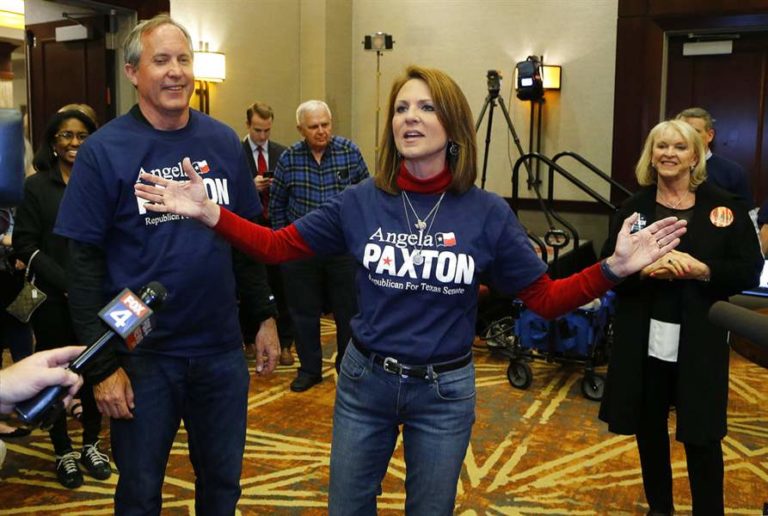
Texas Attorney-General and his wife State Senator Angela Paxton

A lot has been made about the corruption of the Trump administration and Republicans generally at the national level, and deservedly so. Very little however is said about the entrenched corruption among Republicans at the state level, especially in so-called โ€œRed Statesโ€ like Texas that have a GOP trifectaโ€“control of the Judiciary, Legislature and Executive Branch.

Hopefully this bombshell piece by Texas Tribune will open the door to more coverage of the entrenched GOP Corruption in the Lone Star State and other โ€œRed Statesโ€

The Texas Tribune piece above goes into great detail about how State Senator Angela Paxtonโ€™s new bill opens her up to charges of corruption. So in order to avoid redundancy, Yours Truly will do what he does bestโ€“cut to the chase and tell grassroots Democrats what is corrupt/swampy about Senator Paxtonโ€™s bill.

You will remember that in 2015, Texas Attorney-General was indicted and charged for violating a Texas securities lawโ€“essentially giving investment advice that he was not authorized to give. In Texas, as in many other states, one is required to register with the state board before giving investment advice. Giving investment advice without registering with the state board is a third degree felony in Texas (2-10 years jail). There are many reasons for the state board registration requirement, key among them curbing corruption/self dealing. If I am a major shareholder at a large Texas company, and I am advising someone/ a corporation to make a major investment in the same company, the folks at the Texas state board can easily sniff out the self dealing because they will have records of all my financial entanglements. Simply put, it is a very important anti-corruption measure to have investment advisers register with the Texas state board.

Angela Paxton the wife of Texas AG Ken Paxton ran for office in 2018 and was elected Texas State Senator for Senate District 8(SD 8). One of her first actions as a Texas legislator was introducing Senate Bill 860 (SB860) which among other things, seeks to make it legal for someone to give investment advice without registering with the Texas state boardโ€“the same thing her husband is currently in trouble for. Itโ€™s not hard to see why the naked self-dealing/corruption that is inherent in Sen Paxtonโ€™s SB860 has sparked outrage in Texas. Sadly however, this is just a sample of the kind of entrenched corruption that is commonplace in โ€œRed Statesโ€ like Texas that never get the mainstream media attention they deserveHopefully from here on out the Texas Tribune and other major Texas publications will expose instances of public corruption like the one exhibited by the Paxtons. Yours Truly will certainly make #TexasSwamp a major topic of debate especially as we approach the 2020 elections.

Bottom line if Democrats hope to turn Texas blue, they have to make the entrenched GOP Corruption a key campaign issue in 2020 and beyond. Maybe just maybe this may be the key to Democrats capturing the coveted US Senate seat currently held by John Cornyn in 2020.

For those of you very happy with @Emolclauseโ€™s activism donโ€™t shy away from the โ€œtip jarโ€ below on your way out. You may also Cash App

Email author at admin@grassrootsdempolitics.com

Become an Octapharma Plasma donor. Make up to $200 in one week and help save lives too! Learn More