Birthright Citizenship and the Constitution’s Bright Line

What Ali Velshi is getting at goes beyond a simple policy disagreement—it’s a clash over whether the meaning of citizenship in the United States is fixed by the Constitution or open to reinterpretation by political power. His framing roots the debate where it actually belongs: in the historical rupture created by the Fourteenth Amendment after one of the darkest chapters in American legal history, the Dred Scott decision. That ruling didn’t just deny citizenship to Black Americans; it asserted that an entire class of people could be permanently excluded from the political community, regardless of birthplace. The 14th Amendment was designed as a direct, unequivocal rejection of that idea. It didn’t leave room for ambiguity or shifting political winds—it established a constitutional baseline: if you are born on American soil and subject to its laws, you are a citizen.

Velshi’s argument is powerful because it highlights that this wasn’t just a legal tweak; it was a structural safeguard. Before the amendment, states—and by extension, political actors—could decide who counted and who didn’t. That meant citizenship could expand or contract based on prejudice, economics, or political expediency. The framers of the 14th Amendment deliberately removed that discretion. By constitutionalizing birthright citizenship, they created a bright-line rule that would prevent future generations from relitigating who belongs. In that sense, the amendment is not just about inclusion; it’s about stability. It ensures that citizenship is not something that can be negotiated away or narrowed through executive action or shifting interpretations.

From this perspective, any attempt by the Trump administration to end or limit birthright citizenship through executive action runs directly into that constitutional wall. Velshi’s point that the amendment placed citizenship “beyond the reach” of presidents is not rhetorical flourish—it reflects a core principle of constitutional law: the executive branch cannot override a constitutional guarantee. The language of the amendment—“All persons born or naturalized in the United States, and subject to the jurisdiction thereof, are citizens”—has long been understood, including by the Supreme Court, to apply broadly. The landmark 1898 case United States v. Wong Kim Ark reinforced that interpretation, affirming that birth on U.S. soil confers citizenship regardless of parental nationality, with narrow exceptions like children of diplomats. Velshi’s argument aligns with over a century of legal precedent and constitutional understanding.

At the same time, to fully grapple with the issue, it’s important to acknowledge the counterarguments that supporters of former President Donald Trump might raise. Their central claim often hinges on the phrase “subject to the jurisdiction thereof.” They argue that this language was never intended to include everyone born on U.S. soil, particularly children of individuals who are in the country unlawfully. In their view, being “subject to the jurisdiction” implies a more complete political allegiance than mere physical presence. They may point to historical debates suggesting that the amendment’s framers were primarily concerned with formerly enslaved people and not modern questions of immigration, and they argue that the current interpretation stretches the original intent beyond recognition.

Additionally, Trump administration defenders might frame the issue less as a constitutional rollback and more as a policy correction. They could argue that birthright citizenship, as currently applied, creates incentives for unauthorized immigration and “birth tourism,” and that reinterpreting the amendment is necessary to align citizenship with contemporary realities. From this standpoint, they may claim that courts have not fully revisited the scope of the 14th Amendment in light of modern immigration systems, leaving room for executive or legislative clarification.

Still, these counterarguments face significant hurdles. The historical record, while complex, largely supports a broad understanding of birthright citizenship, and Supreme Court precedent has consistently reinforced that view. More importantly, Velshi’s underlying point remains difficult to escape: the 14th Amendment was designed precisely to prevent the kind of selective inclusion that these arguments could enable. Once citizenship becomes contingent—on parental status, legal technicalities, or shifting interpretations—it risks returning to a system where belonging is conditional rather than guaranteed.

In the end, the debate is not just about immigration policy; it’s about whether the Constitution sets firm boundaries that protect fundamental rights or whether those boundaries can be reinterpreted by those in power. Velshi’s argument insists that the line drawn by the 14th Amendment is intentional, durable, and essential to the American identity. The counterarguments, while not without legal nuance, ultimately ask whether that line should be moved. And that is a question that goes to the heart of what the Constitution is meant to do: not merely reflect the will of the moment, but to restrain it.

DOGE Accused Of Amassing Massive Data For Political Dosiers

Bombshell report on the 04/30/25 edition of the Rachel Maddow Show (citing the NY times) says that the Department of Government Efficiency (DOGE) is amassing massive amounts of people’s private data from various government agencies in an effort to create a central database that could potentially be used/abused to create “dossiers” of political opponents of President Trump.

Yours Truly captured part of Maddow’s commentary in the tweet below (X below if you like🙄😂).

NY Times’ Julia Angwin told host Maddow that this [dossier politics] is very common in authoritarian countries, especially China. She specifically said: “China is sort of the example that does this. They have these master files that they have on every citizen, everything that they’ve ever done, it’s called social credit score, and they use it to punish dissent.”

Importantly, and quite scaringly, Angwin says compared to other Western nations, America’s privacy laws are the worst equipped to dealing with the dangers of such a centralized database. She adds that our system was designed based on this notion that government officials will always be acting in good faith, and thus tread carefully re the private data of citizens.

If this reporting holds up, it looks like America is gearing up for the biggest civil liberties fight of her 400 year existence. I hate to be a Debbie Downer here, but given since the passage of the Patriot Act right after 09/11, we’ve witnessed increasing encroachments to our civil liberties, and privacy in particular. 

I’ve said it before, and I’ll say it again, advances in technology have for all intents and purposes, rendered the 4thamendment moot. Consequently, there’s no privacy to defend. Congress has had numerous opportunities to deal with the problem, but abdicated at every turn. Too late to solve the problem now.🤷. 

I’ve been quite consistent about this issue. This was me ranting and raving about very issue way back in 2019😳👇When some big time MSMer starts bandwagoning over the issue, make sure to remind them that Yours Truly was already crying about this in 2019…when MSM thought it was just another “conspiracy theory”.🙄

Bombshell Intercept Report Exposes DHS’ Mission Creep From Fighting Terrorism To Disinfo

$upport via Cash App

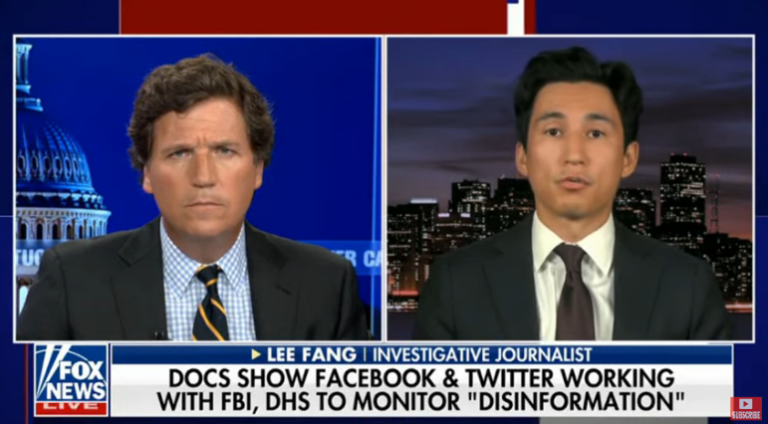
A very interesting segment on Fox News’ Tucker Carlson show(10/31/22) featured a bombshell Pulitzer-worthy report by The Intercept’s Lee Fang, which revealed that the Department of Homeland Security(DHS), has for five years now, been collaborating with Twitter, Facebook, and other social media companies, in determining whose speech needs to be suppressed. This of course flies in the face of the “private company” defense usually used to justify questionable speech infringement practices by the social media giants.

More importantly, Lee Fang’s bombshell also touched on the apparent “mission creep”(his words) of DHS, where over the last five years, the powerful agency had unilaterally(without congressional approval) shifted from its stated focus of combating terrorism and terrorist groups like Al-Qaida, to combating disinformation online.

Asked whether the Biden administration was working with tech companies to censor people, Lee Fang responded (1:10): “Yeah, that’s right Tucker. We looked at really hundreds of documents that paint a vivid picture of the FBI, the DHS, closely collaborating with top social media platforms, Twitter and Facebook, to censor various forms of content under the banner of fighting disinformation, and the story shows a couple of things, one, it shows what you just mentioned, a very cozy relationship between the government and these tech giants. There’s those monthly meetings that you just mentioned, but also, just very cozy emails and texts, not a very adversarial relationship. We looked at one text where a Microsoft executive texts Jen Easterly, the top disinfo director at DHS, appointed by[President]Biden, basically saying that the private sector needs to get more comfortable with the government closely collaborating on reports, talking about the expanded role for DHS in censoring a really broad collection of topic areas of policy and political topics.”

Lee Fang then touched on what I believe is by far, the biggest bombshell from his piece, and that is, the “mission creep” aspect. Fang said(2:11): “Just broadly speaking, the story also just looks at the mission creep of DHS. This is an agency that was founded in the aftermath of 9/11 to combat foreign terror threats of Al-Qaeda and the like, but over the last five years, it’s kind of evolved in its mission, its move towards fighting disinfo, and their justification is disinfo radicalizes the homeland, it can lead to disruptions in public health, or political violence…”

Even given DHS’ understandable explanation for going after online disinformation, no reasonable person can ever conclude that Congress would have approved the same powerful tools/tactics used to counter terrorist groups like Al-Qaeda, to be applied against U.S. residents for basically saying the “wrong things” on social media. Sadly however, this is exactly where we find ourselves today, with DHS’ speech police designating people they deem “misinformers” as terrorists, and then mercilessly destroying their lives and livelihoods using among other things, the military. This is shameful conduct which most Americans have always associated with third world dictatorships.

It is because of DHS’ mission creep, that Yours Truly believes Lee Fang’s bombshell piece deserves a Pulitzer. Simply put, DHS’ mission creep, which at the very least should have been run through Congress for approval prior to enforcement, has not only seriously impacted the lives and livelihoods of many U.S. residents who have nothing to do with terrorism, but has also robbed them of their rights under the first amendment.

Congress needs to immediately step in to not only address DHS’ mission creep, but also to hold the officials involved accountable, preferably, via referral for criminal prosecution given the way their unconstitutional actions upend innocent people’s lives

It’s also important to point out here what history has taught us, and that is, not everything the government labels “misinformation” is necessarily so. Often times, there are topics the government simply doesn’t want out there, being discussed in public. One recent classic example is directed energy weapons. For decades, government agents, and their surrogates in the mainstream media, went out of their way to label people who expressed concerns about these weapons as delusional conspiracy theorists. In 2022 however, we not only have the same directed energy weapons being openly discussed by the same mainstream media channels who denied their existence, but also, the government considers the threat so serious, that Congress swiftly enacted a handsome compensation scheme for victims of such attacks.

Bottom line folks, as host Tucker Carlson correctly stated, this bombshell piece by The Intercept is not only a great story, it’s also a huge public service for which Lee Fang deserves a lot of praise and reward. The only question now is whether Congress will do its job, and rein in Mission Creep DHS, and its unconstitutional speech police.

For those of you very happy with @Emolclause’s activism don’t shy away from the “tip jar” below on your way out. You may also Cash App

Email author at admin@grassrootsdempolitics.com

Become an Octapharma Plasma donor. Make up to $200 in one week and help save lives too! Learn More

Moderate House Dems Shoot Down AOC’s Intel Oversight Amendment

$upport via Cash App

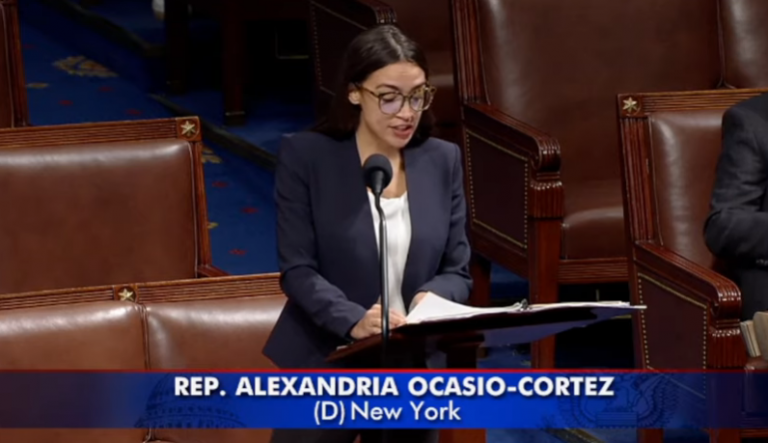
On 12/9/21 Rep Alexandria Ocasio-Cortez(D-NY) introduced an amendment(Amendment 148 to H.R. 5314–Protect Our Democracy Act), that would have restored the oversight powers Congress always intended the Government Accountability Office(GAO) to have, including over our intelligence agencies. Our intelligence agencies, as everyone knows, are notoriously impervious to any Congressional oversight, and often hide behind a vague 1988 Department of Justice opinion to justify their need for secrecy. Rep Ocasio-Cortez’s amendment would have taken away that cover, ensuring much-needed transparency from our intelligence agencies. Surprisingly, 23 Centrist Democrats voted with House Republicans to kill her amendment.

As Rep Ocasio-Cortez correctly pointed out on the House floor, given the kinds of abuses we’ve witnessed during Trump’s presidency, it is only prudent that we restore GAO’s oversight powers over all federal agencies, including our intelligence agencies. Any reasonable person would agree, that it is foolhardy to assume that former President Trump abused all other federal agencies for his selfish political interests, except our intelligence apparatus, the easiest ones to abuse given the secrecy with which they are allowed to operate.

Rep Ocasio-Cortez said on the House floor: “Since it’s creation in 1921, the Government Accountability Office(GAO) has had the purview to conduct oversight of all federal agencies with the goal of reducing waste, fraud and abuse, and holding accountable bad actors. However and unfortunately, most of our intelligence agencies today are not fully cooperative with the GAO, pointing to an outdated and vague 1988 Department of Justice opinion. Our amendment would allow the GAO to act as a check on this behavior, not creating new powers, but restoring the power Congress always intended the GAO to have. This amendment is welcomed by many in the intelligence community, who want to protect their important work and resources from abuse, particularly after the last presidency we just endured. We drafted this amendment in partnership with the community and I’m proud to have the support of Representative Adam Schiff who serves as the Chairman of the House Permanent Select Committee on Intelligence. In fact many of my colleagues have already taken a stand in support of this legislation because in 2010, the House passed a virtually identical amendment.”

The amendment failed with a final tally of 233 nays, 196 yeas, with 4 members not voting. Among the 233 nays were 23 Centrist Democrats who Yours Truly is compelled to name. The nay Dems included Reps Cynthia Axne(IA), Cheri Bustos(IL), Matt Cartwright(PA), Angie Craig(MN), Antonio Delgado(NY), Val Demings(FL), Jared Golden(ME), Josh Gottheimer(NJ), Chrissy Houlahan(PA), Conor Lamb(PA), Susie Lee(NV), Elaine Luria(VA), Tom O’Halleran(AZ), Chris Pappas(NH), Kurt Schrader(OR), Kim Schrier(WA), Terri Sewell(AL), Mikie Sherrill(NJ), Abigail Spanberger(VA), David Trone(MD), Filemon Vela(TX), Jennifer Wexton(VA), Susan Wild(PA).

Ever since the Patriot Act was enacted after the terrorist attacks of September 11 2001, there have been growing calls from civil libertarians and others, for there to be some checks on the almost absolute powers we granted our intelligence agencies after the 9/11 attacks. The reasoning behind this is pretty simple–power corrupts, absolute power corrupts absolutely. Fast forward to the Trump administration and the abuses we witnessed occurring across all federal agencies–(DOJ being used for the Big Lie, Military on Black Lives Matter protesters in DC, numerous abuses of DHS, “failure” by our intel agencies to anticipate Jan 6th insurrection)– and the need to look into our intel agencies becomes an absolute necessity. It’s against this backdrop that Rep Ocasio-Cortez, with the support of many in the intel community, are pushing for more transparency. One would assume given these set of circumstances, that more oversight would be a no-brainer for Democrats, but apparently not.

Concerns about possible abuses of our intel agencies run the gamut, from the mundane warrantless snooping of our electronic communications (emails, texts, voicemails, etc), to much more serious allegations that if proven, constitute serious violations of our commitments under the United Nations Conventions Against Torture(CAT). These include allegations of 24/7 organized stalking, non-consensual for-profit human experimentation on people entered on terrorism watchlists by weapons manufacturers and others in Big Tech(remote neuromonitoring), militarized attacks on civilians(usually watchlisted) with directed energy weapons, manufactured terrorism cases, etc. These are serious human rights violations that can only come to light through proper oversight. It also bears pointing out that similar egregious abuses have in the past been attributed to our intel agencies, a recent good example being the non-consensual experimentation on U.S. civilians using radiation. President Clinton in 1995, did the just and moral thing by not only exposing this inhumane conduct, but also making whole the surviving victims. The same can be done today.

Bottom line folks, Rep Ocasio-Cortez deserves a lot of praise for pushing for reform on a topic most politicians, and quite frankly the mainstream media, have been terrified to venture into. One only hopes that she musters the courage to push on with it, despite the recent setback on the House floor. Simply put, time has come for our intel agencies to be subjected to some real oversight.

For those of you very happy with @Emolclause’s activism don’t shy away from the “tip jar” below on your way out. You may also Cash App

Email author at admin@grassrootsdempolitics.com

Become an Octapharma Plasma donor. Make up to $200 in one week and help save lives too! Learn More