Trumpโ€™s Business Dealings With U.A.E. Sheikh Fuels More Corruption Allegations

On the February 1, 2026 edition of ABCโ€™s This Week, host George Stephanopoulos raised a question that cuts to the heart of the ethical cloud hanging over the Trump administration: how can President Trumpโ€™s private business dealings with a senior foreign power broker not constitute a glaring conflict of interest? Pressing Deputy Attorney General Todd Blanche, Stephanopoulos pointed directly to reporting that suggests the lines between U.S. policy, presidential power, and private profit are once again dangerously blurred.

Citing a Wall Street Journal investigation, Stephanopoulos noted that Sheikh Tahnoum bin Zayed Al Nahyanโ€”one of the most powerful figures in the United Arab Emirates and a central player in its national security and intelligence apparatusโ€”made a substantial investment in a Trump familyโ€“linked cryptocurrency venture around the time Trump was inaugurated for his second term. The WSJ underscored how extraordinary this arrangement is: it is virtually unprecedented for a senior foreign government official to hold an ownership stake in a business tied to a sitting U.S. president. The concern is obvious and unavoidable. Such a financial relationship creates at least the appearance, if not the reality, of leverage over the president of the United States by a foreign actor whose interests may not align with Americaโ€™s.

Those concerns only deepen when viewed alongside subsequent U.S. policy decisions. Not long after Sheikh Tahnoumโ€™s investment became public, the United States approved the sale or transfer of advanced, high-end computer chips to the UAEโ€”technology the country had previously been restricted from accessing due to national security concerns. The timing invites scrutiny. At minimum, it raises the question of whether a foreign officialโ€™s financial stake in a presidentโ€™s business created privileged access or influence over U.S. decision-making. At worst, it suggests a pay-to-play dynamic in which private investment is rewarded with favorable government action.

The national security implications are significant. The United Statesโ€™ dominance in artificial intelligence and advanced computing rests heavily on its control of cutting-edge semiconductor technology. Allowing these chips to flow to the UAE carries the risk that they could be shared, resold, or otherwise end up in the hands of strategic competitors such as China. Even the possibility of that outcome should demand extreme caution. When such decisions coincide with financial entanglements involving the presidentโ€™s private ventures, the question is no longer hypotheticalโ€”it becomes whether U.S. security interests are being subordinated to personal enrichment.

This episode fits a broader pattern that has defined Trumpโ€™s return to power: persistent allegations that public office is being used as an extension of private business interests. From foreign investments and licensing deals to policy decisions that appear to benefit political allies and financial partners, the administration has repeatedly asked the public to accept ethical gray zones that past presidents were expected to avoid outright. The strategy has been familiarโ€”dismiss every concern as partisan noise or the hysterics of the โ€œradical leftโ€โ€”but the sheer volume and seriousness of the allegations make that defense increasingly untenable.

As the 2026 midterms approach, these issues are unlikely to fade. Voters may disagree on ideology, but conflicts of interest that implicate foreign influence and national security tend to cut across partisan lines. If Democrats can frame these stories not as abstract ethics debates but as concrete examples of corruption that put American interests at risk, they may find a potent line of attack. Simply put, there are now too many red flags, too many suspicious alignments between money and policy, for the administration to wave them away. Whether Trump chooses to confront these questions or continue to ignore them may help determine not only the political narrative of his second term, but the balance of power in Congress come 2026.

President Biden’s Interview On CNN’s Outfront Show (05/08/24)

$upport via Cash App

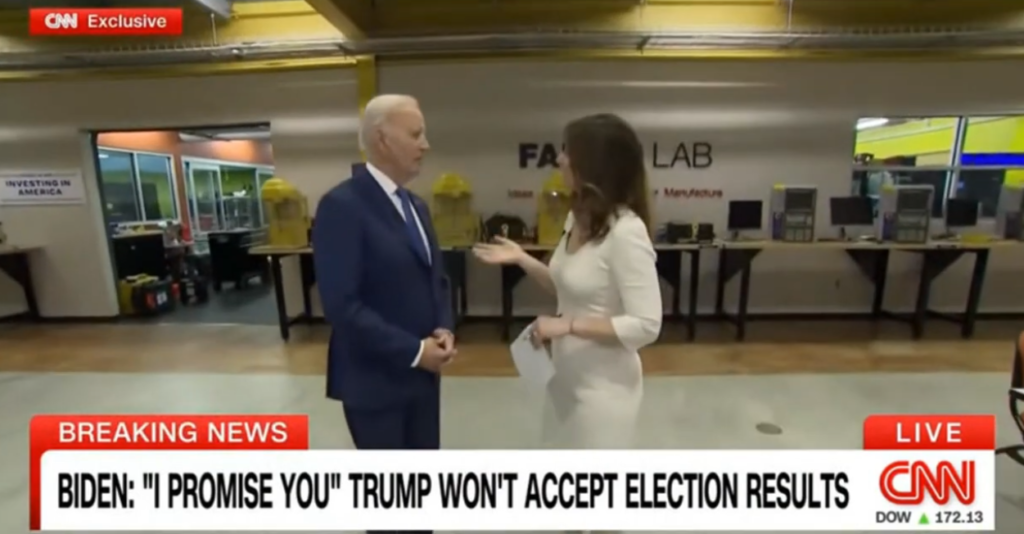
On 05/08/24 U S. President Joe Biden sat down with Outfront CNN host Erin Burnett in Milwaukee Wisconsin, for a wide ranging interview that included his reelection campaign, the economy, his thoughts about his Republican challenger Donald Trump, AI, the crisis in Gaza… The interview provided an excellent compare and contrast situation between president Biden and his Republican challenger Trump, thanks in large part to excellent questioning by host Erin Burnett.

As host Erin Burnett correctly pointed out at the start of the interview, President Biden was in the battleground state of Wisconsin to tout plans for the creation of a massive Microsoft AI (artificial intelligence) data center, that will reportedly bring some 2,000 union construction jobs to that region, plus provide AI training to some 100,000 people (more job opportunities). As Erin pointed out, Trump, while president, promised the creation of some 13,000 FoxConn jobs in the same area, a promise we now know, never panned out. Only about 1,000 jobs exist right now, as opposed to the promised 13,000.

Asked why Wisconsinites should believe his jobs promise after clearly being duped by his predecessor Trump, Biden’s response boiled down to this(1:42): “He [Trump] has never succeeded in creating jobs, and I’ve never failed. I’ve created over 15 million jobs since I have been president. 15 million in 3.75 years and secondly, Microsoft is a serious player, and they are very much engaged in making sure that they pick this area as the home base for their AI initiative in the nation. They are going to do it.” Biden then delivered a body shot to Trump (liver shot if you will), telling host Erin, “When has he [Trump] ever done anything that he said? I’m not being facetious…” You get the drift–Trump is all talk, or as they say in Texas, “All hat and no cattle”.

Next up on the interview was the economy, where host Erin Burnett pointed out that recent polls show his challenger Trump beating him when it comes to the question as to who voters think would handle the economy better. Specifically, Erin asked whether he was worried that time was running out for him to turn around that sentiment. President Biden responded in relevant part (7:31), “We’ve already turned around. Look at the Michigan survey. Over 65% of Americans think they are in good shape economically. They think the nation is not in good shape, but they are personally in good shape. The polling data has been wrong all along…” Yours Truly has warned about these mainstream media “polls” in a previous post.

The next major topic was the crisis in Gaza, which is having ripple effects way beyond the Middle East.

Host Erin Burnett(10:26): “I know that you have paused, Mr President, shipments of 2,000-pound U.S. bombs to Israel due to concern that they could be used in any offensive on Rafah. Have those bombs, those powerful 2000-pound bombs been used to kill civilians in Gaza?”

President Biden: “Civilians have been killed in Gaza as a consequence of those bombs and other ways in which they [Israel] go after population centers. I made it clear that if they go into Rafah…I’m not supplying the weapons that have been used historically to deal with Rafah, to deal with the cities, to deal with that problem…” Simply put, the United States will continue supporting Israel in its efforts to counter terrorism, but it will no longer just rubber-stamp and supply weapons for anything Israel does to Gazans. The Biden administration will hold the Netanyahu government to some human rights standards, a commendable position indeed. As for the related protests popping out at U.S. institutions of higher learning, and the legitimate questions such protests have raised regarding the first amendment, President Biden said (13:06): “There’s a legitimate right to free speech and protest…They [students] have a right to do that. There’s not a legitimate right to use hate speech. There’s not a legitimate right to threaten Jewish students.There’s not a legitimate right to block people’s access to class. That’s against the law.”

Next up was a discussion about the real potential for a repeat of a January 6th style insurrection if Biden defeats Trump again. Specifically, Erin asked how seriously President Biden takes the remarks by Trump, that he will not accept the election results if he loses. President Biden responded(16:44): “Very seriously, just like I did with January 6th. The guy is not a democrat (small d)…You can’t only love your country when you winHe may not accept the outcome of an election? I promise you he won’t.”

The interview concluded with a question as to whether former President Obama, who did very well in his election and re-election, and who Biden served as vice president, was giving him any advice on how to run his re-election campaign. President Biden admitted that he was indded getting advice from Obama, adding that the advice was, “You’ve got to organize, block and tackle, people knocking on doors, putting up signs…”. One has to admit, that is as “Obama-esque” as it gets. Hopefully Team BidenHarris heeds his advice and get the results Obama always delivered–kicking Republicans in their you know what!!

For those of you very happy with @Emolclauseโ€™s activism donโ€™t shy away from the โ€œtip jarโ€ below on your way out. You may also Cash App

Email author at admin@grassrootsdempolitics.com

Become an Octapharma Plasma donor. Make up to $200 in one week and help save lives too! Learn More