Rep Clyburn’s New Book Looks At How SCOTUS Is Taking Us Back To Jim Crow Era


Please consider $upporting GDPolitics by scanning the QR code below or clicking on this link

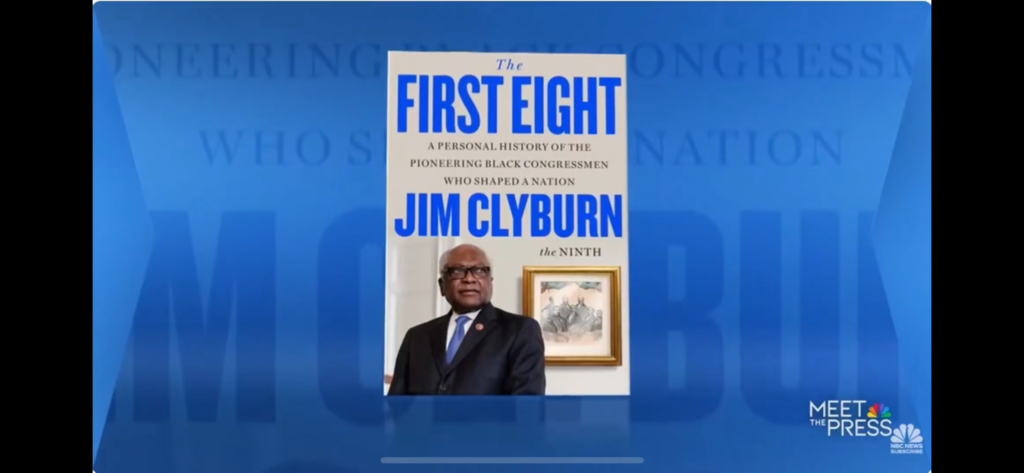
An important new book by Rep. James Clyburn (D-SC), The First Eight, warns that disturbing signs suggest we may be sliding back toward a modern form of Jim Crow. In it, Clyburn examines the lives and careers of the first eight Black men to serve in Congress from South Carolina — all elected in the period after the Civil War during Reconstruction. He recalls that after the last of those eight left Congress in 1897, there was no Black representation from South Carolina for 95 years, until Clyburn himself was elected in 1992.

Clyburn uses their stories not just to spotlight that lost legacy, but to warn that many of the same forces that disenfranchised Black voters at the turn of the 20th century are resurfacing today. He draws parallels between the backlash that ended Reconstruction — Jim Crow laws, restrictive state constitutions, poll taxes, literacy tests, and violence — and current efforts to redraw voting districts and suppress minority voting power. A key part of his argument is the role the Supreme Court played then and now. He notes that foundational decisions like the Slaughterhouse Cases narrowed the scope of the 14th Amendment almost immediately after its ratification, stripping federal protections from formerly enslaved people and allowing Southern states to impose discriminatory laws. That judicial retreat set the stage for later rulings such as Plessy v. Ferguson, which constitutionally sanctioned segregation and cemented the legal framework that enabled Black disenfranchisement for generations.

In particular, Clyburn argues that modern partisan and racial gerrymandering — especially in his home state of South Carolina — resembles the “old Jim Crow power play” that erased a century of Black political representation. He points to recent attempts by the State Legislature to redraw congressional districts in a way that moved tens of thousands of Black voters out of his district, a practice a federal court found to be an unconstitutional racial gerrymander. When the map was challenged, however, it was the current Supreme Court that stepped in and reversed the lower court, making it significantly harder for voting-rights advocates to block discriminatory district maps. To Clyburn, this echoes the pattern of the past: when state governments use race to manipulate electoral maps, and the Court either narrows protections or declines to intervene, the result is the same erosion of political power that once produced the 95-year gap between the eighth Black congressman from South Carolina and himself.

Clyburn does not merely retell history — he warns that history is repeating. He argues the country is in the early stages of what he calls a “Third Reconstruction,” threatened by political forces determined to dilute or suppress the votes of people of color. In his view, the stakes are nothing less than the integrity of democracy itself: the story of those first eight Black congressmen is a reminder that gains in political power and representation can be undone — and undone intentionally. The book emerges not just as history, but as a timely call-to-action to defend voting rights, safeguard fair representation, and resist any revival of Jim Crow-era disenfranchisement.

Clyburn closes with a telling reminder that the first eight Black congressmen from South Carolina were routinely assigned racist and belittling nicknames by their opponents — a tactic meant to diminish their legitimacy, sow disrespect, and discourage those they represented. He notes that the weaponization of mockery and demeaning labels is not a relic of the past; it echoes loudly in today’s political climate, where leaders of color are again targeted with derisive nicknames designed to undercut their standing and weaken the communities they serve. For Clyburn, these parallels — from state laws to Supreme Court decisions to symbolic attacks — underscore his broader warning: the architecture of disenfranchisement is being rebuilt piece by piece, and the patterns of the past are reappearing in unmistakably familiar ways.

Chief Justice Roberts Slammed As Biggest Enemy To Voting Rights Act

In the October 19, 2025, edition of MSNBC’s Velshi, legal commentator Elie Mystal delivered a striking critique, telling host Ali Velshi that U.S. Supreme Court Chief Justice John Roberts has, in many respects, become the most formidable obstacle to the enforcement of the landmark 1965 Voting Rights Act (VRA)—and, by extension, a significant impediment to protecting the voting rights of communities of color.

Mystal’s remarks were prompted by the high-profile redistricting case currently before the Supreme Court, Louisiana v. Calais. Experts warn that the Court’s ruling could fundamentally undermine the VRA, effectively allowing racially motivated redistricting and diluting the electoral power of Black and minority voters. The stakes are enormous: analysts suggest that, if the Court rules in favor of Louisiana’s approach, Republicans could gain as many as 19 additional House seats in the 2026 elections alone.

The case raises critical questions under the VRA’s Section 2, which prohibits voting practices that result in racial discrimination, and Section 5, which historically required jurisdictions with a documented history of voter suppression to obtain federal approval before changing voting laws. Louisiana v. Calais centers on whether the state’s proposed redistricting plan unfairly diminishes the influence of Black voters in certain congressional districts. Proponents of the challenge argue that the plan reflects legitimate political considerations, while opponents contend it is a transparent attempt to circumvent the VRA and dilute minority voting power.

This moment is reminiscent of a discussion I initiated back in 2018, when I criticized what I then termed the “unjust Roberts Supreme Court” for systematically chipping away at the VRA’s protections. At the time, such a stance was considered controversial. Today, with mainstream voices like Mystal echoing similar concerns, it appears those warnings have entered the broader public discourse.

As the Supreme Court deliberates Louisiana v. Calais, the implications extend far beyond a single state. The decision could redefine the legal contours of voting rights protections nationwide, setting a precedent that either reinforces or weakens decades of civil rights progress. Observers on both sides of the political spectrum will be watching closely, as the Court’s ruling could reshape congressional representation and influence the trajectory of American democracy for years to come.

Michael Moore Slams Michigan Officials For Zero Criminal Prosecutions Over Flint Water Scandal

$upport via Cash App

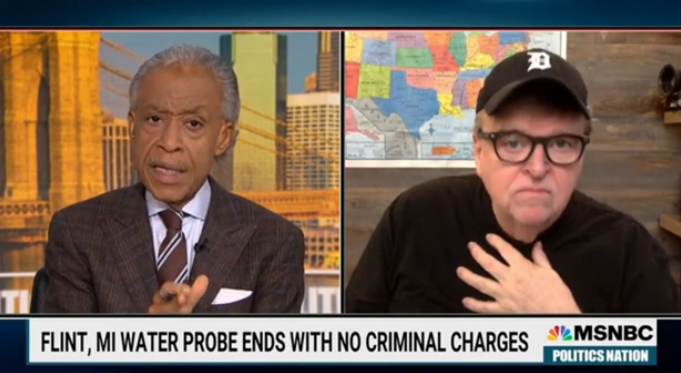
Film Producer and Activist Michael Moore appeared on MSNBC’s Politics Nation show (11/04/23) to discuss among other things, the ongoing Israel-Palestine conflict. Moore’s home state is Michigan, which is home to the largest Arab-American population in the United States. Later in the interview, the discussion moved on to another disaster that Moore got intricately involved in as an activist, and that is, the Flint water scandal, which caused lead poisoning of poor (primarily Black) families in Flint Michigan. Moore expressed frustration that to date, no Michigan state official has been criminally held responsible for the poisoning.

Here’s what Michael Moore told host Al Sharpton regarding the decision by the Michigan Attorney General to end the investigation into Flint without any criminal prosecution (8:38): “It’s so disgusting, appalling, and again, sad…Here we are, talking really about…an ethnic cleansing of a majority Black city, where the state of Michigan in order to save some money, took the city off the clean water supply from Lake Huron, and made the people of Flint, Michigan, majority Black, drink from the Flint River, a massively polluted river, for decades, and what it did was, it poisoned nearly 10,000 children. Any lead poisoning, if you’re…six years and younger, you will have permanent brain damage…And the Governor, and his people, once they knew what was going on, they tried to cover it up…and they got away with it…If this was a White town in Michigan…you never would have seen this. This is going on for seven years, and nobody convicted, nobody having to be responsible for what they knew what was going on, they knew what was going to happen…”

Moore then went on to subtly call out the current Michigan Attorney General Dana Nessel, a Democrat, for not criminally prosecuting the people responsible for the Flint water poisoning. To be clear, AG Nessel assumed office in 2019, long after the Flint water scandal broke (2014-2016). She was not the state’s AG as the crisis was playing out. Any reasonable person would conclude however, judging from Moore’s tone, that he is terribly disappointed with AG Nessel for the lack of criminal prosecutions.

Bottom line folks, unless and until we start holding public officials criminally responsible for atrocities such as Flint and many others that have happened before (MKULTRA, Cointelpro etc), atrocities that cause irreparable harm to unsuspecting citizens, we will continue to see them happen again in the future. It’s really that plain and simple.

For those of you very happy with @Emolclause’s activism don’t shy away from the “tip jar” below on your way out. You may also Cash

Email author at admin@grassrootsdempolitics.com

Become an Octapharma Plasma donor. Make up to $200 in one week and help save lives too! Learn More

Little Known FBI’s Race-Based Surveillance

$upport via Cash App

There have been numerous media reports about a very troubling practice by the FBI to designate Black activists as “Black Identity Extremists”, an often bogus designation which is then used to justify subjecting the said activists to all levels of surveillance–private, local, state, federal and even military surveillance in major cities like Houston, LA, Chicago, New York and others. The rationale, a bogus one, is that a “Black Identity Extremist” or BIE is more likely to attack law enforcement officers and thus needs to be placed under 24-hour surveillance.

The controversy surrounding this program, beyond its prima facie racism, centers around the ease with which a Black activist could end up in this designation. Several media reports have said that even mundane activities like organizing or attending a Black Lives Matter rally could in the eyes of the FBI qualify a Black activist as a BIE subjecting them to unjustified long-term government surveillance, the fruits of which could be used in their criminal prosecution. Needless to say, Black activists who support/sympathize with Black Lives Matter on social media (Twitter, Facebook) can also very easily be designated as BIEs. Simply put, this is a very serious problem that is yet to garner the mainstream media attention it deserves.

Yours Truly has ranted and raved about the lack of mainstream media attention surrounding this seemingly–let’s face it–racist surveillance by the FBI for quite a while now, wondering when House Democrats would take up this serious issue with the justice department.

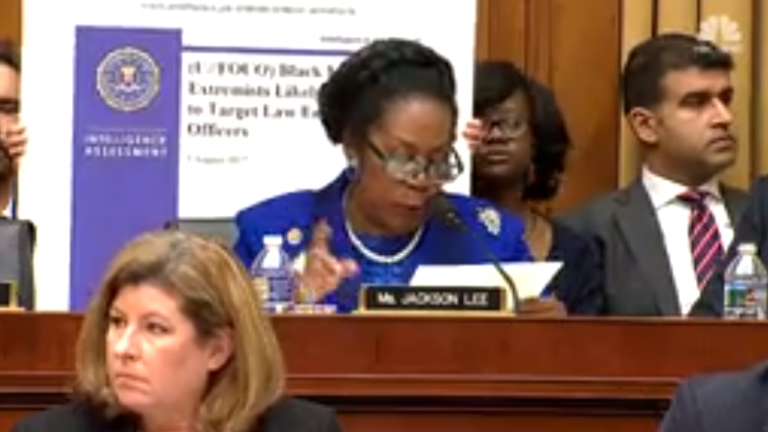
Well, it turns out Rep Sheila Jackson-Lee (R-TX) did indeed raise this issue with then U.S. Attorney General Jeff Sessions at a House hearing on November 14, 2017. Rep Jackson-Lee asked Sessions; “My question is, as I hold up the poster dealing with the report under your jurisdiction–Black Identity Extremists. It is interesting to me that you are opposing [meant targeting] individuals who are opposing lethal force, similar to the attack on Reverend Dr Martin Luther King on Cointelpro, but there seems to be no report dealing with the tiki torch parade in Charlottesville chanting ‘Jews will not replace us’. Why is there an attack on Black activists versus any report dealing with the Alt Right and the White Nationalists?” AG Sessions responded that he was not aware of the report.

Cointelpro which Rep Jackson-Lee referenced in her questioning was a controversial and secret surveillance program the FBI deployed on Black civil rights activists in the 60s, most notably, on the Reverend Martin Luther King, Jr. Historians agree that the primary reason the FBI ran Cointelpro on Black civil rights activists was to scare them into silence. This is precisely why when Black activists hear about “Black Identity Extremists” they are immediately reminded of stories they’ve read about Cointelpro and are justified in questioning whether the FBI has indeed reverted back to its 1960s tactic of stifling Black dissent.

Bottom line the “Black Identity Extremist” debate is one that begs for serious mainstream media attention. The mainstream media and indeed members of Congress must not remain silent as a section of the population is unjustly subjected to heightened levels of government surveillance all in an effort to stifle their first amendment compliant political speech. At moments like these, Martin Niemoller’s famous words come to mind; “First they came for the socialists, and I did not speak out because I was not a socialist, then they came for the trade unionists, and I did not speak out because I was not a trade unionist, then they came for the Jews, and I did not speak out because I was not a Jew. Then they came for me—and there was no one left to speak for me.”

For those of you very happy with @Emolclause’s activism don’t shy away from the “tip jar” below on your way out. You may also Cash App

Email author at admin@grassrootsdempolitics.com

Become an Octapharma Plasma donor. Make up to $200 in one week and help save lives too! Learn More