Rep Clyburn’s New Book Looks At How SCOTUS Is Taking Us Back To Jim Crow Era


Please consider $upporting GDPolitics by scanning the QR code below or clicking on this link

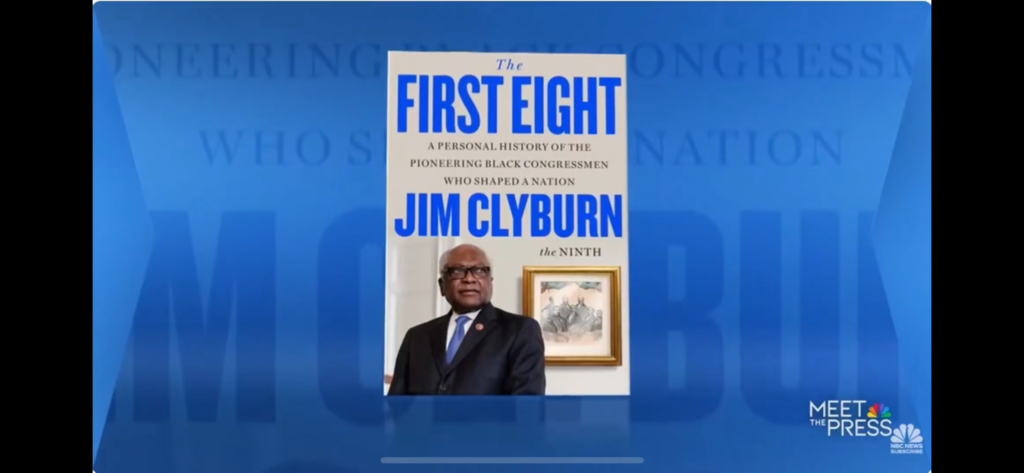
An important new book by Rep. James Clyburn (D-SC), The First Eight, warns that disturbing signs suggest we may be sliding back toward a modern form of Jim Crow. In it, Clyburn examines the lives and careers of the first eight Black men to serve in Congress from South Carolina — all elected in the period after the Civil War during Reconstruction. He recalls that after the last of those eight left Congress in 1897, there was no Black representation from South Carolina for 95 years, until Clyburn himself was elected in 1992.

Clyburn uses their stories not just to spotlight that lost legacy, but to warn that many of the same forces that disenfranchised Black voters at the turn of the 20th century are resurfacing today. He draws parallels between the backlash that ended Reconstruction — Jim Crow laws, restrictive state constitutions, poll taxes, literacy tests, and violence — and current efforts to redraw voting districts and suppress minority voting power. A key part of his argument is the role the Supreme Court played then and now. He notes that foundational decisions like the Slaughterhouse Cases narrowed the scope of the 14th Amendment almost immediately after its ratification, stripping federal protections from formerly enslaved people and allowing Southern states to impose discriminatory laws. That judicial retreat set the stage for later rulings such as Plessy v. Ferguson, which constitutionally sanctioned segregation and cemented the legal framework that enabled Black disenfranchisement for generations.

In particular, Clyburn argues that modern partisan and racial gerrymandering — especially in his home state of South Carolina — resembles the “old Jim Crow power play” that erased a century of Black political representation. He points to recent attempts by the State Legislature to redraw congressional districts in a way that moved tens of thousands of Black voters out of his district, a practice a federal court found to be an unconstitutional racial gerrymander. When the map was challenged, however, it was the current Supreme Court that stepped in and reversed the lower court, making it significantly harder for voting-rights advocates to block discriminatory district maps. To Clyburn, this echoes the pattern of the past: when state governments use race to manipulate electoral maps, and the Court either narrows protections or declines to intervene, the result is the same erosion of political power that once produced the 95-year gap between the eighth Black congressman from South Carolina and himself.

Clyburn does not merely retell history — he warns that history is repeating. He argues the country is in the early stages of what he calls a “Third Reconstruction,” threatened by political forces determined to dilute or suppress the votes of people of color. In his view, the stakes are nothing less than the integrity of democracy itself: the story of those first eight Black congressmen is a reminder that gains in political power and representation can be undone — and undone intentionally. The book emerges not just as history, but as a timely call-to-action to defend voting rights, safeguard fair representation, and resist any revival of Jim Crow-era disenfranchisement.

Clyburn closes with a telling reminder that the first eight Black congressmen from South Carolina were routinely assigned racist and belittling nicknames by their opponents — a tactic meant to diminish their legitimacy, sow disrespect, and discourage those they represented. He notes that the weaponization of mockery and demeaning labels is not a relic of the past; it echoes loudly in today’s political climate, where leaders of color are again targeted with derisive nicknames designed to undercut their standing and weaken the communities they serve. For Clyburn, these parallels — from state laws to Supreme Court decisions to symbolic attacks — underscore his broader warning: the architecture of disenfranchisement is being rebuilt piece by piece, and the patterns of the past are reappearing in unmistakably familiar ways.

Is MAGA Trumpism A Form Of Political Religion?

$upport via Cash App

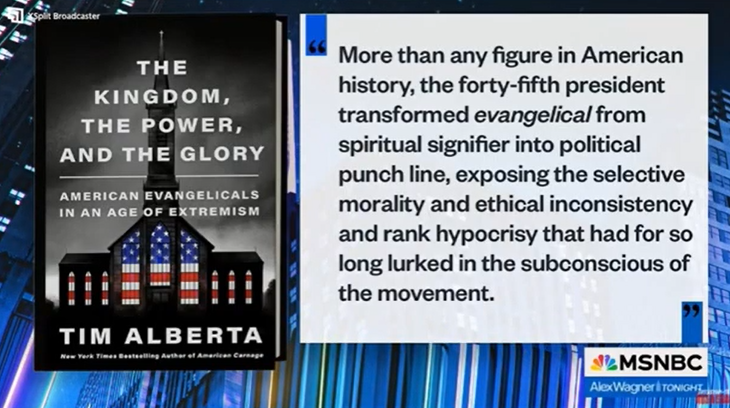
An interesting segment on MSNBC’s Alex Wagner Tonight (01/1624) show delved into the strange daliance between Evangelical Christians(predominantly White), and the politics of former President Donald Trump, often referred to as Trumpism, or MAGA Trumpism. The alliance between these two strange bedfellows has led many to question whether MAGA Trumpism has become some sort of political/civil religion.

The MSNBC segment came against the backdrop of Trump’s massive win in the Iowa Republican presidential primary, and specifically, his command of the White Evangelical vote, which polls placed at 53%. Back in 2016, when Trump first ran for president, he only received 21% of the White Evangelical vote in Iowa, a clear sign that he has now consolidated the White Evangelical vote in Iowa, and arguably nationwide.

Host Alex Wagner posed this question to her guest, Author Tim Alberta, who’s also a staff writer at The Atlantic (2:07): “I wonder in your estimation, what it means to be an Evangelical in this country, at this moment?”
Tim Alberta responded in relevant part: “We are beginning to flirt with this territory where definitionally speaking, Evangelicalism has far more to do, at least in the perception of the greater public, with political engagement, partisan political identification, than it does with any particular theology or any real religious conviction, and if you take it a step further, if you look at the exit polling, if you look at some of the social science around this, if you look at the fact that during Donald Trump’s presidency, more and more of Donald Trump’s supporters were self-identifying as Evangelicals even though they were simultaneously attending Church less and less often, I think one might reach the uncomfortable conclusion that perhaps the best definition now for what it means to be an Evangelical, is to be a conservative White Republican Trump supporter, and that is a tragedy on any number of different levels, but I think most profoundly, it’s a tragedy for the Gospel of Jesus Christ.”

Host Alex Wagner then interjected with this profound question (3:50): “If the Gospel is no longer part of the equation, what is it replaced by…do you think MAGA-ism has become a placeholder for a certain kind of religion?”

Tim Alberta: “Yes…I don’t want to paint with too broad a brush, the Evangelical community is large, it’s huge, and it’s complicated…but…we are reaching a place where we are being confronted with some uncomfortable realities about what it means to be a part of the Evangelical movement and frankly, where the line blurs between sort of religious identity and political identity, and is there a merging of the two, and frankly I think that there’s always a danger in politics…of sort of turning political conviction into religious conviction, or worshipping at a certain altar that is not an altar to God, but is an altar to political idolatry or to political identity. That is a danger that has always been there, but it is I think uniquely dangerous in this moment, and to be clear…we have examples from the not so distant past, of a sort of political religion, or at least a civil religion, supplanting, competing with actual religion, and I don’t think that we’re all that far removed from that in this country now, looking at just what happened…in Iowa.”

To conclude the segment, Tim Alberta floated this interesting scenario, which gets right to the fallacy of the Evangelical-MAGA Trumpism alliance. He said (8:19): “If during Barack Obama’s presidency, or while he was running for president, if you had heard him talking with, or promoting a video saying that he was a shepherd to all of mankind, the Evangelical movement would have been up in arms [and rightly so], I mean this is heretical, this is blasphemous and yet, Donald Trump seems to get a pass time and time again for doing these things that no other politician, Republican or Democrat frankly, would get a pass for doing, and we should ask ourselves why. If the answer does not at least start to flirt with this terrain of civil religion, or political religion, then I think that we’re not being honest with ourselves, and if we are being honest with ourselves, if we are willing to engage with the very uncomfortable topic around what happens when Trumpism becomes civil religion in this country for millions of millions of people, and what that might imply moving forward, then we are doing a disservice to our prularistic democracy.”

Bottom line folks, we’ve always operated on the separation of church and state doctrine, and have for decades, shunned foreign theocracies like the ones in Afghanistan and Iran. Author Tim Alberta is absolutely correct when he says, we need to be honest with ourselves, and admit that there is no difference between the Evangelical-MAGA dalliance in the American political scene, and the theocracies in Iran and Afghanistan. Simply put, we need to make a decision as to whether we want to continue with the separation of church and state doctrine, or whether, that time-honored tradition has also been sacrificed at the altar of MAGA Trumpism.

For those of you very happy with @Emolclause’s activism don’t shy away from the “tip jar” below on your way out. You may also Cash App

Email author at admin@grassrootsdempolitics.com

Become an Octapharma Plasma donor. Make up to $200 in one week and help save lives too! Learn More