The Deep State Debate Returns: Inside Peter Thiel’s Secretive Dialog Network

A newly leaked membership list from Dialog, an invitation-only organization co-founded by billionaire investor Peter Thiel, has reignited one of America’s oldest fears: that the country isn’t really governed by elected officials, but by a small, interconnected network of elites operating behind closed doors. The leak itself appears to be genuine and has been independently reported by multiple outlets, including WIRED, which says internal records and membership directories were left exposed online and later verified. According to those reports, Dialog was founded in 2006 and hosts private, off-the-record retreats attended by leaders from politics, technology, finance, media, and academia. The organization has kept its membership secret for years, leading some to compare it to the Bilderberg Group—a long-rumored gathering of global elites that has fueled speculation and conspiracy theories for decades.
The names reportedly appearing on the leaked list span the political spectrum and include some of the most influential figures in the United States today. Among the politicians and public officials said to be involved are Ted Cruz, Cory Booker, Tulsi Gabbard, Jared Polis, Wes Moore, Julian Castro, Jim Himes, and Jared Kushner. The list also reportedly includes major figures from technology and media, such as Elon Musk, Ezra Klein, Joseph Gordon-Levitt, along with executives tied to artificial intelligence, venture capital, and Silicon Valley. The sheer breadth of the roster is what has captured the public imagination. Conservatives, liberals, celebrities, journalists, entrepreneurs, and government officials all appearing under the umbrella of the same secretive organization naturally raises eyebrows and invites questions about what exactly is happening behind closed doors.
For many Americans, this leak will seem to confirm their worst suspicions. How is it that politicians who publicly disagree on almost everything can belong to the same exclusive organization? Why are billionaires, intelligence officials, senators, governors, journalists, and tech executives all meeting in private? What exactly is discussed when cameras are off and the public isn’t invited? Those questions naturally fuel concerns about a so-called “deep state”—the belief that an invisible, bipartisan establishment exercises power regardless of who wins elections. To many skeptics, this is not merely a social club or networking group. It looks like evidence that the real centers of power exist outside democratic institutions and that elections merely determine who speaks for the public while a permanent elite class quietly shapes the country’s future.
And to be fair, the perception problem is real. When powerful people gather secretly, public trust suffers. When organizations refuse to disclose their members, people assume there is something to hide. And when ordinary citizens feel increasingly powerless while wealth and influence become concentrated among a tiny elite, stories like this do not emerge in a vacuum—they fit into an already existing narrative that the rules are different for those at the top. The Dialog leak is especially striking because it reportedly includes individuals from both left and right, establishment Democrats and conservatives alike. To skeptics, this looks less like democracy and more like an elite class protecting its own interests while political battles play out on television for everyone else.
But there is another side to this story, and it is important not to ignore it. Secretive does not necessarily mean sinister. History is full of private forums where influential people meet: business conferences, academic retreats, policy think tanks, and informal gatherings designed to encourage candid discussion. The annual Bilderberg meetings, for example, have long attracted conspiracy theories, yet no concrete evidence has ever emerged showing that they secretly govern the world. Likewise, being listed as a member of Dialog does not prove wrongdoing, corruption, or collusion. Some attendees may have joined only once. Others may disagree vehemently with Peter Thiel’s views. Still others may attend precisely because they want to engage with people outside their ideological bubble.
In fact, the leaked roster reportedly includes people who are political rivals or who have publicly criticized one another. That reality cuts against the notion that everyone involved shares a single agenda. It is entirely possible that the meetings are exactly what their organizers claim: a place where influential people exchange ideas and debate important issues away from the pressures of social media and public grandstanding. Even some of the conference topics that sound provocative—subjects reportedly involving artificial intelligence, geopolitics, “Build-a-Cult,” and the future of society—do not necessarily imply malicious intent. Conferences often use provocative titles to spark debate rather than endorse the ideas being discussed.
Still, there is a legitimate debate to be had. Should elected officials participate in secret organizations? Should journalists attend private gatherings alongside the very people they cover? Should intelligence officials, CEOs, and lawmakers be expected to disclose these affiliations to the public? Those are fair questions, and citizens have every right to ask them. Transparency has long been viewed as a cornerstone of democracy, and when influential figures operate in private, skepticism is inevitable.
The Dialog leak may not prove the existence of a shadow government or a hidden cabal directing America’s future. But it does reveal something undeniably true: a relatively small group of influential people has access to one another in ways ordinary citizens do not. Whether that represents healthy networking among leaders or an unhealthy concentration of power is a question Americans will continue debating long after the headlines fade. And perhaps that is the real significance of this leak—not that it proves the deep state exists, but that it exposes just how fragile public trust has become when powerful people operate behind closed doors, leaving millions to wonder who is really running the country.

House MKULTRA Hearing Set For 051326

When Anna Paulina Luna publicly signals a hearing tied to something as controversial and historically unsettling as Project MKUltra, it’s bound to turn heads—and not just because of the subject matter, but because of the willingness it takes to even go there. For decades, MKUltra has occupied a strange space in American consciousness: partially declassified fact, partially dismissed suspicion, and fully uncomfortable. Many elected officials would rather steer clear of it altogether, treating it as politically radioactive. That’s precisely why Luna’s move stands out. It suggests a readiness to engage with topics that others avoid, not because they lack relevance, but because they carry reputational risk.

There’s a broader context here that makes this moment particularly notable. Across the country, there’s a growing appetite for transparency—whether it’s about government surveillance, intelligence practices, or long-buried programs that were once waved away as conspiracy. From renewed scrutiny of agencies like the Central Intelligence Agency to bipartisan calls for declassification in other areas, the public mood has shifted. People are less willing to accept “trust us” as a sufficient answer, especially when it comes to historical abuses of power. In that sense, this hearing isn’t just about MKUltra itself; it fits into a larger pattern of reevaluating what has been hidden and why.

What makes Luna’s approach noteworthy is not necessarily that she’s promising explosive revelations—there’s no indication that May 13 will suddenly rewrite the historical record—but that she’s legitimizing the conversation within a formal government setting. That alone matters. When something moves from the fringes into a congressional hearing room, it changes how it’s perceived. It becomes something that can be questioned, documented, and entered into the public record, rather than dismissed outright.

For a subset of Americans often referred to as “targeted individuals,” this development will likely carry particular significance. Many in that community have long argued that programs resembling MKUltra never truly ended, but instead evolved under different classifications and technologies. Their claims are controversial and widely disputed, but they persist in part because of the historical reality that MKUltra itself was once denied before being partially confirmed. A hearing like this, even if it doesn’t validate those beliefs, signals that the door to inquiry is not completely shut—and that alone can feel like a shift.

At the same time, expectations should remain grounded. It’s unlikely that May 13 will produce a major bombshell or definitive answers to decades-old questions. Government hearings, especially on sensitive intelligence matters, tend to move incrementally rather than dramatically. But that doesn’t make them meaningless. In many cases, the first hearing is less about revelation and more about establishing that the topic deserves attention at all.

If anything, this could serve as a starting point—a signal that even the most uncomfortable chapters of government history are not off-limits forever. And if that leads to more hearings, more documents, and more scrutiny over time, then it will have achieved something meaningful. Because in a climate increasingly defined by demands for openness, even small steps toward transparency matter. As the saying goes, sunshine is the best disinfectant.

OathKeepers Indictment Raises Serious Questions About Higher Up Involvement

$upport via Cash App

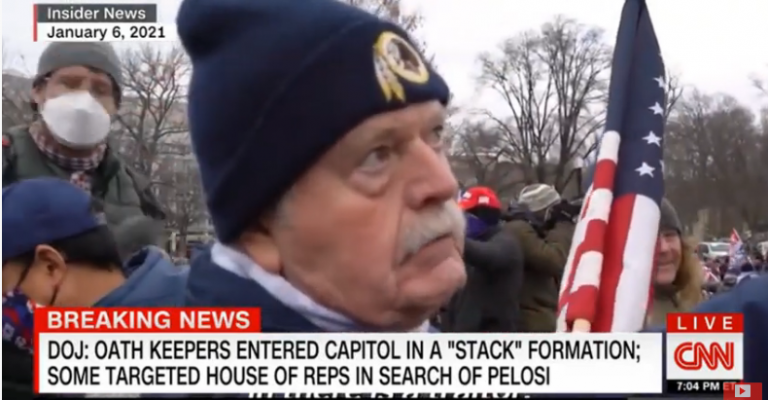
The bombshell seditious conspiracy indictment of 11 members of the militia group OathKeepers following their involvement in the January 6th insurrection, is raising serious questions as to how far up the law enforcement, military, and intelligence food chain, the conspiracy went. Specifically, given the level of tactical military sophistication they displayed on January 6th, there are valid questions as to whether Trump-allied senior members of U.S. law enforcement, military, and intelligence apparatus, gave material support, or even worse, are still members of this dangerous militia group that attempted to violently overthrow the government. A segment on CNN’s Outfront with Erin Burnett(01/13/22) delved into this very topic.

Host Erin Burnett said in relevant part: “Prior planning, coordination, sedition, weapons. The 11 people charged today, were[in a]conspiracy, and they are not small fish, like many of the more than 700 people already charged, some of who may have been wrapped up in the moment. Not the case with these individuals. This group had a level of combat training, they were prepared to use force, they had a stash of weapons that they brought for that specific intent, and the question tonight is…now you’ve got a conspiracy, you’ve got planning, you’ve got it all laid out. How much higher does that go?”

Any reasonable person presented with the OathKeepers indictment would reasonably conclude, as host Erin Burnett did, that given the sophistication of their January 6th operation, people higher up in the law enforcement, military, intelligence and even political food chain, were providing material support to the OathKeepers. Providing material support to this dangerous militia group would also necessarily imply that they are members of the group–a scary thought indeed.

CNN’s Sara Sidner followed up with an in depth look at OathKeepers leader Stewart Rhodes in an appearance on New Day (01/14/22), where she dropped a bombshell that further bolsters the troubling prospect that the OathKeepers may have enjoyed material support from insiders within our law enforcement, military and intelligence ranks.

Sara Sidner said: “One of the things the OathKeepers do, is they try and recruit either current or former military, current or former members of law enforcement, current or former people who have been part of the intelligence apparatus in the United States, whether it be the FBI , CIA, anybody that they can get and bring into the organization, and when you think about that, it means that they have tactical training to do something like this[January 6th], and to plan something like this.”

This raises serious questions including but not limited to, what kind of arms and illegally acquired intelligence the OathKeepers currently have, whether in light of this indictment, it’s still okay to have active members of our law enforcement, military, and intelligence apparatus being active members of this violent militia group, etc.

Bottom line folks, Erin Burnett’s question as to how high up this conspiracy goes, is a very serious one, that needs to be seriously addressed by Congress, especially the January 6th Committee, and the mainstream media. For the record, this question has been raised before by concerned members of the public, including Yours Truly, but always treated as one requiring a voluntary answer from our law enforcement, military and intelligence brass. Given the seriousness of this OathKeepers indictment, this question should no longer be one that requires a voluntary answer. The mainstream media and Congress, preferably the January 6th Committee, must demand an answer from leaders in our law enforcement, military and intelligence agencies, as to how much the OathKeepers have infiltrated their ranks. This is a serious national security problem, and it should be treated as such. A major part of the January 6th Committee’s mission is to prevent another January 6th-type insurrection. Reasonable people will agree that rooting out extremism within our law enforcement, military, and intelligence ranks will go a long way in fulfilling that mission.

Specific emphasis should be placed on Trumper states like Texas, which has a heavy OathKeepers presence, and was involved all the way to the top(AG Paxton and other political leaders) in Trump’s efforts to overturn the 2020 election results. What other nefarious activities are the OathKeepers enlisted for in such states? Did the Texas political establishment provide material support to the OathKeepers, for their January 6th operation?

For those of you very happy with @Emolclause’s activism don’t shy away from the “tip jar” below on your way out. You may also Cash App

Email author at admin@grassrootsdempolitics.com

Become an Octapharma Plasma donor. Make up to $200 in one week and help save lives too! Learn More