The Hope Florida scandal has taken another unexpected turn. According to CBS Miami investigative reporter Jim DeFede, Orange-Osceola State Attorney Monique Worrell is now beginning her own review of the controversy and is considering whether a new grand jury may be necessary. Worrell says her office has received information suggesting that some of the money at the center of the scandal may have been spent in the Central Florida media market, which falls within her jurisdiction. At the same time, Worrell has publicly claimed that she was warned her removal from office could be imminent and suggested that her interest in the Hope Florida matter may be connected. There has been no public confirmation from Gov. Ron DeSantis that he intends to remove her, and Attorney General James Uthmeier has said he was unaware of any such plan.
This is significant because it goes directly to the argument I made in my previous article, “Hope Florida: Why No Indictments Is No Vindication.” Read my previous Hope Florida analysis here The first grand jury did not conclude that nothing improper happened. It concluded that the DeSantis administration had misappropriated $10 million in taxpayer money and described the movement of those funds as part of a “sophisticated scheme to fund political activities.” The money originated from a $67 million Medicaid settlement with Centene and was ultimately routed through the Hope Florida Foundation and other organizations before substantial amounts reached political committees. The grand jury simply concluded that it did not have sufficient evidence to criminally charge anyone because no witness would take responsibility for the crucial decision to send the $10 million to Hope Florida. That is an accountability problem—not a declaration of innocence.
And this is where the possibility of another investigation becomes particularly important. The unanswered question has always been who made the decision? The grand jury’s report identified James Uthmeier, who was DeSantis’ chief of staff at the time, as someone who was in a position of authority over those involved in the Centene settlement. His political committee, Keep Florida Clean, ultimately received the majority of the money that moved out of the two nonprofits that received Hope Florida funds. The grand jury also noted that witnesses claimed they could not remember who made the decision to transfer the money in the first place. That is precisely why the argument that “there were no indictments” settles the matter is so misleading. A prosecutor’s inability to establish criminal responsibility beyond the required standard is not the same thing as proving that the underlying conduct was legitimate.
The political implications of Worrell’s review also cannot simply be ignored. DeSantis suspended Worrell in 2023, but she subsequently won her office back from voters in 2024 with nearly 60% of the vote. Now, as her office begins examining information connected to the Hope Florida money, Worrell says she has been warned that she could once again be removed. She has explicitly connected the timing to the investigation, saying that if she is removed, it would not be because her office isn’t doing its job, but because of concerns about what that work might uncover. To be clear, Worrell’s allegation is not proof that DeSantis is attempting to stop the investigation, and there is currently no public confirmation that he plans to suspend her. But given the extraordinary circumstances surrounding Hope Florida, the public has every reason to pay close attention. If a prosecutor is investigating whether taxpayer money was diverted into political activity, the investigation should be allowed to proceed without political interference.
Ultimately, the latest development reinforces the central point: Hope Florida is not a closed case simply because the first grand jury did not return indictments. In fact, the grand jury’s own findings left behind a remarkable contradiction: it found that $10 million in taxpayer money had been misappropriated and used for political purposes, yet nobody could—or would—take responsibility for the decision that set the money on that path. Even former prosecutors interviewed by CBS Miami have questioned whether the investigation went far enough, with some arguing that prosecutors should have continued investigating rather than simply accepting that witnesses could not establish responsibility. Now another state attorney is asking whether there is more to uncover. That doesn’t mean Ron DeSantis, James Uthmeier, Casey DeSantis or anyone else is guilty of a crime. It means the public deserves to know exactly what happened to its money, who authorized it, who knew where it was going, and why millions of dollars connected to a Medicaid settlement ultimately found their way into political operations. Until those questions are answered, Hope Florida deserves investigation—not dismissal.
In reference to my previous post on the Hope Florida money trail, there is one defense from Florida officials that deserves a closer examination because, on its face, it sounds compelling: if the Hope Florida affair really involved fraud, corruption or the misuse of taxpayer money, why didn’t the grand jury indict anyone? In that earlier piece, I traced how $10 million connected to Florida’s $67 million Medicaid settlement with Centene went to the Hope Florida Foundation—the charitable arm associated with First Lady Casey DeSantis’ signature initiative—then through two nonprofits and ultimately into political organizations advancing Gov. Ron DeSantis’ agenda. I also raised the question of whether Vice President JD Vance’s highly publicized anti-fraud crusade would be applied with the same intensity when allegations involving public health-care money lead into the political orbit of a powerful Republican governor. But the absence of indictments presents a separate question, and former Republican congressman and Democratic gubernatorial nominee David Jolly offered an important answer during an appearance with Jen Psaki on MSNOW: you cannot fairly evaluate the lack of indictments without examining why the grand jury said it was unable to indict anyone. The jury did not investigate the transaction and conclude that nothing improper happened. According to the leaked report, it concluded that $10 million in taxpayer money had been “misappropriated,” called the diversion part of a “sophisticated scheme to fund political activities,” and nevertheless found insufficient evidence to charge a particular person criminally because investigators could not establish who made the critical decision to send the money to Hope Florida.
#BREAKING: Psaki: “This completely crazy level of corruption is happening in a state you are hoping to lead. What do you think is most important for people just tuning into the story, trying to digest it, to really understand?”
That distinction changes the entire meaning of the “no indictments” defense. There is an enormous difference between a grand jury saying, we examined what happened and found no wrongdoing, and a grand jury saying, we found wrongdoing but cannot establish which individual can be criminally charged for it. The latter is much closer to what the Hope Florida report says. The grand jury concluded that the entire Centene settlement represented taxpayer reimbursement and rejected the characterization that the disputed $10 million was simply some extra “bonus” that could be directed elsewhere. It identified the decision to send that money to Hope Florida as the original misappropriation. But when jurors attempted to determine who actually made that decision, they encountered a remarkable problem: according to the report, “Nobody will take responsibility” for deciding that the $10 million would go to Hope Florida, and witnesses either could not identify or did not remember who made the decision. The jury therefore found itself in the unusual position of saying it could see that taxpayer money had been misused for political purposes while being unable to establish who, individually, could be prosecuted for causing it to happen.
That is not a minor technical distinction. Criminal prosecution requires prosecutors to do more than demonstrate that something improper happened. They must connect specific conduct to specific defendants and establish the elements of a particular criminal offense. Depending on the alleged crime, that can require evidence showing who authorized an action, what that person knew, whether there was criminal intent and what role that individual played. Investigators can therefore trace money from point A through points B, C and D, establish that its ultimate disposition was improper, and still find themselves unable to prosecute if they cannot prove who ordered the crucial first step. That appears to be the fundamental problem the Hope Florida grand jury encountered. The jury’s inability to identify who made the original decision is therefore not evidence that the decision was proper. In fact, the grand jury expressly reached the opposite conclusion about the money itself. As the report put it, despite finding that the money was misappropriated, jurors found “insufficient evidence to charge anyone criminally.”
The circumstances that produced that evidentiary gap are precisely what make Jolly’s argument so significant. According to the grand jury, virtually everyone involved was a lawyer, and many witnesses said they were acting based upon the advice of other lawyers. Jurors explicitly recognized that this created an impediment to criminal prosecution. Yet the jury still concluded that it could “plainly see” taxpayer money had been misused for political purposes. That is a remarkable statement. It essentially means the grand jury believed it could identify the improper disposition of the money but could not penetrate the decision-making structure sufficiently to assign prosecutable responsibility to an individual. Rather than resolving the scandal, the absence of charges therefore leaves perhaps its most important question unanswered: Who decided that $10 million belonging to Florida taxpayers should be sent to Hope Florida in the first place?
That question becomes even more consequential when considering who reportedly never testified before the grand jury. Gov. DeSantis was not called. Then-Attorney General Ashley Moody, now a U.S. senator, was not called. James Uthmeier, who was DeSantis’ chief of staff at the time and is now Florida’s attorney general, was not called either. Yet the report concluded that Uthmeier was “in a position of authority” over officials involved in settling with Centene, and testimony identified him as having involvement in directing the money after it reached Hope Florida. His Keep Florida Clean political committee ultimately became the principal recipient of most of the disputed $10 million. The grand jury also concluded that Moody knew about the diversion plan and authorized her chief deputy to sign the settlement, although Moody says her office had no knowledge of how Hope Florida or subsequent recipients would ultimately spend the money. None of these facts establishes criminal guilt by DeSantis, Moody, Uthmeier or anyone else. But when the central reason for not bringing charges is the inability to establish who made the critical decision, the fact that several of the highest-ranking officials connected to the episode never testified is hardly irrelevant.
This is where the claim that the grand jury “cleared” everyone becomes particularly difficult to sustain. Imagine how different the situation would be if the grand jury had heard sworn testimony from every major participant, obtained all relevant communications and records, established who made the decision to direct the $10 million to Hope Florida, reconstructed what everyone knew at the time, determined whether anyone anticipated its subsequent political use, and then concluded that no crime had occurred. Such a finding would represent powerful evidence in favor of DeSantis and the officials involved. Critics would have to reckon seriously with it. But that is not what happened according to the report. Instead, investigators were left with a central decision for which nobody would accept responsibility and witnesses could not—or would not—identify a decision-maker. To take the resulting absence of charges and transform it into proof that nothing improper occurred is to omit the very reason the grand jury gave for its inability to bring charges.
Jolly’s argument goes further. Speaking with Psaki, he described a situation in which some of the officials connected to the controversy subsequently rose into even more powerful positions in Florida and federal government. Moody, who was attorney general when the settlement was approved, was later appointed by DeSantis to the United States Senate. Uthmeier moved from DeSantis’ chief of staff to attorney general. John Guard, Moody’s chief deputy, who signed the settlement despite concerns described in the grand jury report about the arrangement’s compliance with Florida law, was subsequently appointed by DeSantis to the Second District Court of Appeal. Those appointments do not prove bribery, a quid pro quo or a criminal conspiracy, and they should not be presented as if they do. But they add to the institutional problem: people connected to the underlying events have subsequently occupied some of the very positions from which Floridians might ordinarily expect governmental accountability. That is one reason Jolly says the investigation should be reopened and additional facts pursued.
And that is why independence matters so much. The issue is not that the existing grand jurors themselves should be presumed partisan, compromised or corrupt. There is no basis for making such an accusation. The issue is whether a new investigation, conducted by an independent special counsel or similarly insulated authority with the ability to pursue the unanswered questions, could reach a much more definitive conclusion. Such an investigation could seek testimony from the central officials who did not appear before the grand jury, obtain relevant communications and records, reconstruct the decision-making process surrounding the Centene settlement, determine who authorized the $10 million transfer, establish what state officials knew about its intended destination, and examine whether its subsequent movement into political organizations was anticipated or coordinated. The objective should not be to find a way to prosecute DeSantis or anyone else. It should be to obtain the answers that the first investigation was unable to obtain.
That point is important because a truly independent investigation could just as easily vindicate the officials involved. Suppose an independent special counsel obtained testimony from every central figure, established exactly who authorized the transfer and why, examined communications surrounding the settlement, followed the subsequent movement of the money, tested every legal argument offered by the administration and ultimately concluded that no individual committed a crime. That would be a substantially different—and far more powerful—finding than the one Florida has today. It would mean investigators knew who made the decisions, understood why they were made, possessed the relevant evidence and nevertheless determined that criminal prosecution was unwarranted. If an independent investigation produced that conclusion, it should carry enormous weight. The existing grand jury report cannot provide the same vindication precisely because it says the jury could not determine who made the crucial decision. The unanswered question is not incidental to its failure to indict; it is central to it.
The grand jury’s recommendations make the claim of complete exoneration even harder to reconcile with what jurors actually found. The jury recommended that Florida lawmakers establish clearer requirements governing money received by the state and impose tracking, monitoring and consequences governing how state-affiliated entities such as Hope Florida may use taxpayer dollars. That is significant. A grand jury persuaded that the entire controversy was imaginary would have little reason to recommend laws designed to prevent something similar from happening again. Instead, the jurors concluded taxpayer money had been misappropriated, said they could plainly see that it had been misused for political purposes, and then urged the Legislature to create safeguards against a recurrence. Those are the findings of a grand jury frustrated by the limits of its ability to assign criminal responsibility, not the findings of one announcing that everything was aboveboard.
DeSantis, Uthmeier, Moody and the other officials involved are nevertheless entitled to have their defenses presented fairly. DeSantis strongly disputes the grand jury’s characterization of the $10 million, saying there was “no diversion of any Medicaid funds” and describing the money as a private contribution connected to a legally sound settlement. Uthmeier calls the controversy a politically motivated witch hunt and says nobody did anything wrong. Moody says her office was only one of several agencies involved in the settlement and had no knowledge of how Hope Florida or other organizations would subsequently spend the money. Those are not arguments that should simply be brushed aside because critics distrust the officials making them. They should be tested against evidence. If the $10 million really was a private contribution rather than money owed to Florida taxpayers, establish that conclusively. If state officials properly possessed the legal authority to structure the settlement this way, demonstrate it. If the subsequent political spending was entirely disconnected from the people responsible for directing the money to Hope Florida, establish that through testimony and records. An independent investigation could ultimately substantiate those defenses.
But “nobody was indicted” cannot substitute for those answers. Attorney General Uthmeier himself had emphasized the absence of an indictment even before the report became public, saying that he had not been indicted, had not been a suspect or target and had not engaged in criminal activity. After the report emerged, he again emphasized that there was not even probable cause to proceed. Yet the grand jury’s findings complicate that argument enormously. The relevant question is not merely whether an indictment emerged at the end of the process. It is whether investigators possessed sufficient evidence to identify and prove who was responsible for conduct the grand jury itself considered improper. According to the report, they did not—and the report tells us why.
This is ultimately why Jolly’s call to reopen the investigation deserves serious consideration regardless of one’s political affiliation. Indeed, Jolly has challenged his Republican opponent for governor, Byron Donalds, to commit to doing the same. The principle should be straightforward: if public money was handled properly, an independent investigation should be capable of demonstrating that. If laws were broken, an independent investigation should identify who broke them. And if something improper occurred but falls short of criminal conduct, Floridians should still know exactly what happened and who made the decisions. Accountability is not limited to criminal indictments. Misuse of public money can raise questions of ethics, governance, statutory compliance and public trust even when prosecutors cannot prove a crime against a particular individual.
The most important question surrounding Hope Florida therefore is not simply, “Where are the indictments?” It is, “Why weren’t there indictments?” If the answer were that investigators established every important fact and found no wrongdoing, the administration would have an exceptionally strong defense. But the grand jury itself supplied a very different explanation: it found the money had been misappropriated, found that taxpayer money had been used for political purposes, could not determine who made the original decision to send it to Hope Florida, encountered witnesses who would not accept responsibility or could not remember who had done so, and recognized those evidentiary problems as an impediment to criminal prosecution. The absence of an indictment under those circumstances is a failure to establish individual criminal liability. It is not the same thing as a finding that nothing improper happened.
There is therefore a straightforward way to settle the competing narratives. Put the matter before investigative authority sufficiently independent from the people and institutions implicated in the controversy. Obtain testimony from the central decision-makers. Examine the communications and financial records. Determine who authorized the transfer. Establish what that person believed the money represented and why it was directed to Hope Florida. Determine what officials knew about its subsequent disposition. Test the administration’s legal explanation against the grand jury’s conclusion that the entire $67 million represented taxpayer reimbursement. Follow the evidence without regard to whether the result helps Democrats or Republicans. If that investigation ultimately concludes that no crime occurred, DeSantis and his allies would have something far more persuasive than the talking point they have today: a complete, independent investigation that answered the outstanding questions and cleared them.
Until then, the Hope Florida grand jury’s failure to indict should not be mistaken for vindication. In some respects, the reasons it gave for not indicting are among the strongest arguments for continuing the investigation. A grand jury concluded that $10 million belonging to taxpayers was misappropriated and ultimately used for political purposes, yet it could not establish who was criminally responsible because nobody would take responsibility for the crucial decision that put the money on that path. That finding demands caution about accusing any individual of a crime, but it also demands something more than a declaration that the case is closed. If a genuinely independent investigation hears from the principal players, obtains the missing evidence, answers the unanswered questions and still concludes that no charges are warranted, that would be meaningful vindication. Florida does not have that finding today. What it has is an unresolved question sitting at the center of $10 million in taxpayer money: who made the decision, and why? Until somebody can answer it, “no indictments” should not be the end of the Hope Florida story. It should be the beginning of the demand for an independent accounting.
A recent segment on The Rachel Maddow Show drew fresh attention to reporting from The New York Times that places Jared Kushner back at the center of ethics concerns involving Saudi Arabia and U.S. policy in the Middle East. According to the report discussed on air, Kushner—who played a central diplomatic role in the region during the administration of Donald Trump—has continued pursuing substantial investments from Saudi sources through his private equity firm, even as he remains closely associated with ongoing Middle East policy conversations tied to Trump’s political orbit.
The backdrop to this controversy is well established. After leaving government, Kushner’s firm Affinity Partners secured a $2 billion investment from Saudi Arabia’s sovereign wealth fund, a move that drew bipartisan scrutiny at the time due to Kushner’s prior role shaping U.S.-Saudi relations. That history is critical context for the latest reporting, which suggests he has sought to expand those financial ties significantly, with discussions reportedly involving billions more in potential capital. While private investment activity is not inherently improper, the overlap between Kushner’s financial interests and his continued informal influence on geopolitical strategy raises familiar—and unresolved—questions about where public policy ends and private gain begins.
During the segment, Rachel Maddow emphasized the apparent tension between Kushner’s business dealings and his proximity to policymaking circles that could directly affect Saudi Arabia’s strategic position, particularly regarding Iran. Maddow framed the situation in stark terms, arguing that the optics alone—of a former senior adviser with deep regional relationships seeking large-scale funding from a key U.S. partner while remaining engaged in diplomacy—create an unmistakable conflict of interest. Her commentary, including the provocative suggestion that such arrangements could be perceived as “renting out” U.S. influence or power, underscores how politically charged the issue has become.
It is important, however, to distinguish between verified facts and interpretive claims. There is no public evidence that U.S. military actions are being directed in exchange for private financial arrangements, and such assertions remain speculative. What is firmly documented is the scale of the Saudi investment in Kushner’s firm and the concerns raised by ethics experts about the precedent it sets. The lack of formal guardrails—such as mandatory financial disclosures or clear separation from policymaking roles—has only amplified those concerns. Unlike current government officials, Kushner does not appear to be subject to standard disclosure requirements, which limits transparency and makes it difficult for Congress or watchdog groups to fully assess potential conflicts.
The broader issue here is less about any single transaction and more about systemic vulnerability. When former officials with extensive foreign policy portfolios transition into private ventures that depend on capital from foreign governments they once dealt with, the lines can blur quickly. In Kushner’s case, his deep ties to Saudi leadership—cultivated during his White House tenure—continue to carry both diplomatic and financial implications, creating a feedback loop that critics argue demands closer scrutiny.
Given the controversy surrounding the initial $2 billion Saudi investment, renewed reporting of additional fundraising efforts is almost certain to reignite calls for oversight. Whether those calls translate into formal investigations or policy reforms remains to be seen, but the underlying concern is unlikely to fade: in an era where private capital and public influence increasingly intersect, the Kushner-Saudi relationship has become a high-profile test of how—or whether—those boundaries can be enforced.
President Donald Trump has made his first cabinet-level shakeup of his second term, removing Kristi Noem as Secretary of the United States Department of Homeland Security. True to the style that has defined much of his political career, Trump announced the decision on his social media platform while Noem was in the middle of a public appearance at a law enforcement conference in Nashville. The timing immediately created a spectacle in Washington media circles, as Noem proceeded with her speech without acknowledging the announcement, leading some observers to speculate that she may not have been aware of the decision while she was on stage.
The removal ends a turbulent tenure for the former governor of South Dakota, whose leadership of DHS had increasingly come under scrutiny from lawmakers in both parties. Over the past several months, criticism of Noem had steadily mounted amid complaints about the department’s internal management, its handling of disaster response through FEMA, and the administration’s aggressive immigration enforcement strategy. Tensions came to a head during a series of congressional hearings in which senators from both sides of the aisle openly questioned her leadership and demanded explanations for controversial policies and spending decisions.
One of the most contentious issues involved a massive taxpayer-funded advertising campaign—reported to cost more than $200 million—that was designed to promote the administration’s “self-deportation” messaging abroad. The contract raised eyebrows because it appeared to bypass traditional competitive bidding procedures, and lawmakers pressed Noem repeatedly about how the contract was awarded and whether political allies had benefited. During questioning, Noem suggested that President Trump had been aware of and approved the campaign, a claim that quickly drew pushback from the White House. Trump publicly denied authorizing the spending, and according to reports, privately expressed frustration that his name had been invoked during the controversy.
The controversy surrounding the advertising contract was not the only cloud hanging over Noem’s tenure. Her department also faced backlash after federal immigration enforcement operations in Minneapolis resulted in the deaths of two U.S. citizens, incidents that intensified scrutiny of DHS tactics and leadership. Noem’s comments about the events—where she suggested the individuals were connected to domestic extremism—were widely criticized and added to the growing political pressure on the department. At the same time, lawmakers faulted her management of the Federal Emergency Management Agency, arguing that policy changes requiring high-level approval for routine expenditures had slowed disaster assistance and frustrated state officials awaiting federal aid.
Ultimately, the cumulative effect of these controversies appears to have eroded Noem’s standing inside the administration. Trump, who has long prized public loyalty from senior officials, was reportedly particularly displeased by the suggestion that he had personally approved the disputed advertising campaign. The episode reinforced a perception within the White House that Noem had become a political liability at a time when the administration is attempting to maintain focus on its immigration and border agenda.
Despite the dramatic nature of her removal, Trump did not fully push Noem out of his orbit. Instead, he reassigned her to a newly created diplomatic role as “Special Envoy for the Shield of the Americas,” a regional security initiative the administration says will focus on cooperation with Western Hemisphere governments to combat drug cartels and transnational crime. The move allows Trump to sideline Noem from the operational leadership of DHS while still publicly praising aspects of her tenure—particularly the administration’s hardline border policies, which she had aggressively championed during her time in office.
To replace her, Trump announced the nomination of Markwayne Mullin, the Republican senator from Oklahoma and a loyal supporter of the president’s immigration agenda. Mullin, a former House member and businessman, has built a reputation in Washington as a combative defender of the administration’s policies and a vocal advocate for stronger enforcement against illegal immigration. If confirmed by the Senate, he will assume leadership of the sprawling department that oversees agencies ranging from Customs and Border Protection to FEMA and the Secret Service.
Whether the upheaval at DHS will calm under Mullin’s leadership remains to be seen. The department sits at the center of some of the most contentious political debates in the country—from immigration enforcement and border security to disaster response and domestic counterterrorism. What is clear is that Trump’s decision underscores the volatile nature of cabinet politics in his administration: officials who fall out of favor can find themselves abruptly replaced, sometimes in the middle of a speech, by the very platform that helped propel Trump’s rise to power.
On the February 1, 2026 edition of ABC’s This Week, host George Stephanopoulos raised a question that cuts to the heart of the ethical cloud hanging over the Trump administration: how can President Trump’s private business dealings with a senior foreign power broker not constitute a glaring conflict of interest? Pressing Deputy Attorney General Todd Blanche, Stephanopoulos pointed directly to reporting that suggests the lines between U.S. policy, presidential power, and private profit are once again dangerously blurred.
#BREAKING: Stephanopoulos: “I want to ask you about a report breaking in the WSJ overnight, I want to show you the headline…The headline is saying ‘Spy Sheikh Bought Secret Stake In Trump Company—a $500 million investment for 49% of World Liberty came months before U.A.E. won… pic.twitter.com/KLPCHyZbYt
Citing a Wall Street Journal investigation, Stephanopoulos noted that Sheikh Tahnoum bin Zayed Al Nahyan—one of the most powerful figures in the United Arab Emirates and a central player in its national security and intelligence apparatus—made a substantial investment in a Trump family–linked cryptocurrency venture around the time Trump was inaugurated for his second term. The WSJ underscored how extraordinary this arrangement is: it is virtually unprecedented for a senior foreign government official to hold an ownership stake in a business tied to a sitting U.S. president. The concern is obvious and unavoidable. Such a financial relationship creates at least the appearance, if not the reality, of leverage over the president of the United States by a foreign actor whose interests may not align with America’s.
Those concerns only deepen when viewed alongside subsequent U.S. policy decisions. Not long after Sheikh Tahnoum’s investment became public, the United States approved the sale or transfer of advanced, high-end computer chips to the UAE—technology the country had previously been restricted from accessing due to national security concerns. The timing invites scrutiny. At minimum, it raises the question of whether a foreign official’s financial stake in a president’s business created privileged access or influence over U.S. decision-making. At worst, it suggests a pay-to-play dynamic in which private investment is rewarded with favorable government action.
The national security implications are significant. The United States’ dominance in artificial intelligence and advanced computing rests heavily on its control of cutting-edge semiconductor technology. Allowing these chips to flow to the UAE carries the risk that they could be shared, resold, or otherwise end up in the hands of strategic competitors such as China. Even the possibility of that outcome should demand extreme caution. When such decisions coincide with financial entanglements involving the president’s private ventures, the question is no longer hypothetical—it becomes whether U.S. security interests are being subordinated to personal enrichment.
This episode fits a broader pattern that has defined Trump’s return to power: persistent allegations that public office is being used as an extension of private business interests. From foreign investments and licensing deals to policy decisions that appear to benefit political allies and financial partners, the administration has repeatedly asked the public to accept ethical gray zones that past presidents were expected to avoid outright. The strategy has been familiar—dismiss every concern as partisan noise or the hysterics of the “radical left”—but the sheer volume and seriousness of the allegations make that defense increasingly untenable.
As the 2026 midterms approach, these issues are unlikely to fade. Voters may disagree on ideology, but conflicts of interest that implicate foreign influence and national security tend to cut across partisan lines. If Democrats can frame these stories not as abstract ethics debates but as concrete examples of corruption that put American interests at risk, they may find a potent line of attack. Simply put, there are now too many red flags, too many suspicious alignments between money and policy, for the administration to wave them away. Whether Trump chooses to confront these questions or continue to ignore them may help determine not only the political narrative of his second term, but the balance of power in Congress come 2026.
Please consider $upporting GDPolitics by scanning the QR code below or clicking on this link
On the 12/22/25 edition of MSNBC’s Rachel Maddow Show, Maddow zeroed in on what is rapidly emerging as a defining feature of Trump administration 2.0: corruption. There is a bitter irony here. Trump first rode to power on the promise to “drain the swamp,” arguing that his personal wealth insulated him from influence peddling and that his outsider status would free Washington from its culture of self-dealing. Instead, one year into his second term, corruption is no longer a peripheral criticism of Trump’s presidency — it is becoming the central storyline.
#BREAKING: Legendary #Maddow: "How about the $15 million of your money (tax dollars) that the U.S. military just handed to a little known drone company SOON AFTER @DonaldJTrumpJr was put on its board and given shares in that company? Weird, their revenue like tripled in a few… pic.twitter.com/tn72e5Gf2U
Maddow opened the segment not in Washington, but in Bulgaria. There, a government recently collapsed under sustained public pressure over endemic corruption. Maddow’s choice was deliberate. By beginning abroad, she framed corruption not as an abstract moral failing, but as a destabilizing force capable of toppling governments when it becomes too blatant to ignore. The lesson was implicit but unmistakable: corruption has political consequences, and no democracy is immune. Only after establishing that broader context did she pivot back to the United States — and to Trump administration 2.0.
What followed was a catalogue of ethically dubious dealings that, taken together, have led many observers to already label this administration as the most corrupt in modern American history. Maddow focused first on Donald Trump Jr., whose proximity to power appears to be translating directly into extraordinary financial opportunities. One case involves a little-known drone company that placed Trump Jr. on its board and awarded him company shares, only to subsequently land a $15 million Pentagon contract. The timing alone raises obvious questions, and Maddow bluntly asked the one many Americans are already asking: was the contract awarded on merit, or because the president’s son now sat inside the company’s boardroom?
That deal, troubling as it is, appears to be only part of a much larger pattern. Maddow reported that another company tied to Trump Jr. received a staggering $620 million loan or contract from the Pentagon — the largest loan ever issued by the Department of Defense. The scale of that award, coupled with Trump Jr.’s personal financial stake, moves the story beyond appearances and into territory that looks like textbook influence trading. Even by Washington’s historically lax standards, this is extraordinary.
The corruption narrative does not stop with the president’s family. Maddow also revisited the case of Tom Homan, now serving as Trump’s Border Czar. Before assuming his current role, Homan reportedly accepted $50,000 in cash — money allegedly intended to influence how DHS contracts would be steered once he reentered government. What makes the episode particularly striking is the level of foresight involved. Both Homan and those paying him appeared confident not only that Trump would return to power, but that Homan would land in a specific, strategically valuable position within the administration. It suggests corruption that is not opportunistic, but premeditated — a system anticipating power and positioning itself to exploit it.
Department of Homeland Security Secretary Kristi Noem has also found herself at the center of corruption allegations. Maddow detailed how DHS steered lucrative advertising contracts to a little-known firm with longstanding political ties to Noem, dating back well before her appointment as secretary. The pattern again feels familiar: public money flowing toward private entities connected to powerful figures, with little transparency and even less accountability. These are not isolated incidents; they form a mosaic of governance that treats the federal government as an extension of a political and personal network.
Hovering over all of this is the unresolved legacy of Jared Kushner. His dealings during the first Trump administration — particularly his post-White House financial windfall tied to foreign governments — were never fully reckoned with. Now, Maddow noted, Kushner is once again positioned to profit, this time through involvement in discussions surrounding the rebuilding of Gaza. The reemergence of Kushner in a role adjacent to foreign policy and massive reconstruction funding reinforces the sense that Trumpworld never truly left its transactional mindset behind. It simply paused, regrouped, and returned more emboldened.
All of this is unfolding as the country barrels toward the 2026 midterm elections. Historically, corruption has been one of the few issues capable of cutting through partisan loyalty, particularly when it becomes this overt and this personal. Democrats are clearly betting that the accumulation of these scandals — not one, but many — will erode public trust and mobilize voters who may be exhausted by chaos but still responsive to clear abuses of power. For Republicans, the question is whether they can continue to normalize or deflect these stories without paying an electoral price.
The Bulgarian example Maddow opened with now feels less like a foreign curiosity and more like a cautionary tale. Corruption, when left unchecked, does not merely stain reputations — it destabilizes governments and reshapes political futures. Whether Trump administration 2.0 faces similar consequences will be decided not just in courtrooms or congressional hearings, but at the ballot box in November 2026.
Please consider $upporting GDPolitics by scanning the QR code below or clicking on this link
One of the most closely watched races of the 2026 election cycle is the U.S. Senate contest in Texas, where longtime incumbent John Cornyn faces not only pressure from his own MAGA-aligned base but also a rejuvenated Democratic challenge. At the forefront of that challenge is State Representative James Talarico, whose record, communication skills, and appeal across the political spectrum suggest he could finally break the Republican hold on this Senate seat. On a recent appearance on MSNBC’s All In with Chris Hayes, Talarico made a compelling case for why voters—Democrat and moderate Republican alike—should consider a new direction.
#BREAKING: Talarico: "…they (MAGA) promised to lower the cost of everything, they promised to put working families first, they promised to drain the swamp, and that sounded pretty good, including to some of my family members in south Texas who voted for Donald Trump in the last… pic.twitter.com/kf55Z7td9F
Talarico highlighted how Republicans rode a wave of promises into the 2024 elections, pledging to tackle inflation, support working families, and confront corruption in Washington. One year into the Trump administration, however, those promises remain largely unfulfilled, and the failure to meaningfully address corruption, particularly in the highest levels of government, has left a growing swath of voters disillusioned. This is the message Talarico brings to the table: a reasoned, principled alternative to empty rhetoric, one that not only strengthens his appeal in a Democratic primary crowded with talent but also positions him to take on Cornyn directly in November 2026.
Talarico’s devout Christian faith is another asset that could resonate in rural Texas and among voters who recall the compassionate conservatism of George W. Bush. Many Texans who privately chafe at the performative cruelty of modern MAGA politics—from gutting food stamps to rolling back student loan forgiveness, and the harsh treatment of undocumented immigrants who have committed no crimes—may find in Talarico a candidate who aligns with their moral values while offering pragmatic solutions. The Trump administration’s ongoing evasions surrounding the Epstein case have also shaken faith in Republican leadership, creating an opening that Cornyn will struggle to defend. In contrast, Talarico presents himself as both ethical and effective, someone capable of bridging divides without compromising principle.
The dynamics that nearly propelled Beto O’Rourke to victory in 2018 are very much alive for Talarico—but with added advantages. Unlike Beto, whose insurgent campaign relied heavily on excitement and turnout without a fully seasoned political apparatus, Talarico combines grassroots energy with legislative experience and a clear, grounded message. His middle-ground approach, moral credibility, and proven communication skills make him exceptionally well-positioned to capitalize on the frustration with unkept Republican promises while energizing the Democratic base. In a state increasingly restless over entrenched incumbents, Talarico’s youth, clarity of vision, and principled appeal could make him the candidate who finally pushes a Democrat across the finish line, unseating Cornyn and reshaping Texas politics for years to come.
Please consider $upporting GDPolitics by scanning the QR code below or clicking on this link
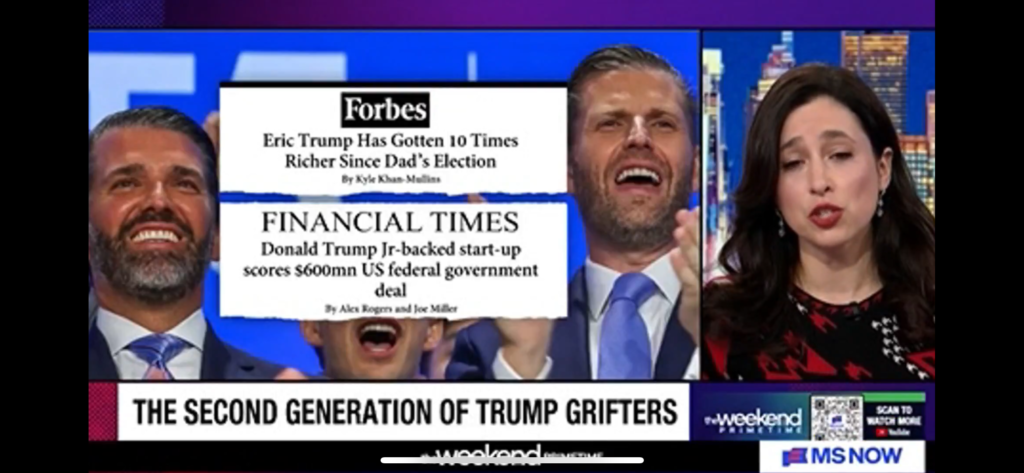
An interesting segment on MSNOW’s Weekend Primetime show delved into the staggering corruption emerging in Trump administration 2.0 — even coining the phrase “Grifting Nepo-Babies” to capture the growing concern about the financial windfalls reportedly enjoyed by the children of several senior Trump–era officials. Co-host Catherine Rampell laid out what she called a pattern of politically connected offspring cashing in during the second Trump presidency. According to the segment, Secretary of Commerce Howard Lutnick’s sons were among those observers have flagged as benefiting enormously from their father’s presence in government — and in their case, the benefits come via the Wall Street powerhouse their father built, Cantor Fitzgerald.
#BREAKING: 🔥Rampell: "A whole new generation of flim-flam artists has been born, including not just Trump's own children, but the children of the entire Trump administration. Call them second generation grifters or the grifting nepo-babies. There's the adult sons of Commerce… pic.twitter.com/2LKVYJtyEP
Specifically: when Lutnick stepped into the Cabinet, ownership and control of Cantor Fitzgerald were formally transferred to his two oldest sons, Brandon Lutnick (now Chairman & CEO) and Kyle Lutnick (Executive Vice-Chairman). Under their leadership, the firm is on track for a 2025 revenue haul that reportedly represents its most profitable year ever — a jump of more than a quarter over last year. Much of that windfall stems from Cantor’s aggressive crypto-investment banking, SPAC dealmaking, stablecoin custody and other high-risk, high-reward operations that the firm has doubled down on since the crypto boom took off. Critics argue that this close alignment between a senior Cabinet official and a high-performing Wall Street firm controlled by his children constitutes a textbook example of revolving-door conflicts of interest — especially given the firm’s deep involvement in sectors (like crypto) where regulatory and trade policy decisions may directly affect their bottom line. The optics are stark: a firm once headed by the Commerce Secretary is now raking in record profits under the leadership of his sons, just as policies that shape global trade and regulation are being decided by that same Secretary.
The segment also highlighted another striking example beyond the Lutnicks: Alex Witkoff, the son of Steve Witkoff — himself appointed by Trump as a Middle East envoy. According to multiple recent reports, Alex has aggressively pursued large-scale investments from sovereign‐wealth funds and Gulf-state investors. In 2024 he pitched a $4 billion U.S. real-estate credit fund to the Qatar Investment Authority, promising returns and sizeable management fees; while Qatar reportedly declined, sources say Alex continued courting investors from Qatar, the United Arab Emirates, and Kuwait through at least August 2025. As his father negotiated cease-fire and hostage-release deals across the Middle East under the auspices of the Trump administration, Alex was quietly soliciting money — a convergence of diplomacy and real-estate finance that ethics experts argue raises serious conflict-of-interest concerns. Indeed, GULF-state investment vehicles have already backed several properties owned or developed by the family firm (known as the Witkoff Group), including major assets in New York and Florida. While a spokesperson for the firm has since claimed the specific real-estate fund proposal was “preliminary” and will not move forward, critics maintain that even the attempt — coming alongside high-stakes diplomatic negotiations — exemplifies the growing problem of political power being leveraged for private enrichment.
Rampell then pivoted to Trump’s own children, where the accusations grow louder and the optics far more politically potent. She cited a Forbes report claiming Eric Trump’s wealth has increased dramatically since his father returned to office — with critics arguing that this level of enrichment while a parent is in the White House reflects the same ethical vulnerabilities that plagued Trump’s first term. She also referenced reporting about a startup associated with Donald Trump Jr. that has reportedly secured a major Pentagon-related deal — figures like the oft-circulated “$600 million” have fueled alarm among ethics experts and bipartisan government watchdogs who argue that such arrangements warrant far more transparency. And even Trump’s youngest son, Barron Trump — normally kept out of the political spotlight — was mentioned in the segment due to media chatter about alleged lucrative cryptocurrency-related ventures linked indirectly to his name, though these claims remain murky and largely unverified, further contributing to the perception of a sprawling and loosely monitored financial ecosystem orbiting around the Trump family.
Rampell also revisited the long-running controversies around Trump’s son-in-law Jared Kushner, whose massive financial gains following Trump’s first term — including high-profile investments from foreign sovereign funds — continue to be held up by critics as one of the most glaring examples of blurred ethical boundaries. His ongoing business expansions during Trump’s second presidency only reinforce concerns among ethics observers who argue that the revolving door between political power and personal enrichment is now swinging more freely than ever.
The larger point the MSNOW hosts made was that corruption — whether alleged, implied or documented — has quickly become a defining theme of Trump 2.0. Democrats are already gearing up to make it a core message for the 2026 midterms, framing the administration as a government increasingly captured by the financial ambitions of the president’s inner circle and their families. But what may pose a more immediate threat to Trump is that even portions of his MAGA base are beginning to grumble. Online circles that once defended every decision of the Trump family have begun to express frustration at what they see as blatant self-dealing — especially as the administration continues to sideline issues that energized Trump’s grassroots supporters in the first place: lower prices, avoiding new foreign conflicts, demands for release of the Epstein files, and promises of “draining the swamp.” For some longtime loyalists, the contrast between those unmet commitments and the constant headlines about politically connected children becoming wealthier has begun to feel impossible to ignore.
How this discontent evolves could have real consequences in the 2026 midterms. If the corruption narrative continues to grow, and if MAGA voters feel increasingly alienated or taken for granted, Republicans could find themselves facing a demoralized base at the very moment Democrats are preparing to campaign on a simple, sharp message: that Trump 2.0 has become a family business masquerading as a government. The question heading into 2026 is not just whether Democrats can capitalize on this narrative, but whether the erosion of enthusiasm among core Trump supporters will quietly do the job for them.
Ever since President Trump beat his Democratic challenger Kamala Harris in the 2024 U.S. presidential election, Democrats have been in disarray, struggling to find a compelling narrative with which to challenge the new Trump administration.
Corruption is slowly becoming the galvanizing issue that is uniting Democrats in their opposition to the Trump administration. My posts on X(formerly Twitter) referencing these corruption stories generate a lot of engagement(retweets, likes, comments) which supports my assertion that corruption is clearly a hot topic for Democrats as we approach the 2026 midterms. Below are examples of such posts.
#BREAKING: 🔥Erin: "Now to our other big story tonight, the Trump family CASHING IN big time. President Trump's son @EricTrump is now arriving in Vietnam. In just hours, he'll be breaking ground on a $1.5 billion golf resort there…and while #EricTrump is in Vietnam receiving a… pic.twitter.com/RHOxxzomE7
#BREAKING: Legendary #Maddow: "The eldest son of POTUS, @DonaldJTrumpJr, has made multiple trips to Serbia to try to shore up their very Trumpy president against [protests] that he resign…WHY…?? In the middle of the capital city of Serbia, there is a ruined building [never… pic.twitter.com/eNqhYcbdID
#BREAKING: Erudite Anne to Morning Mika: "He [Trump] has been involved in an industry, the real estate industry, that relied on secret Russian money coming through anonymous bank accounts buying anonymous properties in his businesses for many years. He's been dealing in that… pic.twitter.com/Hh8VAaXitW
An interesting segment on MSNBC’s Alex Wagner Tonight (01/1624) show delved into the strange daliance between Evangelical Christians(predominantly White), and the politics of former President Donald Trump, often referred to as Trumpism, or MAGA Trumpism. The alliance between these two strange bedfellows has led many to question whether MAGA Trumpism has become some sort of political/civil religion.
The MSNBC segment came against the backdrop of Trump’s massive win in the Iowa Republican presidential primary, and specifically, his command of the White Evangelical vote, which polls placed at 53%. Back in 2016, when Trump first ran for president, he only received 21% of the White Evangelical vote in Iowa, a clear sign that he has now consolidated the White Evangelical vote in Iowa, and arguably nationwide.
#BREAKING:🔥Alex: "In the eight years between those two #IowaCaucuses, Donald Trump has not only more than doubled his support from #Evangelicals, he has also REDEFINED what it means to be one."
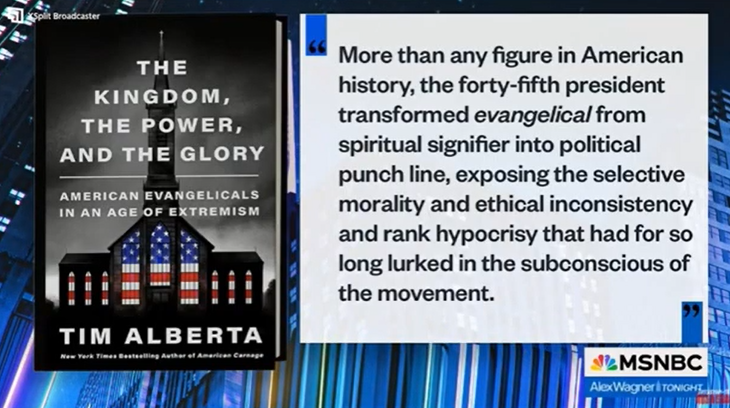
Host Alex Wagner posed this question to her guest, Author Tim Alberta, who’s also a staff writer at The Atlantic (2:07): “I wonder in your estimation, what it means to be an Evangelical in this country, at this moment?” Tim Alberta responded in relevant part: “We are beginning to flirt with this territory where definitionally speaking, Evangelicalism has far more to do, at least in the perception of the greater public, with political engagement, partisan political identification, than it does with any particular theology or any real religious conviction, and if you take it a step further, if you look at the exit polling, if you look at some of the social science around this, if you look at the fact that during Donald Trump’s presidency, more and more of Donald Trump’s supporters were self-identifying as Evangelicals even though they were simultaneously attending Church less and less often, I think one might reach the uncomfortable conclusion that perhaps the best definition now for what it means to be an Evangelical, is to be a conservative White Republican Trump supporter, and that is a tragedy on any number of different levels, but I think most profoundly, it’s a tragedy for the Gospel of Jesus Christ.”
Host Alex Wagner then interjected with this profound question (3:50): “If the Gospel is no longer part of the equation, what is it replaced by…do you think MAGA-ism has become a placeholder for a certain kind of religion?”
Tim Alberta: “Yes…I don’t want to paint with too broad a brush, the Evangelical community is large, it’s huge, and it’s complicated…but…we are reaching a place where we are being confronted with some uncomfortable realities about what it means to be a part of the Evangelical movement and frankly, where the line blurs between sort of religious identity and political identity, and is there a merging of the two, and frankly I think that there’s always a danger in politics…of sort of turning political conviction into religious conviction, or worshipping at a certain altar that is not an altar to God, but is an altar to political idolatry or to political identity. That is a danger that has always been there, but it is I think uniquely dangerous in this moment, and to be clear…we have examples from the not so distant past, of a sort of political religion, or at least a civil religion, supplanting, competing with actual religion, and I don’t think that we’re all that far removed from that in this country now, looking at just what happened…in Iowa.”
To conclude the segment, Tim Alberta floated this interesting scenario, which gets right to the fallacy of the Evangelical-MAGA Trumpism alliance. He said (8:19): “If during Barack Obama’s presidency, or while he was running for president, if you had heard him talking with, or promoting a video saying that he was a shepherd to all of mankind, the Evangelical movement would have been up in arms [and rightly so], I mean this is heretical, this is blasphemous and yet, Donald Trump seems to get a pass time and time again for doing these things that no other politician, Republican or Democrat frankly, would get a pass for doing, and we should ask ourselves why. If the answer does not at least start to flirt with this terrain of civil religion, or political religion, then I think that we’re not being honest with ourselves, and if we are being honest with ourselves, if we are willing to engage with the very uncomfortable topic around what happens when Trumpism becomes civil religion in this country for millions of millions of people, and what that might imply moving forward, then we are doing a disservice to our prularistic democracy.”
Bottom line folks, we’ve always operated on the separation of church and state doctrine, and have for decades, shunned foreign theocracies like the ones in Afghanistan and Iran. Author Tim Alberta is absolutely correct when he says, we need to be honest with ourselves, and admit that there is no difference between the Evangelical-MAGA dalliance in the American political scene, and the theocracies in Iran and Afghanistan. Simply put, we need to make a decision as to whether we want to continue with the separation of church and state doctrine, or whether, that time-honored tradition has also been sacrificed at the altar of MAGA Trumpism.
For those of you very happy with @Emolclause’s activism don’t shy away from the “tip jar” below on your way out. You may also Cash App
Email author at admin@grassrootsdempolitics.com
Become an Octapharma Plasma donor. Make up to $200 in one week and help save lives too! Learn More