A revealing segment on MSNOW’s Alex Witt show unpacked the Supreme Court’s emphatic 6–3 decision striking down Donald Trump’s tariff regime. While many court watchers expected the legal challenge to succeed, the real suspense centered on whether this particular Court—dominated by six conservatives, three of them Trump appointees—would side with the law or bend toward the former president. Critics have long accused the current majority of showing deference to Trump in key disputes, an accusation the justices themselves have publicly bristled at.
#BREAKING: Leah Litman: “…the fact that they [SCOTUS] ruled against him on this issue [tariffs] and may also rule against him in his efforts to try to fire a governor of the federal reserve ISN’T an indication that this court understands the systemic and brazen nature of the… pic.twitter.com/Dw86SZmaaU
The 6–3 ruling against Trump’s tariffs was decisive. On its face, it appeared to be a clear rebuke of executive overreach and a sign that even this Court has limits. Naturally, the conversation turned to whether the decision signals a broader willingness by the so-called Roberts Court to check Trump’s more aggressive assertions of presidential power going forward.
Guest Leah Litman offered a far more skeptical take. She cautioned viewers against interpreting the ruling as any meaningful shift in posture. In her view, nothing fundamental has changed. Litman argued that the Court’s conservative majority is willing to rule against Trump only when his brand of authoritarianism collides with interests that matter directly to them—particularly economic interests. Put bluntly, she suggested the justices are far less inclined to tolerate executive overreach when it threatens financial stability or, more cynically, their own bottom lines.
Litman went further, predicting a similar outcome in the forthcoming case over Trump’s asserted authority to fire Federal Reserve Bank governors at will. If the Court sees an unchecked power grab as destabilizing to markets or the broader financial system, she implied, that is when it is most likely to step in. The legal merits may matter, but under her theory, the practical economic consequences carry equal—if not greater—weight.
Whether Litman’s provocative framework proves accurate remains to be seen. As the Court prepares to weigh additional cases testing the limits of presidential authority, observers will be watching closely for patterns. If future rulings align with her prediction, the tariff decision may come to be seen not as a principled stand against authoritarianism, but as a narrow defense of institutional and economic self-interest.
An unusually pointed moment on MSNBC’s Last Word with Lawrence O’Donnell saw O’Donnell step into territory most of cable news has long treated as a no-go zone: the personal and political contradiction embodied by an openly gay Cabinet secretary who serves as a vocal defender of an administration and movement that has spent years portraying marriages like his as immoral, illegitimate, or worse. O’Donnell’s target was Treasury Secretary Scott Bessent, a Senate-confirmed Cabinet official and one of the most prominent openly gay figures to rise within MAGA-aligned economic circles. The charge was blunt and uncomfortable: Bessent is an apologist for a political project that, if fully empowered, would gladly undermine the very legal foundations that make his family possible.
#BREAKING: Lawrence: “…the real hardcore Christian Nationalists in that room could be why Donald Trump didn’t bring his treasury secretary to the National Prayer Breakfast, because Donald Trump’s treasury secretary lives a life that some of the strongest Trump supporters at the… pic.twitter.com/1OkAMfAvxy
What made the segment so jarring wasn’t simply the criticism, but the fact that Bessent’s marriage and family life have largely been treated as invisible by the mainstream press. Bessent is married to his husband, and together they are raising children—an arrangement that would have been legally impossible not very long ago. Yet media profiles have gone out of their way to sanitize or sidestep this reality, even as Bessent aligns himself with a movement that openly champions “traditional marriage,” entertains rolling back marriage equality, and elevates figures who describe same-sex unions as an abomination. O’Donnell shattered that silence, arguing that this contradiction isn’t incidental or private, but central to understanding Bessent’s role and moral posture within the administration.
O’Donnell went further, explicitly crediting Democratic presidents Bill Clinton and Barack Obama with laying the groundwork that ultimately made Bessent’s marriage and family legally possible. The history is complicated but undeniable. Clinton signed the Defense of Marriage Act in 1996, a political concession to the era that barred federal recognition of same-sex marriage. But it was the Democratic legal and judicial ecosystem that later dismantled DOMA’s core. The Obama administration declined to defend the law in court, supported the plaintiffs in United States v. Windsor, and appointed Supreme Court justices who formed the backbone of the majority in Obergefell v. Hodges, which finally recognized marriage equality nationwide. Whatever one thinks of Bessent’s economic views, Republican administrations did not create the legal scaffolding for his marriage. Democrats did.
That context is what gives O’Donnell’s critique its sting. This wasn’t a cheap shot about sexuality. It was an indictment of political ingratitude and moral compartmentalization: enjoying the protections secured by one political tradition while actively defending another that relies on demonizing people like you to energize its base. O’Donnell framed Bessent not as a passive beneficiary or a token figure, but as a powerful participant in sustaining a coalition that has shown little hesitation in sacrificing LGBTQ rights when it suits broader ideological goals.
Still, the segment raises an unavoidable question: did O’Donnell cross a line? Some viewers recoiled, arguing that invoking Bessent’s sexuality so directly veered into something uncomfortably close to gay-bashing. That concern deserves to be taken seriously. Historically, the media has weaponized sexuality in ways that reinforce stigma rather than challenge power. But intent and framing matter. O’Donnell was not mocking Bessent’s marriage or questioning its legitimacy. He was highlighting that others in Bessent’s political camp do exactly that—and that Bessent chooses to excuse, rationalize, or ignore it. The critique was not “you are gay,” but “you know precisely what is at stake, and you are still carrying water for people who believe your family should not exist under the law.”
Whether Bessent responds remains to be seen. He may argue that economic policy outweighs cultural hostility, or that working within the movement offers a path to moderation from the inside. But O’Donnell’s segment forced an overdue reckoning. Visibility cuts both ways. You don’t get to quietly enjoy the fruits of marriage equality while energetically defending a political project that has made clear—through rhetoric, policy, and judicial ambition—that it would gladly uproot the tree that bore them.
Please consider $upporting GDPolitics by scanning the QR code below or clicking on this link
An interesting discussion unfolded on MSNOW’s All In with Chris Hayes in a segment that was initially intended to examine whether the courts have held up against the threat of authoritarianism posed by Trump 2.0. What emerged instead was a sobering assessment of the judiciary’s uneven performance—and a striking indictment of the Supreme Court’s role in enabling, rather than constraining, presidential power.
#BREAKING: Smart Melissa to Hayes: “I’m just gonna say this. John Roberts as a Chief Justice, is getting dangerously close to Roger Taney. Roger Taney was the Chief Justice in 1857 when Dred Scott was issued by this court [SCOTUS]. John Roberts himself, despite his… pic.twitter.com/nvLu19PUFt
There was broad agreement among the panelists that the lower federal courts have largely done their job. District courts and federal appellate courts have repeatedly pushed back against Trump-era policies that stretch or outright exceed constitutional authority, issuing rulings that reflect a continued commitment to legal norms and institutional guardrails. In that sense, the judiciary below the Supreme Court was seen as functioning as a genuine check on executive overreach. That consensus, however, collapsed the moment the conversation turned to the nation’s highest court.
On the Supreme Court, the panel was unified in its criticism. Rather than reinforcing the limits imposed by the Constitution, the Court was described as an active enabler of the Trump administration, routinely undermining or reversing lower-court efforts to restrain him. The justices, in this telling, have not merely failed to defend democracy but have helped hollow it out, often by cloaking deeply political outcomes in the language of neutral legal principle.
The segment took a dramatic turn when NYU Law Professor Melissa Murray made a blunt and explosive claim: that Chief Justice John Roberts has now surpassed Roger Taney as the most damaging chief justice in American history. Taney, long regarded as the Court’s nadir, presided over the infamous Dred Scott decision of 1857, which declared that Black Americans could not be citizens and helped propel the nation toward civil war. To suggest that Roberts belongs in the same conversation—let alone that he is worse—was a jarring assertion, and Murray did not soften it.
Professor Murray argued that Roberts has authored at least four opinions that she described as “the absolute most corrosive for democracy.” She pointed first to Rucho v. Common Cause, a decision that effectively blessed extreme partisan gerrymandering by declaring it a nonjusticiable political question. In doing so, the Court closed the federal courthouse doors to challenges against a practice that allows politicians to choose their voters, entrenching minority rule in state after state. She then cited Shelby County v. Holder, the 2013 ruling that gutted the Voting Rights Act by striking down its preclearance formula, a move that unleashed a wave of voter suppression laws across the country almost immediately. Murray also pointed to Trump v. United States, the presidential immunity case, which dramatically expanded the scope of executive immunity and signaled that a president may be functionally above the law when acting under the guise of official duties.
Although she did not explicitly name a fourth decision, the implication was hard to miss. Citizens United looms over any discussion of democratic corrosion, having opened the floodgates to unlimited, often opaque political spending and accelerating the transformation of American democracy into something approaching oligarchy. Taken together, these rulings form a throughline in which democratic participation is narrowed, accountability is weakened, and power is consolidated in the hands of the few—all under the stewardship of a chief justice who has repeatedly claimed to care deeply about the Court’s legitimacy.
Whether the argument that “Roberts is worse than Taney” gains wider traction remains to be seen, but it is crucial to note that Professor Murray is far from alone in making it. Legal scholars and commentators have increasingly drawn parallels between Taney’s Court, which entrenched slavery and inequality, and a modern Court that has systematically undermined voting rights, empowered unchecked executive authority, and normalized vast concentrations of political power. What made the moment on All In so striking was not just the severity of the claim, but the growing sense that it no longer sounds fringe. Instead, it reflects a mounting recognition that the greatest threats to American democracy may now be coming not from lawless actors outside the system, but from those entrusted to interpret and preserve it.
Please consider $upporting GDPolitics by scanning the QR code below or clicking on this link
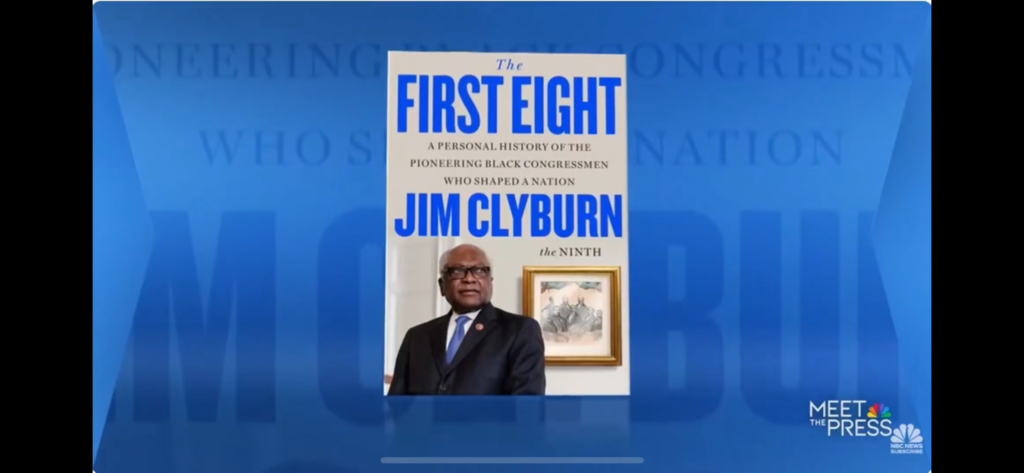
An important new book by Rep. James Clyburn (D-SC), The First Eight, warns that disturbing signs suggest we may be sliding back toward a modern form of Jim Crow. In it, Clyburn examines the lives and careers of the first eight Black men to serve in Congress from South Carolina — all elected in the period after the Civil War during Reconstruction. He recalls that after the last of those eight left Congress in 1897, there was no Black representation from South Carolina for 95 years, until Clyburn himself was elected in 1992.
#BREAKING: Rep Clyburn: “We are seeing today, and this is so much what ‘The First Eight’ [his new book] is all about, a REPEAT of a history that led to some catastrophic consequences in our previous history. My book is all about what happened after the civil war, what happened… pic.twitter.com/LZmbiEVoi0
Clyburn uses their stories not just to spotlight that lost legacy, but to warn that many of the same forces that disenfranchised Black voters at the turn of the 20th century are resurfacing today. He draws parallels between the backlash that ended Reconstruction — Jim Crow laws, restrictive state constitutions, poll taxes, literacy tests, and violence — and current efforts to redraw voting districts and suppress minority voting power. A key part of his argument is the role the Supreme Court played then and now. He notes that foundational decisions like the Slaughterhouse Cases narrowed the scope of the 14th Amendment almost immediately after its ratification, stripping federal protections from formerly enslaved people and allowing Southern states to impose discriminatory laws. That judicial retreat set the stage for later rulings such as Plessy v. Ferguson, which constitutionally sanctioned segregation and cemented the legal framework that enabled Black disenfranchisement for generations.
In particular, Clyburn argues that modern partisan and racial gerrymandering — especially in his home state of South Carolina — resembles the “old Jim Crow power play” that erased a century of Black political representation. He points to recent attempts by the State Legislature to redraw congressional districts in a way that moved tens of thousands of Black voters out of his district, a practice a federal court found to be an unconstitutional racial gerrymander. When the map was challenged, however, it was the current Supreme Court that stepped in and reversed the lower court, making it significantly harder for voting-rights advocates to block discriminatory district maps. To Clyburn, this echoes the pattern of the past: when state governments use race to manipulate electoral maps, and the Court either narrows protections or declines to intervene, the result is the same erosion of political power that once produced the 95-year gap between the eighth Black congressman from South Carolina and himself.
Clyburn does not merely retell history — he warns that history is repeating. He argues the country is in the early stages of what he calls a “Third Reconstruction,” threatened by political forces determined to dilute or suppress the votes of people of color. In his view, the stakes are nothing less than the integrity of democracy itself: the story of those first eight Black congressmen is a reminder that gains in political power and representation can be undone — and undone intentionally. The book emerges not just as history, but as a timely call-to-action to defend voting rights, safeguard fair representation, and resist any revival of Jim Crow-era disenfranchisement.
Clyburn closes with a telling reminder that the first eight Black congressmen from South Carolina were routinely assigned racist and belittling nicknames by their opponents — a tactic meant to diminish their legitimacy, sow disrespect, and discourage those they represented. He notes that the weaponization of mockery and demeaning labels is not a relic of the past; it echoes loudly in today’s political climate, where leaders of color are again targeted with derisive nicknames designed to undercut their standing and weaken the communities they serve. For Clyburn, these parallels — from state laws to Supreme Court decisions to symbolic attacks — underscore his broader warning: the architecture of disenfranchisement is being rebuilt piece by piece, and the patterns of the past are reappearing in unmistakably familiar ways.
Please consider $upporting GDPolitics by scanning the QR code below or clicking on this link
In the October 19, 2025, edition of MSNBC’s Velshi, legal commentator Elie Mystal delivered a striking critique, telling host Ali Velshi that U.S. Supreme Court Chief Justice John Roberts has, in many respects, become the most formidable obstacle to the enforcement of the landmark 1965 Voting Rights Act (VRA)—and, by extension, a significant impediment to protecting the voting rights of communities of color.
#BREAKING: Velshi: "One of the crown jewels of the civil rights movement is the Voting Rights Act (VRA). It was signed into law by President LBJ while surrounded by civil rights leaders like MLK…in 1965…It was a key part of ending the Jim Crow era policies of the day, which… pic.twitter.com/7PkcTCwWKK
Mystal’s remarks were prompted by the high-profile redistricting case currently before the Supreme Court, Louisiana v. Calais. Experts warn that the Court’s ruling could fundamentally undermine the VRA, effectively allowing racially motivated redistricting and diluting the electoral power of Black and minority voters. The stakes are enormous: analysts suggest that, if the Court rules in favor of Louisiana’s approach, Republicans could gain as many as 19 additional House seats in the 2026 elections alone.
The case raises critical questions under the VRA’s Section 2, which prohibits voting practices that result in racial discrimination, and Section 5, which historically required jurisdictions with a documented history of voter suppression to obtain federal approval before changing voting laws. Louisiana v. Calais centers on whether the state’s proposed redistricting plan unfairly diminishes the influence of Black voters in certain congressional districts. Proponents of the challenge argue that the plan reflects legitimate political considerations, while opponents contend it is a transparent attempt to circumvent the VRA and dilute minority voting power.
This moment is reminiscent of a discussion I initiated back in 2018, when I criticized what I then termed the “unjust Roberts Supreme Court” for systematically chipping away at the VRA’s protections. At the time, such a stance was considered controversial. Today, with mainstream voices like Mystal echoing similar concerns, it appears those warnings have entered the broader public discourse.
As the Supreme Court deliberates Louisiana v. Calais, the implications extend far beyond a single state. The decision could redefine the legal contours of voting rights protections nationwide, setting a precedent that either reinforces or weakens decades of civil rights progress. Observers on both sides of the political spectrum will be watching closely, as the Court’s ruling could reshape congressional representation and influence the trajectory of American democracy for years to come.
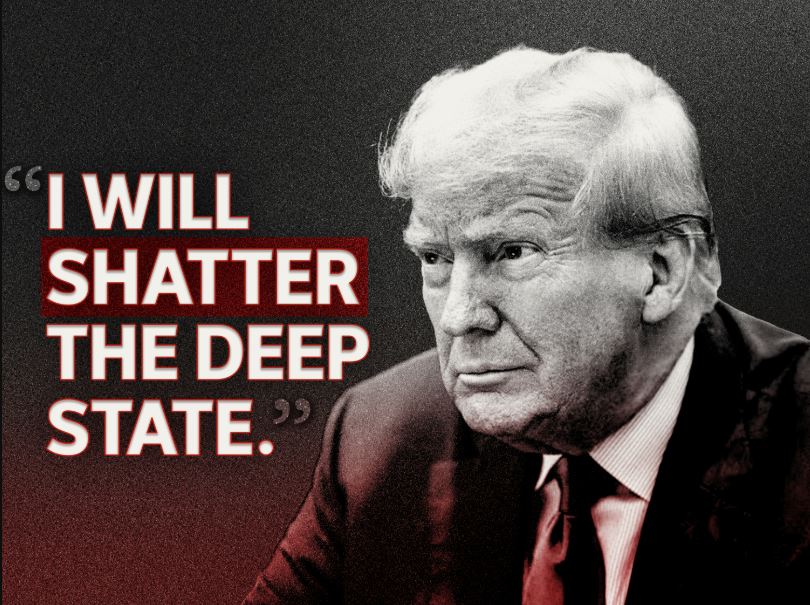
In one of his post election posts on X, President-Elect Donald Trump promised to “dismantle the Deep State.” This as you know, was a central theme of his presidential campaign so it should come as no surprise to anyone. The question now is whether he will actually deliver on this seemingly tall order that may play well on the campaign trail, but prove very difficult in terms of actually pulling it off.
Different people have different notions as to what the Deep State actually means, or whether it even exists, but the general consensus is that they are powerful but unelected bureaucrats, who control the levers of power behind the scenes, and span different administrations (both Democrat and Republican)–essentially a permanent unelected ruling class, who ruthlessly protect their power from “outsiders”–ambitious people they don’t approve of/like. They use the instruments of government(the ABC agencies we shall not name) to crush their perceived enemies.
Trump has cast himself as one of those outsiders, and he points to his endless criminal prosecutions as proof of the Deep State coming after him. He has repeatedly singled out the FBI as one of the key instruments of the Deep State that he wants hollowed out.
Whether or not the FBI has become an instrument of the Deep State as Trump alleges, is a question Yours Truly chooses to sidestep for now–way above my pay grade. What Yours Truly finds very encouraging about Trump’s proclamation however, is that during his 4 years, maybe, just maybe, we may achieve something I have begged and prayed for for quite a long time now, and that is, a Church-type Committee to look into the abuses of our intelligence agencies.
The last time we did an audit of our intelligence agencies was way back in the 1960s so reasonable people will agree that a fresh audit is way past due. A lot of “dirt” was uncovered in the previous audit (cointelpro being the main one) so smart money is that 70 years after that, there are bound to be some let’s just say, “interesting” new programs to be “unearthed”. I for one, would keep my eyes open for the notorious Targeted Individual program, which our intelligence agencies have categorically dismissed as a conspiracy theory. A Church-type committee would be the perfect venue to get to the bottom of this supposed “conspiracy theory”.
Yours Truly has long advocated for the enactment of a new Church-type commission to investigate the abuses of power by our intelligence agencies. Though President-Elect Trump doesn’t outrightly call for the creation of such a commission, reasonable people will agree that his recent post on X is the most serious attempt yet by a modern American president to rein in our out of control intel agencies, and for that, he deserves a lot of praise. Whether he will keep his promise is a different matter altogether.
President-Elect Trump is known to desire things/issues that cast him aside from other American presidents in terms of greatness. Well, 70 years later, historians are still talking about the historic Church Committee hearings, and the administration that was in charge then. If Trump pushes for a new Church-type committee during his four years, historians will also be talking favorably about his administration 100 years from now, especially if a lot of illegal government activity is uncovered.
President-Elect Trump should also know that a much overdue audit of our intelligence agencies is an issue that enjoys tremendous bipartisan support despite the media’s depiction of it as a partisan MAGA issue.
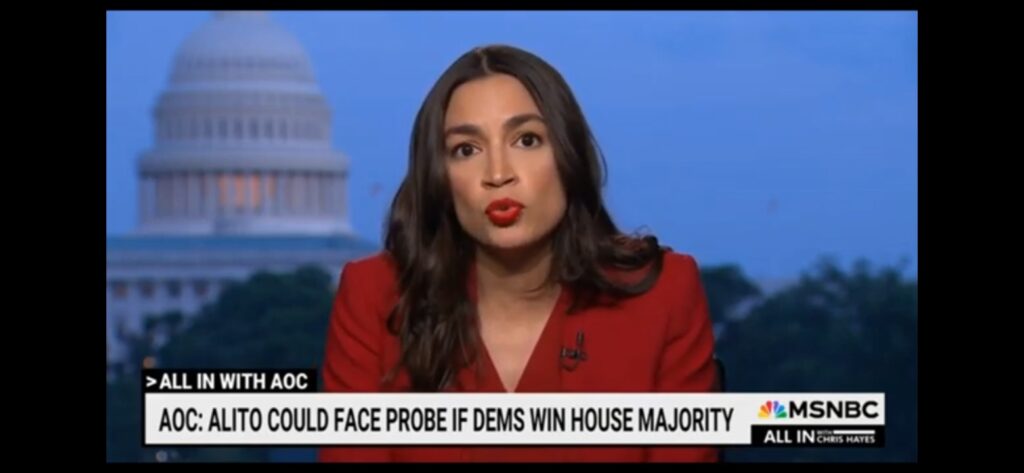
Rep Alexandria Ocasio-Cortez (D-NY) appeared on the 05/22/24 edition of MSNBC’s All In w/Chris Hayes show, where she dropped a bombshell by calling for a U.S. Senate probe into the affairs of Supreme Court Justice Samuel Alito. Rep AOC’s call for an investigation is of course related to recent news reports that say a flag known to be sympathetic to the January 6th insurrection, was spotted flying at Justice Alito’s residence.
Asked by host Chris Hayes what she thought about the Alito news reports, Rep AOC replied(2:22): “I don’t even think that we have to wait until we have a Democratic House majority, because we have a Democratic Senate majority. This is an alarm that I have been sounding for quite some time now. I think that what we’re seeing here, is an extraordinary breach of not just the trust and the stature of the Supreme Court, but we’re seeing a fundamental challenge to our democracy. [Justice] Samuel Alito has identified himself with the same people who raided the Capitol on January 6th, and is now going to be presiding over court cases that have deep implications over the participants of that rally.”
Rep AOC went on to add that Democrats cannot just keep on sitting on power after getting elected. They actually have to use the power that voters bestow upon them, to start addressing this runaway Supreme Court, and other burning voter concerns.
Rep AOC specifically told host Chris Hayes(3:13): “Democrats have a responsibility for defending our democracy, and in the Senate, we have gavels. There should be subpoenas going out, there should be active investigations that are happening, and I believe that when House Democrats take the majority, we are preparing and ensuring to support the broader effort to stand up our democracy…When Democrats have power, we have to use it. We cannot be in perpetual campaign mode. We need to be in governance mode, we need to be in accountability mode, with every lever that we have…”
As you know, Yours Truly has for a long time lamented weakness by congressional Dems. It was therefore quite refreshing to see Rep AOC calling it out too.
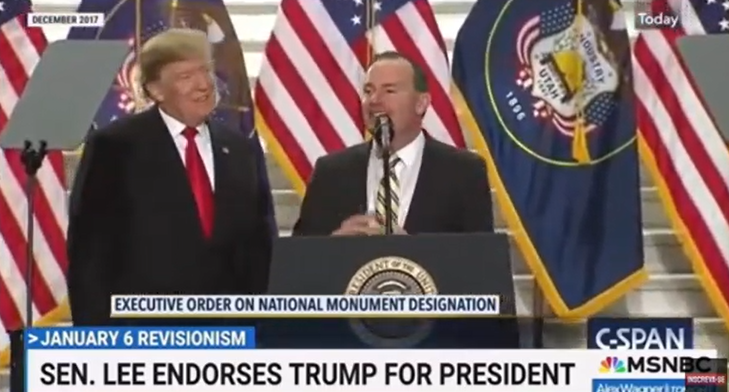
Interesting segment on MSNBC’s Alex Wagner Tonight show (01/19/24) delved into the conspiracy theories currently being spewed out there by right wing activists about the yet unsolved mystery surrounding the January 6th pipe bomb. Apparently, even sitting U.S. Senator Mike Lee (R-UT) is now pertaking in this conspiracy theory, per his recent social media post which Wagner cited.
Host Alex Wagner then dropped a bombshell on “constitutional conservative” Senator Lee’s strange fawning over former President Trump, including his latest endorsement of the former president for the upcoming 2024 election, saying it may all be about Senator Lee’s ambitions for the United States Supreme Court. Yeah, you read that right. Senator Lee may be angling for a Supreme Court seat.
You’ll remember that Senator Lee was also intricately involved in efforts by then outgoing President Trump to overturn the results of the 2020 election using the fake elector scheme.
Host Alex Wagner(2:49): “Senator Lee joins 25 of his Republican colleagues in the Senate, who have endorsed Donald Trump as of this evening, but his special distinction is that he was twice on Trump’s short list to be a Supreme Court justice. In 2018 Senator Lee interviewed for the seat that eventually went to Justice Brett Kavanaugh, and with Justice Clarence Thomas approaching 80, and Justice Samuel Alito hitting 74 this year, who knows, if Donald Trump is re-elected in November, the man who believes January 6th was an inside job could just get another crack at a seat on the highest court in the land.”
Bottom line folks, as much as I have been critical of “constitutional conservative” Senator Lee over his strange support of Trump despite his authoritarian tendencies, I readily admit that this Supreme Court ambition theory makes me ease up on him a little bit. I’m not saying I condone his strange support for authoritarian Trump, but that at least, it makes me understand why he’s doing it.
For those of you very happy with @Emolclause’s activism don’t shy away from the “tip jar” below on your way out. You may also Cash App
Email author at admin@grassrootsdempolitics.com
Become an Octapharma Plasma donor. Make up to $200 in one week and help save lives too! Learn More
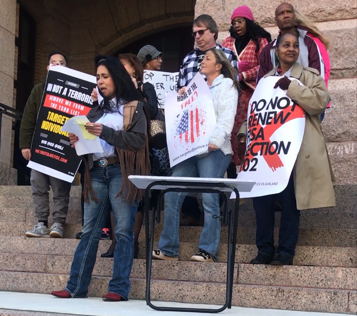
Attorney Ana Toledo Addresses A Targeted Individuals Rally From The Steps Of The Historic Houston Courthouse On 301 Fannin Street (01/12/2024)
On Friday 01/12/24, in commemoration of the one year anniversary of the filing of TJ v Garland lawsuit, Attorney Ana Toledo led a targeted individuals rally at the steps of the historic Houston courthouse on 301 Fannin Street. The lawsuit seeks to have 18 plaintiffs, who Ana alleges have been placed there by the FBI under an unconstitutional “secret criteria”, removed from the terrorism watchlist.
Ana Toledo(0:02): “The FBI has abused the watchlist, what’s known as the terrorism watchlist for a long time…and 400,000 targeted individuals in the United States, and indeed around the world, have been put on this list. Today marks one year anniversary since we filed TJ v Garland, an extraordinary lawsuit that seeks to remove the names of innocent listed individuals from the terrorist screening database (TSDB) in two secret categories that are not known to the public, and not even to the people that are in them, because the FBI has admitted, they don’t represent a terrorist threatand they are not screened as such. Therefore these innocent Americans, and innocent civilians around the world, don’t encounter problems when traveling...[the list] of all those innocent people that are labeled as suspected terrorists…is distributed through the national crime information center (NCIC), to 18,000 law enforcement agencies, which translates to over 100,000 agents, to over 532 private corporations such as Air BnB, Western Union and many others that retaliate against people that don’t even know are on the list, and 1440 organizations such as universities that could very well deny entrance to somebody to a university of higher education just because unbeknownst to them, they are on this nefarious watchlist.”
Speaking specifically about the TJ v Garland lawsuit, Ana said(2:21): “We urge you to look at the appeal pending before the 5th Circuit[Court of Appeal], TJ v Garland case. It’s case #23-23402. It’s fully briefed and we’re ready for oral argumentation…The single remedy we seek, is the removal of the 18 plaintiffs from the TSDB categories 3 & 4, that are secret categories that the FBI has admitted, they put people on that list under secret criteria. That is not the America we were born into. That is not what the constitution provides. Please be aware, the watchlist in not the entire list. Pursuant to DOJ, the watchlist–the known and suspected terrorist list–comprises 0.5% of the entire list, so if that list is at two million, we don’t want to know how many innocent civilians have been placed secretly under codes 3 & 4, which represents 97% of the terrorist screening database pursuant to DOJ, not pursuant to Targeted Justice.”
Apparently, per Ana, an investigation by the DOJ Inspector-General recently found that the FBI doesn’t even follow its own regulations regarding watchlisting. Ana specifically said: “One of the most nefarious conclusions of an audit report by DOJ Inspector-General, report 08-16, is that the FBI field offices nominate and place people on the terrorist screening database without complying with agency regulations, now let that sink in. Innocent Americans that have never been arrested, tried, or convicted of any terrorist offense, and that by FBI’s own admission, do not meet the reasonable suspicion criteria, are secretly placed on this list. The labeling of innocent Americans, and people around the world, as suspected terrorists, deprives them of basic rights, constitutional and human rights. This has got to stop.”
Ana also took issue with the mainstream media’s strange silence regarding this issue, saying(6:34): “The evidence that the U.S. government is suppressing any dialogue about this, [targeted individuals], any discussion about it, is that despite the distribution of the press release on social media and through email, the press did not come here today. They are not interested in the freedom that second class citizens, targeted individuals, have a right to.”
It’s important to note that Senator Elizabeth Warren (D-MA) has recently expressed similar watchlisting concerns, and is asking President Biden and the DOJ to address these problems.
The terrorist watchlist is rampant with inaccuracies and fuels discriminatory profiling.
I'm fighting to protect due process and civil rights for Americans who are wrongfully watchlisted. https://t.co/CXJ3LZO333
No reasonable person looking at the people standing behind Attorney Ana Toledo at the downtown Houston courthouse steps, would conclude that these were the kind of people the terrorist screening database was originally meant to weed out. Sadly, however, it’s normal people like these–your mother, sister, uncle, cousin, who maybe said the wrong/inflammatory thing on social media or elsewhere, or complained about some corruption in high places–who end up getting ensnared by these watchlists/targeting lists, and are then punished in ways regular Americans will never comprehend, up to and including using military assets. Its a total travesty that needs to be fixed and those responsible held to account. In other words, the grave injustice here is not just the malicious watchlisting, but also, the unconstitutional torture that goes with it–organized stalking, financial sabotage, assaults/experiments using DEWs, remote neuromonitoring…the quintessential weaponization of government, which in many cases, constitute violations of the Geneva Conventions against Torture(CAT)
Bottom line folks, this rally at the steps of the historic Houston courthouse marks a watershed moment for the struggle to free targeted individuals in that it officially takes the fight from the dark corners of social media, where often severely shadowbanned TIs anonymously scream from X(formerly Twitter), Facebook, Reddit, Tik Tok and other social media platforms, to real life activism. Put another way, it is very different, much more effective when real, normal people show up and cogently make their grievances known in public. It becomes very hard for the abusers to use their tried and true defense–“Oh, TIs are just a bunch of loons on social media.”
Hopefully we get to see more of these rallies and importantly, a meaningful response from authorities regarding the serious allegations Attorney Ana Toledo and her Targeted Justice are making. Oh and the mainstream media, both nationally and locally(Houston), it’s about time you started doing your jobs. The public deserves to get answers to these serious questions regarding the abuse of the watchlisting system.
For those of you very happy with @Emolclause’s activism don’t shy away from the “tip jar” below on your way out. You may also Cash App
Email author at admin@grassrootsdempolitics.com
Become an Octapharma Plasma donor. Make up to $200 in one week and help save lives too! Learn More
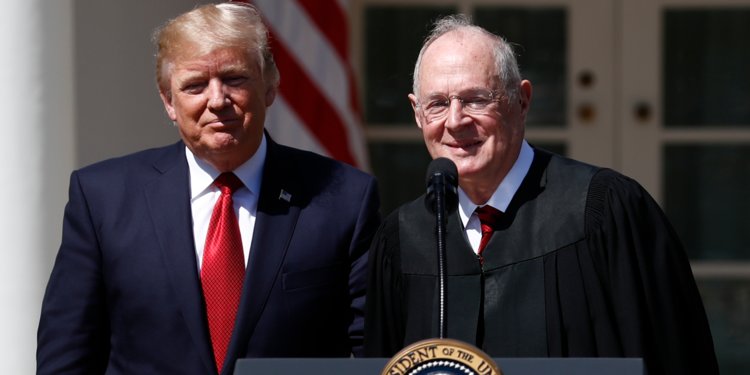
President Trump with Justice Anthony Kennedy(Retired)
In the days following the June 2018 announcement by Justice Anthony Kennedy that he was retiring from the Supreme Court, there was rampant speculation that his resignation was not entirely voluntary but rather that the Trump administration engineered/even forced him out for fear that the GOP may lose their U.S. Senate majority to the Democrats in the November 2018 elections. In essence, the Trump administration did not want Justice Kennedy to retire at a time when Democrats controlled the Senate because that would make it difficult for any Trump SCOTUS nominee to be confirmed.
Speculation that the Trump Admin forced out Justice Kennedy took a whole new turn after the New York Times did a bombshell piece revealing that Justice Kennedy’s son Justin Kennedy had been a longtime financier for Trump. Specifically, that Justin Kennedy was Trump’s financier at the troubled Deutsche Bank which has come under international scrutiny over allegations that it is the bank of choice for Russian money launderers.
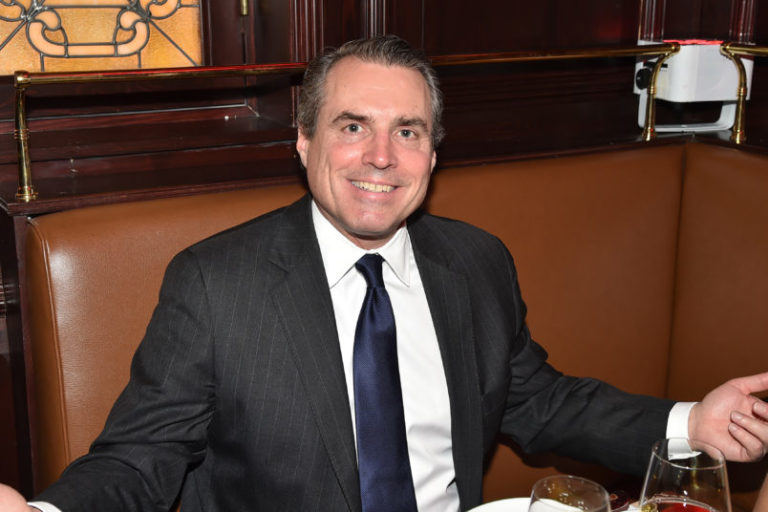
Justin Kennedy, the son of Retired Supreme Court Justice Anthony Kennedy
Justin Kennedy was apparently the global head of real estate capital markets at Deutsche Bank which leaves absolutely no doubt that he would be the point man at Deutsche Bank for Trump’s vast real estate empire. Part of the bombshell The NYT piece read;“During Mr. Kennedy’s tenure, Deutsche Bank became Mr. Trump’s most important lender, dispensing well over $1 billion in loans to him for the renovation and construction of skyscrapers in New York and Chicago at a time other mainstream banks were wary of doing business with him because of his troubled business history.”
With Special Counsel Mueller increasingly zeroing in on Trump’s business ties to Russia and news that German authorities recently raided the troubled Deutsche Bank, the question now being raised is whether with their new found majority in the House, Democrats will subpoena Trump-related Deutsche Bank records and specifically whether they will call Justin Kennedy to testify about his financial dealings with Trump.
Justin Kennedy’s testimony in Congress could also lay to rest the lingering speculation as to whether his dad was forced by the Trump administration to resign from the U.S. Supreme Court before the November 2018 elections. For more on this topic Yours Truly suggests that you check out this must read thread, which also raises questions about Justice Kavanaugh’s involvement in Justice Kennedy’s abrupt decision to retire.
Justin Kennedy’s testimony in Congress could also lay to rest the lingering speculation as to whether his dad was forced by the Trump administration to resign from the U.S. Supreme Court before the November 2018 elections.
Bottom line given the serious questions being raised about Deutsche Bank’s ties to President Trump and its troubling history as a conduit for Russian money laundering, it would be Congressional malpractice if House Democrats did not call Justin Kennedy to testify about his role at the troubled bank and specifically, find out what criteria Deutsche Bank used to justify loaning Trump so much money when other “mainstream” banks declined to do so. Was Russia the source of these loans to Trump?. Grassroots Democrats would also like to know whether Kavanaugh played any part in Justice Kennedy’s retirement–essentially engineering his own ascendancy to the U.S. Supreme Court.
For those of you very happy with @Emolclause’s activism don’t shy away from the “tip jar” below on your way out. You may also Cash App
Email author at admin@grassrootsdempolitics.com
Become an Octapharma Plasma donor. Make up to $200 in one week and help save lives too! Learn More