Is CJ Roberts The New Roger Taney?

Please consider $upporting GDPolitics by scanning the QR code below or clicking on this link

An interesting discussion unfolded on MSNOW’s All In with Chris Hayes in a segment that was initially intended to examine whether the courts have held up against the threat of authoritarianism posed by Trump 2.0. What emerged instead was a sobering assessment of the judiciary’s uneven performance—and a striking indictment of the Supreme Court’s role in enabling, rather than constraining, presidential power.

There was broad agreement among the panelists that the lower federal courts have largely done their job. District courts and federal appellate courts have repeatedly pushed back against Trump-era policies that stretch or outright exceed constitutional authority, issuing rulings that reflect a continued commitment to legal norms and institutional guardrails. In that sense, the judiciary below the Supreme Court was seen as functioning as a genuine check on executive overreach. That consensus, however, collapsed the moment the conversation turned to the nation’s highest court.

On the Supreme Court, the panel was unified in its criticism. Rather than reinforcing the limits imposed by the Constitution, the Court was described as an active enabler of the Trump administration, routinely undermining or reversing lower-court efforts to restrain him. The justices, in this telling, have not merely failed to defend democracy but have helped hollow it out, often by cloaking deeply political outcomes in the language of neutral legal principle.

The segment took a dramatic turn when NYU Law Professor Melissa Murray made a blunt and explosive claim: that Chief Justice John Roberts has now surpassed Roger Taney as the most damaging chief justice in American history. Taney, long regarded as the Court’s nadir, presided over the infamous Dred Scott decision of 1857, which declared that Black Americans could not be citizens and helped propel the nation toward civil war. To suggest that Roberts belongs in the same conversation—let alone that he is worse—was a jarring assertion, and Murray did not soften it.

Professor Murray argued that Roberts has authored at least four opinions that she described as “the absolute most corrosive for democracy.” She pointed first to Rucho v. Common Cause, a decision that effectively blessed extreme partisan gerrymandering by declaring it a nonjusticiable political question. In doing so, the Court closed the federal courthouse doors to challenges against a practice that allows politicians to choose their voters, entrenching minority rule in state after state. She then cited Shelby County v. Holder, the 2013 ruling that gutted the Voting Rights Act by striking down its preclearance formula, a move that unleashed a wave of voter suppression laws across the country almost immediately. Murray also pointed to Trump v. United States, the presidential immunity case, which dramatically expanded the scope of executive immunity and signaled that a president may be functionally above the law when acting under the guise of official duties.

Although she did not explicitly name a fourth decision, the implication was hard to miss. Citizens United looms over any discussion of democratic corrosion, having opened the floodgates to unlimited, often opaque political spending and accelerating the transformation of American democracy into something approaching oligarchy. Taken together, these rulings form a throughline in which democratic participation is narrowed, accountability is weakened, and power is consolidated in the hands of the few—all under the stewardship of a chief justice who has repeatedly claimed to care deeply about the Court’s legitimacy.

Whether the argument that “Roberts is worse than Taney” gains wider traction remains to be seen, but it is crucial to note that Professor Murray is far from alone in making it. Legal scholars and commentators have increasingly drawn parallels between Taney’s Court, which entrenched slavery and inequality, and a modern Court that has systematically undermined voting rights, empowered unchecked executive authority, and normalized vast concentrations of political power. What made the moment on All In so striking was not just the severity of the claim, but the growing sense that it no longer sounds fringe. Instead, it reflects a mounting recognition that the greatest threats to American democracy may now be coming not from lawless actors outside the system, but from those entrusted to interpret and preserve it.

Moderate House Dems Shoot Down AOC’s Intel Oversight Amendment

$upport via Cash App

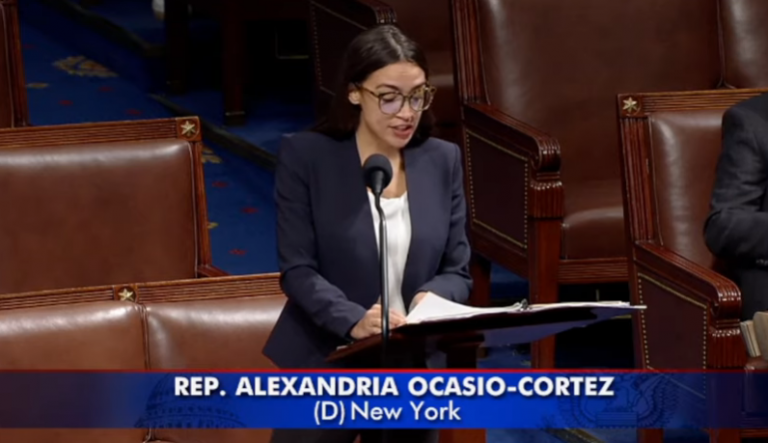
On 12/9/21 Rep Alexandria Ocasio-Cortez(D-NY) introduced an amendment(Amendment 148 to H.R. 5314–Protect Our Democracy Act), that would have restored the oversight powers Congress always intended the Government Accountability Office(GAO) to have, including over our intelligence agencies. Our intelligence agencies, as everyone knows, are notoriously impervious to any Congressional oversight, and often hide behind a vague 1988 Department of Justice opinion to justify their need for secrecy. Rep Ocasio-Cortez’s amendment would have taken away that cover, ensuring much-needed transparency from our intelligence agencies. Surprisingly, 23 Centrist Democrats voted with House Republicans to kill her amendment.

As Rep Ocasio-Cortez correctly pointed out on the House floor, given the kinds of abuses we’ve witnessed during Trump’s presidency, it is only prudent that we restore GAO’s oversight powers over all federal agencies, including our intelligence agencies. Any reasonable person would agree, that it is foolhardy to assume that former President Trump abused all other federal agencies for his selfish political interests, except our intelligence apparatus, the easiest ones to abuse given the secrecy with which they are allowed to operate.

Rep Ocasio-Cortez said on the House floor: “Since it’s creation in 1921, the Government Accountability Office(GAO) has had the purview to conduct oversight of all federal agencies with the goal of reducing waste, fraud and abuse, and holding accountable bad actors. However and unfortunately, most of our intelligence agencies today are not fully cooperative with the GAO, pointing to an outdated and vague 1988 Department of Justice opinion. Our amendment would allow the GAO to act as a check on this behavior, not creating new powers, but restoring the power Congress always intended the GAO to have. This amendment is welcomed by many in the intelligence community, who want to protect their important work and resources from abuse, particularly after the last presidency we just endured. We drafted this amendment in partnership with the community and I’m proud to have the support of Representative Adam Schiff who serves as the Chairman of the House Permanent Select Committee on Intelligence. In fact many of my colleagues have already taken a stand in support of this legislation because in 2010, the House passed a virtually identical amendment.”

The amendment failed with a final tally of 233 nays, 196 yeas, with 4 members not voting. Among the 233 nays were 23 Centrist Democrats who Yours Truly is compelled to name. The nay Dems included Reps Cynthia Axne(IA), Cheri Bustos(IL), Matt Cartwright(PA), Angie Craig(MN), Antonio Delgado(NY), Val Demings(FL), Jared Golden(ME), Josh Gottheimer(NJ), Chrissy Houlahan(PA), Conor Lamb(PA), Susie Lee(NV), Elaine Luria(VA), Tom O’Halleran(AZ), Chris Pappas(NH), Kurt Schrader(OR), Kim Schrier(WA), Terri Sewell(AL), Mikie Sherrill(NJ), Abigail Spanberger(VA), David Trone(MD), Filemon Vela(TX), Jennifer Wexton(VA), Susan Wild(PA).

Ever since the Patriot Act was enacted after the terrorist attacks of September 11 2001, there have been growing calls from civil libertarians and others, for there to be some checks on the almost absolute powers we granted our intelligence agencies after the 9/11 attacks. The reasoning behind this is pretty simple–power corrupts, absolute power corrupts absolutely. Fast forward to the Trump administration and the abuses we witnessed occurring across all federal agencies–(DOJ being used for the Big Lie, Military on Black Lives Matter protesters in DC, numerous abuses of DHS, “failure” by our intel agencies to anticipate Jan 6th insurrection)– and the need to look into our intel agencies becomes an absolute necessity. It’s against this backdrop that Rep Ocasio-Cortez, with the support of many in the intel community, are pushing for more transparency. One would assume given these set of circumstances, that more oversight would be a no-brainer for Democrats, but apparently not.

Concerns about possible abuses of our intel agencies run the gamut, from the mundane warrantless snooping of our electronic communications (emails, texts, voicemails, etc), to much more serious allegations that if proven, constitute serious violations of our commitments under the United Nations Conventions Against Torture(CAT). These include allegations of 24/7 organized stalking, non-consensual for-profit human experimentation on people entered on terrorism watchlists by weapons manufacturers and others in Big Tech(remote neuromonitoring), militarized attacks on civilians(usually watchlisted) with directed energy weapons, manufactured terrorism cases, etc. These are serious human rights violations that can only come to light through proper oversight. It also bears pointing out that similar egregious abuses have in the past been attributed to our intel agencies, a recent good example being the non-consensual experimentation on U.S. civilians using radiation. President Clinton in 1995, did the just and moral thing by not only exposing this inhumane conduct, but also making whole the surviving victims. The same can be done today.

Bottom line folks, Rep Ocasio-Cortez deserves a lot of praise for pushing for reform on a topic most politicians, and quite frankly the mainstream media, have been terrified to venture into. One only hopes that she musters the courage to push on with it, despite the recent setback on the House floor. Simply put, time has come for our intel agencies to be subjected to some real oversight.

For those of you very happy with @Emolclause’s activism don’t shy away from the “tip jar” below on your way out. You may also Cash App

Email author at admin@grassrootsdempolitics.com

Become an Octapharma Plasma donor. Make up to $200 in one week and help save lives too! Learn More