Did FBI Director Patel Lie Under Oath?

In a striking segment on MSNOWโ€™s Last Word with Lawrence Oโ€™Donnell, host Lawrence Oโ€™Donnell raised a provocative and consequential question: did FBI Director Kash Patel mislead Congress under oath during his exchange with Congressman Eric Swalwell about Donald Trumpโ€™s presence in the Jeffrey Epstein files? During that hearing, Swalwell pressed Patel directly on whether Trumpโ€™s name appeared in the Epstein material and sought clarity about the extent and significance of those references. Patel did not provide a numerical estimate, nor did he use the phrase โ€œvery few,โ€ but his answer was widely interpreted as downplaying the frequency and importance of Trumpโ€™s appearance in those records. He framed his response in a way that suggested there was nothing substantial or alarming tied to Trump in the context of the FBIโ€™s investigative findings.

Since that testimony, claims have circulated asserting that Trumpโ€™s name appears in the Epstein files far more extensively than Patelโ€™s response implied. Some reports and political commentators have cited extraordinarily large raw reference counts, arguing that Trumpโ€™s name appears hundreds of thousands or even more than a million times across various forms of Epstein-related material, including emails, contact directories, flight records, investigative notes, and digital indexing systems. Even accounting for duplication, automated references, and database artifacts, such figuresโ€”if accurateโ€”would appear difficult to reconcile with the general impression Patel conveyed during his testimony. The core issue is not whether Patel gave a precise number, because he did not, but whether his answer created a misleading impression that minimized the scale of Trumpโ€™s documented presence.

Whether that impression rises to the level of criminal conduct is a much more complex question. Federal law makes it a crime to knowingly provide false or materially misleading testimony to Congress, but the key word is โ€œknowingly.โ€ Prosecutors would have to prove that Patel was aware, at the time he testified, that his characterization was materially inconsistent with the actual scope of the records. That is a high bar. The Epstein files are massive, technically complex, and include raw, unfiltered material alongside analyzed investigative conclusions. It is entirely possible that Patel relied on summaries prepared by subordinates or focused specifically on references deemed relevant to criminal conduct rather than raw textual mentions. Under that interpretation, his testimony could be defended as reflecting his understanding of investigative significance rather than literal database frequency.

At the same time, Patelโ€™s role as FBI Director weakens any argument that he lacked access to critical information. As head of the bureau, he has the authority to receive detailed briefings on major investigative matters, especially one as high-profile and politically sensitive as Epsteinโ€™s network and its associated records. Critics argue that it strains credibility to believe that the FBI Director would be unaware of the general magnitude of references to a former president in such a consequential investigative archive. If evidence were to surface showing that Patel had been briefed specifically about the scope or frequency of Trump-related references before his testimony, it could support the argument that his answer was not merely cautious or incomplete, but intentionally misleading.

On the other hand, defenders of Patel would likely emphasize the distinction between raw data mentions and meaningful investigative findings. Large digital archives often contain inflated reference counts due to repetitive indexing, duplicate communications, or incidental references that carry no investigative weight. A personโ€™s name might appear thousands of times without indicating wrongdoing or even direct interaction. From that perspective, Patel could argue that his testimony reflected the FBIโ€™s substantive investigative conclusions, not superficial database metrics. Courts have historically been reluctant to criminalize testimony that can reasonably be interpreted as technically accurate or dependent on interpretation, particularly when the witness avoids making precise factual claims.

The political implications of this controversy are significant and could shape how the matter unfolds. If a future Democratic administration were to take office, there would likely be pressure from some quarters to investigate whether Patelโ€™s testimony crossed the legal line. Such an inquiry could take the form of a congressional referral, a Justice Department investigation, or the appointment of a special counsel. Any decision to prosecute would ultimately depend on whether investigators could uncover clear evidence of intentโ€”such as internal communications, briefing documents, or witness testimony showing that Patel knowingly conveyed a misleading impression. Without that level of proof, the matter would likely remain in the realm of political controversy rather than criminal prosecution.

At the same time, the broader political climate has changed dramatically in recent years. Actions that were once considered unthinkableโ€”such as investigating or prosecuting senior federal law enforcement officialsโ€”are now part of the modern political landscape. That reality cuts both ways. Any future administration pursuing such a case would face accusations of political retaliation, while declining to act could fuel claims of unequal accountability. Ultimately, the question of whether Patel misled Congress may hinge less on public debate over document counts and more on what evidence exists about his state of mind when he testified. Without clear proof that he knowingly created a false impression, the controversy may never evolve into a criminal caseโ€”but it will remain a potent flashpoint in the ongoing struggle over truth, accountability, and political power at the highest levels of government.

Grifting Nepo-Babies In Trump Admin 2.0?


Please consider $upporting GDPolitics by scanning the QR code below or clicking on this link

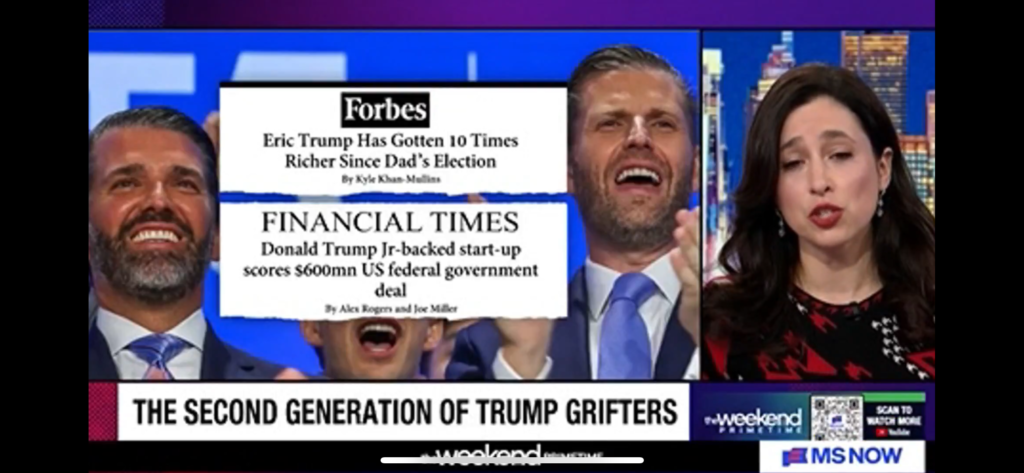
An interesting segment on MSNOWโ€™s Weekend Primetime show delved into the staggering corruption emerging in Trump administration 2.0 โ€” even coining the phrase โ€œGrifting Nepo-Babiesโ€ to capture the growing concern about the financial windfalls reportedly enjoyed by the children of several senior Trumpโ€“era officials. Co-host Catherine Rampell laid out what she called a pattern of politically connected offspring cashing in during the second Trump presidency. According to the segment, Secretary of Commerce Howard Lutnickโ€™s sons were among those observers have flagged as benefiting enormously from their fatherโ€™s presence in government โ€” and in their case, the benefits come via the Wall Street powerhouse their father built, Cantor Fitzgerald.

Specifically: when Lutnick stepped into the Cabinet, ownership and control of Cantor Fitzgerald were formally transferred to his two oldest sons, Brandon Lutnick (now Chairman & CEO) and Kyle Lutnick (Executive Vice-Chairman). Under their leadership, the firm is on track for a 2025 revenue haul that reportedly represents its most profitable year ever โ€” a jump of more than a quarter over last year. Much of that windfall stems from Cantorโ€™s aggressive crypto-investment banking, SPAC dealmaking, stablecoin custody and other high-risk, high-reward operations that the firm has doubled down on since the crypto boom took off. Critics argue that this close alignment between a senior Cabinet official and a high-performing Wall Street firm controlled by his children constitutes a textbook example of revolving-door conflicts of interest โ€” especially given the firmโ€™s deep involvement in sectors (like crypto) where regulatory and trade policy decisions may directly affect their bottom line. The optics are stark: a firm once headed by the Commerce Secretary is now raking in record profits under the leadership of his sons, just as policies that shape global trade and regulation are being decided by that same Secretary.

The segment also highlighted another striking example beyond the Lutnicks: Alex Witkoff, the son of Steve Witkoff โ€” himself appointed by Trump as a Middle East envoy. According to multiple recent reports, Alex has aggressively pursued large-scale investments from sovereignโ€wealth funds and Gulf-state investors. In 2024 he pitched a $4 billion U.S. real-estate credit fund to the Qatar Investment Authority, promising returns and sizeable management fees; while Qatar reportedly declined, sources say Alex continued courting investors from Qatar, the United Arab Emirates, and Kuwait through at least August 2025. As his father negotiated cease-fire and hostage-release deals across the Middle East under the auspices of the Trump administration, Alex was quietly soliciting money โ€” a convergence of diplomacy and real-estate finance that ethics experts argue raises serious conflict-of-interest concerns. Indeed, GULF-state investment vehicles have already backed several properties owned or developed by the family firm (known as the Witkoff Group), including major assets in New York and Florida. While a spokesperson for the firm has since claimed the specific real-estate fund proposal was โ€œpreliminaryโ€ and will not move forward, critics maintain that even the attempt โ€” coming alongside high-stakes diplomatic negotiations โ€” exemplifies the growing problem of political power being leveraged for private enrichment.

Rampell then pivoted to Trumpโ€™s own children, where the accusations grow louder and the optics far more politically potent. She cited a Forbes report claiming Eric Trumpโ€™s wealth has increased dramatically since his father returned to office โ€” with critics arguing that this level of enrichment while a parent is in the White House reflects the same ethical vulnerabilities that plagued Trumpโ€™s first term. She also referenced reporting about a startup associated with Donald Trump Jr. that has reportedly secured a major Pentagon-related deal โ€” figures like the oft-circulated โ€œ$600 millionโ€ have fueled alarm among ethics experts and bipartisan government watchdogs who argue that such arrangements warrant far more transparency. And even Trumpโ€™s youngest son, Barron Trump โ€” normally kept out of the political spotlight โ€” was mentioned in the segment due to media chatter about alleged lucrative cryptocurrency-related ventures linked indirectly to his name, though these claims remain murky and largely unverified, further contributing to the perception of a sprawling and loosely monitored financial ecosystem orbiting around the Trump family.

Rampell also revisited the long-running controversies around Trumpโ€™s son-in-law Jared Kushner, whose massive financial gains following Trumpโ€™s first term โ€” including high-profile investments from foreign sovereign funds โ€” continue to be held up by critics as one of the most glaring examples of blurred ethical boundaries. His ongoing business expansions during Trumpโ€™s second presidency only reinforce concerns among ethics observers who argue that the revolving door between political power and personal enrichment is now swinging more freely than ever.

The larger point the MSNOW hosts made was that corruption โ€” whether alleged, implied or documented โ€” has quickly become a defining theme of Trump 2.0. Democrats are already gearing up to make it a core message for the 2026 midterms, framing the administration as a government increasingly captured by the financial ambitions of the presidentโ€™s inner circle and their families. But what may pose a more immediate threat to Trump is that even portions of his MAGA base are beginning to grumble. Online circles that once defended every decision of the Trump family have begun to express frustration at what they see as blatant self-dealing โ€” especially as the administration continues to sideline issues that energized Trumpโ€™s grassroots supporters in the first place: lower prices, avoiding new foreign conflicts, demands for release of the Epstein files, and promises of โ€œdraining the swamp.โ€ For some longtime loyalists, the contrast between those unmet commitments and the constant headlines about politically connected children becoming wealthier has begun to feel impossible to ignore.

How this discontent evolves could have real consequences in the 2026 midterms. If the corruption narrative continues to grow, and if MAGA voters feel increasingly alienated or taken for granted, Republicans could find themselves facing a demoralized base at the very moment Democrats are preparing to campaign on a simple, sharp message: that Trump 2.0 has become a family business masquerading as a government. The question heading into 2026 is not just whether Democrats can capitalize on this narrative, but whether the erosion of enthusiasm among core Trump supporters will quietly do the job for them.

Trump Wants To Reinstate Eisenhower’s Infamous “Operation Wetback” Immigration Policy

$upport via Cash App

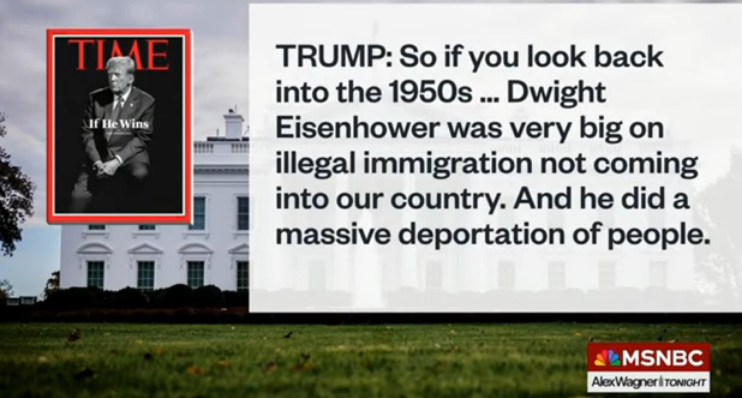
A bombshell segment on MSNBC’s Alex Wagner Tonight show (04/30/24) delved into a recent interview Republican presidential candidate Donald Trump had with Time Magazine. As host Alex Wagner correctly pointed out, the biggest bombshell from the Time interview was Trump’s admission that if elected president again, he would be open to a draconian immigration policy that mirrors former President Eisenhower’s infamous “Operation Wetback.”

Time Magazine’s Eric Cortellessa(2:35): “You’ve said you’re gonna do this massive deportation operation. I want to know specifically how you plan to do that.”

Trump: “So, if you look back to the 1950s, [President] Dwight Eisenhower was very big on illegal immigration not coming to our country. And he did a massive deportation of people.”

Any reasonable person presented with Trump’s response would conclude, as host Alex Wagner did, that if elected president again, Trump intends to craft a draconian immigration policy that mirrors Eisenhower’s “Operation Wetback”.

It will be interesting to see how Hispanics, who Trump has successfully peeled off from the “reliable Democrats” tent, will react to this bombshell revelation. As host Wagner correctly pointed out, a lot of U.S. citizens of Mexican descent also got swept up in Eisenhower’s militarized “Operation Wetback” raids, and got deported illegally to Mexico.

Will a potential “Operation Wetback 2.0” be a game-changer with MAGA Hispanics in 2024, making them pull the lever for Biden? Hmm, as Trump famously says, “We’ll see what happens.”

I’d be remiss if I didn’t point out the fact that in the interview, Trump also appeared eager to expand law enforcement’s “qualified immunity” to a point where it is practically “absolute immunity”. This would dramatically roll back progress that has been made–and there has been progress–in the fight against police brutality, especially as it pertains to Black and Brown communities. Will this be a game-changer for the so-called BlacksForTrump? Hmm, we shall see.

For those of you very happy with @Emolclauseโ€™s activism donโ€™t shy away from the โ€œtip jarโ€ below on your way out. You may also Cash App

Email author at admin@grassrootsdempolitics.com

Become an Octapharma Plasma donor. Make up to $200 in one week and help save lives too! Learn More

Eric Trump Discusses His Fatherโ€™s Indictment On Fox Newsโ€™ Hannity Show

$upport via Cash App

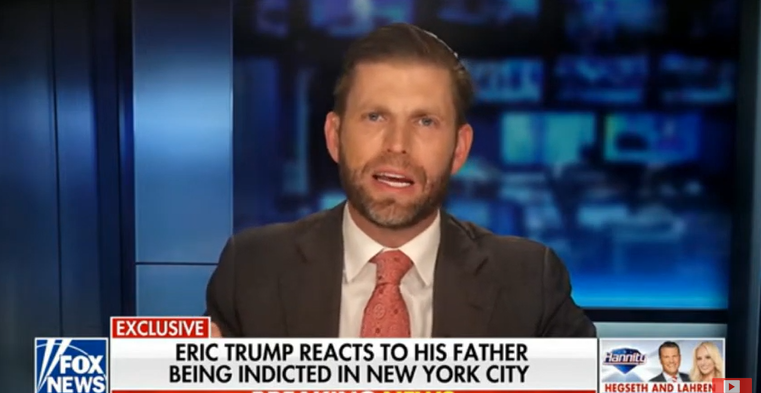
Eric Trump appeared on Fox Newsโ€™ Hannity show (03/30/23) moments after the bombshell revelation that a Manhattan grand jury had indicted his father for crimes related to the hush money payments he made to adult film star Stormy Daniels.

A visibly angry Eric Trump accused the Manhattan DA of among other things, abusing his power, telling host Hannity that he is neglecting rampant crime in New York to go after his father. He also cast his father as the target of an elaborate political witch hunt by both the Manhattan DA Alvin Bragg and the New York Attorney General Leticia James.

Eric Trump specifically told host Hannity(2:08 ): โ€œMy fatherโ€™s only crime was winning the 2016 electionโ€ฆFrom the time my father went down that escalator, we got subpoena after subpoena. We would have people like Alvin Bragg, Leticia James, and so many others, go out and campaign on the promise that they would take down a person, not knowing anything about themโ€ฆThese people are evil, theyโ€™re wicked, and is why people have lost trust in the system in the U.S. This is third world tactics.โ€

Eric Trump then threw in the political bias allegation saying(2:43 ): โ€œYou have Hunter Biden who has crack pictures on his laptop, you have Bill Clinton who is paying Paula Jones $850,000, you have Bill Clinton who is diddling interns in the White House in the Oval Office, you have Hillary Clinton whoโ€™s deleting 33,000 emails while under congressional subpoena, and no one says a damn thing about any of those people, but when my fatherโ€™s leading by 35% in the polls, and they know heโ€™s going to be the guy that Joe Bidenโ€ฆwill ultimatelyโ€ฆrun againstโ€ฆthatโ€™s who they go after, right up against the statute of limitationsโ€ฆThey will do anything to take the man out of the raceโ€ฆโ€

Interestingly, Eric Trump also alleged that his fatherโ€™s prosecution was somehow orchestrated by billionaire Democratic super donor George Soros. He specifically said(5:40): โ€œAmericans see people like [George] Soros paying $1 million to get Alvin Bragg elected, and then this guyโ€™s going out and doing this guyโ€™s dirty work. People get itโ€ฆThat was their calling card. This was a mission. This is what they promised their donors. This is what they promised Soros that they would do. Itโ€™s why they received the big checks.โ€

He strangely concluded by saying his father โ€œneeded a passโ€, which is interesting because it would appear to suggest that he is conceding his dadโ€™s criminal conduct, but only lamenting the fact that he is not getting a break like DOJ presumably gave Hillary Clinton over the email saga. Hmm, very interesting argument indeed.

Bottom line folks, it is perfectly normal for Eric Trump to come out guns blazing in defense of his father over the newly disclosed indictments. The problem he might find himself in however, is that neither he, nor the public, currently knows exactly what allegations are laid out in the indictment(sealed). Ericโ€™s reaction is perfectly understandable, but the wise option would be to wait for his dadโ€™s court arraignment in a few days, where the allegations against him will be laid out in detail.

Maybe, just maybe, the indictment will lay out very serious allegations against his father, which will justify the DAโ€™s/ grand juryโ€™s actions, even in the eyes of Republicans.

For those of you very happy with @Emolclauseโ€™s activism donโ€™t shy away from the โ€œtip jarโ€ below on your way out. You may also Cash Ap

Email the author at admin@grassrootsdempolitics.com

Become an Octapharma Plasma donor. Make up to $200 in one week and help save lives too!ย Learn More