The Hope Florida scandal has taken another unexpected turn. According to CBS Miami investigative reporter Jim DeFede, Orange-Osceola State Attorney Monique Worrell is now beginning her own review of the controversy and is considering whether a new grand jury may be necessary. Worrell says her office has received information suggesting that some of the money at the center of the scandal may have been spent in the Central Florida media market, which falls within her jurisdiction. At the same time, Worrell has publicly claimed that she was warned her removal from office could be imminent and suggested that her interest in the Hope Florida matter may be connected. There has been no public confirmation from Gov. Ron DeSantis that he intends to remove her, and Attorney General James Uthmeier has said he was unaware of any such plan.
This is significant because it goes directly to the argument I made in my previous article, “Hope Florida: Why No Indictments Is No Vindication.” Read my previous Hope Florida analysis here The first grand jury did not conclude that nothing improper happened. It concluded that the DeSantis administration had misappropriated $10 million in taxpayer money and described the movement of those funds as part of a “sophisticated scheme to fund political activities.” The money originated from a $67 million Medicaid settlement with Centene and was ultimately routed through the Hope Florida Foundation and other organizations before substantial amounts reached political committees. The grand jury simply concluded that it did not have sufficient evidence to criminally charge anyone because no witness would take responsibility for the crucial decision to send the $10 million to Hope Florida. That is an accountability problem—not a declaration of innocence.
And this is where the possibility of another investigation becomes particularly important. The unanswered question has always been who made the decision? The grand jury’s report identified James Uthmeier, who was DeSantis’ chief of staff at the time, as someone who was in a position of authority over those involved in the Centene settlement. His political committee, Keep Florida Clean, ultimately received the majority of the money that moved out of the two nonprofits that received Hope Florida funds. The grand jury also noted that witnesses claimed they could not remember who made the decision to transfer the money in the first place. That is precisely why the argument that “there were no indictments” settles the matter is so misleading. A prosecutor’s inability to establish criminal responsibility beyond the required standard is not the same thing as proving that the underlying conduct was legitimate.
The political implications of Worrell’s review also cannot simply be ignored. DeSantis suspended Worrell in 2023, but she subsequently won her office back from voters in 2024 with nearly 60% of the vote. Now, as her office begins examining information connected to the Hope Florida money, Worrell says she has been warned that she could once again be removed. She has explicitly connected the timing to the investigation, saying that if she is removed, it would not be because her office isn’t doing its job, but because of concerns about what that work might uncover. To be clear, Worrell’s allegation is not proof that DeSantis is attempting to stop the investigation, and there is currently no public confirmation that he plans to suspend her. But given the extraordinary circumstances surrounding Hope Florida, the public has every reason to pay close attention. If a prosecutor is investigating whether taxpayer money was diverted into political activity, the investigation should be allowed to proceed without political interference.
Ultimately, the latest development reinforces the central point: Hope Florida is not a closed case simply because the first grand jury did not return indictments. In fact, the grand jury’s own findings left behind a remarkable contradiction: it found that $10 million in taxpayer money had been misappropriated and used for political purposes, yet nobody could—or would—take responsibility for the decision that set the money on that path. Even former prosecutors interviewed by CBS Miami have questioned whether the investigation went far enough, with some arguing that prosecutors should have continued investigating rather than simply accepting that witnesses could not establish responsibility. Now another state attorney is asking whether there is more to uncover. That doesn’t mean Ron DeSantis, James Uthmeier, Casey DeSantis or anyone else is guilty of a crime. It means the public deserves to know exactly what happened to its money, who authorized it, who knew where it was going, and why millions of dollars connected to a Medicaid settlement ultimately found their way into political operations. Until those questions are answered, Hope Florida deserves investigation—not dismissal.
In reference to my previous post on the Hope Florida money trail, there is one defense from Florida officials that deserves a closer examination because, on its face, it sounds compelling: if the Hope Florida affair really involved fraud, corruption or the misuse of taxpayer money, why didn’t the grand jury indict anyone? In that earlier piece, I traced how $10 million connected to Florida’s $67 million Medicaid settlement with Centene went to the Hope Florida Foundation—the charitable arm associated with First Lady Casey DeSantis’ signature initiative—then through two nonprofits and ultimately into political organizations advancing Gov. Ron DeSantis’ agenda. I also raised the question of whether Vice President JD Vance’s highly publicized anti-fraud crusade would be applied with the same intensity when allegations involving public health-care money lead into the political orbit of a powerful Republican governor. But the absence of indictments presents a separate question, and former Republican congressman and Democratic gubernatorial nominee David Jolly offered an important answer during an appearance with Jen Psaki on MSNOW: you cannot fairly evaluate the lack of indictments without examining why the grand jury said it was unable to indict anyone. The jury did not investigate the transaction and conclude that nothing improper happened. According to the leaked report, it concluded that $10 million in taxpayer money had been “misappropriated,” called the diversion part of a “sophisticated scheme to fund political activities,” and nevertheless found insufficient evidence to charge a particular person criminally because investigators could not establish who made the critical decision to send the money to Hope Florida.
#BREAKING: Psaki: “This completely crazy level of corruption is happening in a state you are hoping to lead. What do you think is most important for people just tuning into the story, trying to digest it, to really understand?”
That distinction changes the entire meaning of the “no indictments” defense. There is an enormous difference between a grand jury saying, we examined what happened and found no wrongdoing, and a grand jury saying, we found wrongdoing but cannot establish which individual can be criminally charged for it. The latter is much closer to what the Hope Florida report says. The grand jury concluded that the entire Centene settlement represented taxpayer reimbursement and rejected the characterization that the disputed $10 million was simply some extra “bonus” that could be directed elsewhere. It identified the decision to send that money to Hope Florida as the original misappropriation. But when jurors attempted to determine who actually made that decision, they encountered a remarkable problem: according to the report, “Nobody will take responsibility” for deciding that the $10 million would go to Hope Florida, and witnesses either could not identify or did not remember who made the decision. The jury therefore found itself in the unusual position of saying it could see that taxpayer money had been misused for political purposes while being unable to establish who, individually, could be prosecuted for causing it to happen.
That is not a minor technical distinction. Criminal prosecution requires prosecutors to do more than demonstrate that something improper happened. They must connect specific conduct to specific defendants and establish the elements of a particular criminal offense. Depending on the alleged crime, that can require evidence showing who authorized an action, what that person knew, whether there was criminal intent and what role that individual played. Investigators can therefore trace money from point A through points B, C and D, establish that its ultimate disposition was improper, and still find themselves unable to prosecute if they cannot prove who ordered the crucial first step. That appears to be the fundamental problem the Hope Florida grand jury encountered. The jury’s inability to identify who made the original decision is therefore not evidence that the decision was proper. In fact, the grand jury expressly reached the opposite conclusion about the money itself. As the report put it, despite finding that the money was misappropriated, jurors found “insufficient evidence to charge anyone criminally.”
The circumstances that produced that evidentiary gap are precisely what make Jolly’s argument so significant. According to the grand jury, virtually everyone involved was a lawyer, and many witnesses said they were acting based upon the advice of other lawyers. Jurors explicitly recognized that this created an impediment to criminal prosecution. Yet the jury still concluded that it could “plainly see” taxpayer money had been misused for political purposes. That is a remarkable statement. It essentially means the grand jury believed it could identify the improper disposition of the money but could not penetrate the decision-making structure sufficiently to assign prosecutable responsibility to an individual. Rather than resolving the scandal, the absence of charges therefore leaves perhaps its most important question unanswered: Who decided that $10 million belonging to Florida taxpayers should be sent to Hope Florida in the first place?
That question becomes even more consequential when considering who reportedly never testified before the grand jury. Gov. DeSantis was not called. Then-Attorney General Ashley Moody, now a U.S. senator, was not called. James Uthmeier, who was DeSantis’ chief of staff at the time and is now Florida’s attorney general, was not called either. Yet the report concluded that Uthmeier was “in a position of authority” over officials involved in settling with Centene, and testimony identified him as having involvement in directing the money after it reached Hope Florida. His Keep Florida Clean political committee ultimately became the principal recipient of most of the disputed $10 million. The grand jury also concluded that Moody knew about the diversion plan and authorized her chief deputy to sign the settlement, although Moody says her office had no knowledge of how Hope Florida or subsequent recipients would ultimately spend the money. None of these facts establishes criminal guilt by DeSantis, Moody, Uthmeier or anyone else. But when the central reason for not bringing charges is the inability to establish who made the critical decision, the fact that several of the highest-ranking officials connected to the episode never testified is hardly irrelevant.
This is where the claim that the grand jury “cleared” everyone becomes particularly difficult to sustain. Imagine how different the situation would be if the grand jury had heard sworn testimony from every major participant, obtained all relevant communications and records, established who made the decision to direct the $10 million to Hope Florida, reconstructed what everyone knew at the time, determined whether anyone anticipated its subsequent political use, and then concluded that no crime had occurred. Such a finding would represent powerful evidence in favor of DeSantis and the officials involved. Critics would have to reckon seriously with it. But that is not what happened according to the report. Instead, investigators were left with a central decision for which nobody would accept responsibility and witnesses could not—or would not—identify a decision-maker. To take the resulting absence of charges and transform it into proof that nothing improper occurred is to omit the very reason the grand jury gave for its inability to bring charges.
Jolly’s argument goes further. Speaking with Psaki, he described a situation in which some of the officials connected to the controversy subsequently rose into even more powerful positions in Florida and federal government. Moody, who was attorney general when the settlement was approved, was later appointed by DeSantis to the United States Senate. Uthmeier moved from DeSantis’ chief of staff to attorney general. John Guard, Moody’s chief deputy, who signed the settlement despite concerns described in the grand jury report about the arrangement’s compliance with Florida law, was subsequently appointed by DeSantis to the Second District Court of Appeal. Those appointments do not prove bribery, a quid pro quo or a criminal conspiracy, and they should not be presented as if they do. But they add to the institutional problem: people connected to the underlying events have subsequently occupied some of the very positions from which Floridians might ordinarily expect governmental accountability. That is one reason Jolly says the investigation should be reopened and additional facts pursued.
And that is why independence matters so much. The issue is not that the existing grand jurors themselves should be presumed partisan, compromised or corrupt. There is no basis for making such an accusation. The issue is whether a new investigation, conducted by an independent special counsel or similarly insulated authority with the ability to pursue the unanswered questions, could reach a much more definitive conclusion. Such an investigation could seek testimony from the central officials who did not appear before the grand jury, obtain relevant communications and records, reconstruct the decision-making process surrounding the Centene settlement, determine who authorized the $10 million transfer, establish what state officials knew about its intended destination, and examine whether its subsequent movement into political organizations was anticipated or coordinated. The objective should not be to find a way to prosecute DeSantis or anyone else. It should be to obtain the answers that the first investigation was unable to obtain.
That point is important because a truly independent investigation could just as easily vindicate the officials involved. Suppose an independent special counsel obtained testimony from every central figure, established exactly who authorized the transfer and why, examined communications surrounding the settlement, followed the subsequent movement of the money, tested every legal argument offered by the administration and ultimately concluded that no individual committed a crime. That would be a substantially different—and far more powerful—finding than the one Florida has today. It would mean investigators knew who made the decisions, understood why they were made, possessed the relevant evidence and nevertheless determined that criminal prosecution was unwarranted. If an independent investigation produced that conclusion, it should carry enormous weight. The existing grand jury report cannot provide the same vindication precisely because it says the jury could not determine who made the crucial decision. The unanswered question is not incidental to its failure to indict; it is central to it.
The grand jury’s recommendations make the claim of complete exoneration even harder to reconcile with what jurors actually found. The jury recommended that Florida lawmakers establish clearer requirements governing money received by the state and impose tracking, monitoring and consequences governing how state-affiliated entities such as Hope Florida may use taxpayer dollars. That is significant. A grand jury persuaded that the entire controversy was imaginary would have little reason to recommend laws designed to prevent something similar from happening again. Instead, the jurors concluded taxpayer money had been misappropriated, said they could plainly see that it had been misused for political purposes, and then urged the Legislature to create safeguards against a recurrence. Those are the findings of a grand jury frustrated by the limits of its ability to assign criminal responsibility, not the findings of one announcing that everything was aboveboard.
DeSantis, Uthmeier, Moody and the other officials involved are nevertheless entitled to have their defenses presented fairly. DeSantis strongly disputes the grand jury’s characterization of the $10 million, saying there was “no diversion of any Medicaid funds” and describing the money as a private contribution connected to a legally sound settlement. Uthmeier calls the controversy a politically motivated witch hunt and says nobody did anything wrong. Moody says her office was only one of several agencies involved in the settlement and had no knowledge of how Hope Florida or other organizations would subsequently spend the money. Those are not arguments that should simply be brushed aside because critics distrust the officials making them. They should be tested against evidence. If the $10 million really was a private contribution rather than money owed to Florida taxpayers, establish that conclusively. If state officials properly possessed the legal authority to structure the settlement this way, demonstrate it. If the subsequent political spending was entirely disconnected from the people responsible for directing the money to Hope Florida, establish that through testimony and records. An independent investigation could ultimately substantiate those defenses.
But “nobody was indicted” cannot substitute for those answers. Attorney General Uthmeier himself had emphasized the absence of an indictment even before the report became public, saying that he had not been indicted, had not been a suspect or target and had not engaged in criminal activity. After the report emerged, he again emphasized that there was not even probable cause to proceed. Yet the grand jury’s findings complicate that argument enormously. The relevant question is not merely whether an indictment emerged at the end of the process. It is whether investigators possessed sufficient evidence to identify and prove who was responsible for conduct the grand jury itself considered improper. According to the report, they did not—and the report tells us why.
This is ultimately why Jolly’s call to reopen the investigation deserves serious consideration regardless of one’s political affiliation. Indeed, Jolly has challenged his Republican opponent for governor, Byron Donalds, to commit to doing the same. The principle should be straightforward: if public money was handled properly, an independent investigation should be capable of demonstrating that. If laws were broken, an independent investigation should identify who broke them. And if something improper occurred but falls short of criminal conduct, Floridians should still know exactly what happened and who made the decisions. Accountability is not limited to criminal indictments. Misuse of public money can raise questions of ethics, governance, statutory compliance and public trust even when prosecutors cannot prove a crime against a particular individual.
The most important question surrounding Hope Florida therefore is not simply, “Where are the indictments?” It is, “Why weren’t there indictments?” If the answer were that investigators established every important fact and found no wrongdoing, the administration would have an exceptionally strong defense. But the grand jury itself supplied a very different explanation: it found the money had been misappropriated, found that taxpayer money had been used for political purposes, could not determine who made the original decision to send it to Hope Florida, encountered witnesses who would not accept responsibility or could not remember who had done so, and recognized those evidentiary problems as an impediment to criminal prosecution. The absence of an indictment under those circumstances is a failure to establish individual criminal liability. It is not the same thing as a finding that nothing improper happened.
There is therefore a straightforward way to settle the competing narratives. Put the matter before investigative authority sufficiently independent from the people and institutions implicated in the controversy. Obtain testimony from the central decision-makers. Examine the communications and financial records. Determine who authorized the transfer. Establish what that person believed the money represented and why it was directed to Hope Florida. Determine what officials knew about its subsequent disposition. Test the administration’s legal explanation against the grand jury’s conclusion that the entire $67 million represented taxpayer reimbursement. Follow the evidence without regard to whether the result helps Democrats or Republicans. If that investigation ultimately concludes that no crime occurred, DeSantis and his allies would have something far more persuasive than the talking point they have today: a complete, independent investigation that answered the outstanding questions and cleared them.
Until then, the Hope Florida grand jury’s failure to indict should not be mistaken for vindication. In some respects, the reasons it gave for not indicting are among the strongest arguments for continuing the investigation. A grand jury concluded that $10 million belonging to taxpayers was misappropriated and ultimately used for political purposes, yet it could not establish who was criminally responsible because nobody would take responsibility for the crucial decision that put the money on that path. That finding demands caution about accusing any individual of a crime, but it also demands something more than a declaration that the case is closed. If a genuinely independent investigation hears from the principal players, obtains the missing evidence, answers the unanswered questions and still concludes that no charges are warranted, that would be meaningful vindication. Florida does not have that finding today. What it has is an unresolved question sitting at the center of $10 million in taxpayer money: who made the decision, and why? Until somebody can answer it, “no indictments” should not be the end of the Hope Florida story. It should be the beginning of the demand for an independent accounting.
Bombshell segment on the 09/18/25 edition of MSNBC’s All In w/Chris Hayes delved into the current head of the Federal Housing Finance Authority (FHFA), William Pulte, and specifically whether he is the source of all the mortgage fraud allegations currently leveled at prominent Democrats
#BREAKING: Hayes: "Okay, so allegations against Lisa Cook, Senator Adam Schiff and NY AG Leticia James. It does seem more than a little odd that three people Trump has it out for, just all happen to commit the SAME infraction. Like, WHERE are all these allegations of… pic.twitter.com/QxeaufQL2C
Hayes correctly pointed out that it does appear odd, that Democrats who President Trump has publicly feuded with, and expressed contempt for, are suddenly facing accusations of mortgage fraud. Importantly, the person who President Trump has appointed to head FHFA, which among other things, overseas the U.S. mortgage market, is a diehard MAGA and a major donor to the Trump campaign. Per Hayes, he’s an heir to a major construction company.
Could he be the one digging into Trump opponents’ mortgage files for “dirt”? Hayes certainly seems to be making that argument in this segment. If true, this would not only be a blatant abuse of power, but could potentially also be a legal infraction pertaining to privacy.
But let’s not put the cart before the horse here. The prudent thing is to first confirm that it is indeed Mr Pulte who is leaking people’s mortgage files. After that, we can consider the potential legal ramifications
Bottom line, this is the classic issue that begs for congressional oversight. Americans are already struggling to keep up with their mortgage payments. The last thing they need is some politically-motivated fat cat rummaging through their mortgage files digging for “political dirt”. There are federal agencies already in place to independently deal with mortgage fraud.
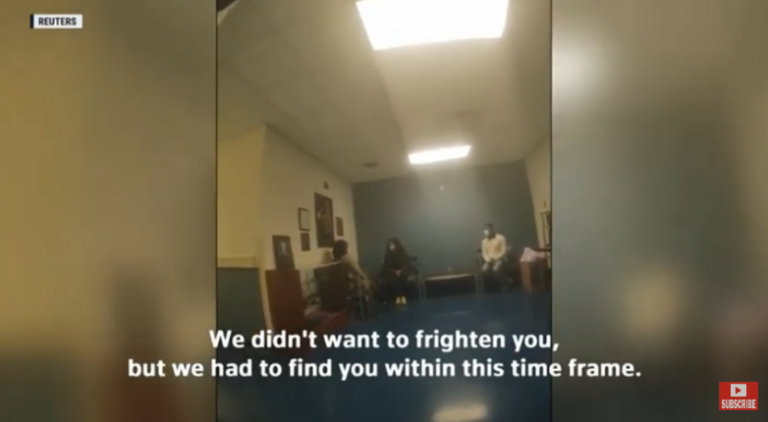
Trumpers Trevian Kutti and Garrison Douglas pressuring election worker Ruby Freeman to confess to a bogus election fraud scheme at a Georgia police station(Jan 4, 2021)
A troubling segment on MSNBC’s Rachel Maddow Show (12/22/21) revealed that three Trump campaign officials were directly involved in the harassment of an elderly Georgia election worker, Ruby Freeman, who they tried to extort into confessing to a bogus election fraud claim pushed by then President Trump. The officials in question are Harrison Floyd, a Black Voices for Trump Executive Director, who until November 2020, was a paid Trump campaign staffer, Trevian Kutti, a publicist for Trump’s Rapper buddy Kanye West(now Ye), and Garrison Douglas, another Black Voices for Trump member who apparently, was also working for the Georgia Republican Party at the time of this harassment scheme.
Trevian Kutti is the woman in the dark outfit, seen in the video pressuring election worker Ruby Freeman to confess in 48 hours, if she wants to avoid getting arrested, and as a condition for her getting “protection”. The man sitting on the right of Trevian Kutti as she issues her threats, is Garrison Douglas, who at the time, was working for the Georgia Republican Party, and is also a member of the Black Voices For Trump. The “high-profile individual” who Trevian Kutti got on the phone with, who was supposedly going to “protect” Ruby Freeman, and keep her out of jail if she confessed in 48 hours, is Harrison Floyd, the Executive Director of Black Voices for Trump. Harrison Floyd was until November 2020, a paid Trump campaign staffer. There’s no question that this shameful harassment scheme was a full blown Trump operation geared towards stopping the certification of Joe Biden’s electoral college victory, scheduled for January 6th.
Maddow said: “Just step back here for a moment, just appreciate what we now know happened here. This is in the midst of what at this point, is already a weeks-long pressure campaign by President Trump and his allies in Georgia. Everybody from President Trump and his lawyer Rudy Giuliani, and everybody on down, is hyping this wackadoodle conspiracy theory about a random Atlanta election worker, and her being like the mastermind of the crime. They are doing that in order to justify getting Republican officials in Georgia to overturn the election results and say that Trump won. That election worker is getting threatened like you cannot believe. She is in fear for her life under an onslaught of harassment and threats, and in the midst of that, three people involved with the Trump campaign, one of whom until recently had been a high profile Trump campaign employee, another who works for the Republican Party, they arrange to show up at this woman’s house and try to get her to admit to election fraud because then they can protect her. And the deadline they gave her was very specific–48 hours….Why was it so important that they get to her before that 48 hours was up? Well, at the end of that 48 hours, remember that conversation happened on January 4th, 48 hours after that was the certification of Joe Biden’s win in Congress, the thing Trump and his allies were trying to stop at all costs.”
Maddow went on to add that on January 6th, as the insurrection was playing out in real time, a bunch of Trumpers surrounded Ruby Freeman’s house in Atlanta, and shouted at her through a bullhorn. Any reasonable person presented with Maddow’s account of this incident would conclude that Ruby Freeman’s harassers were not just some random Trump supporters arbitrarily going out of their way to inflict pain on her, but rather that they were part of an elaborate scheme to force a bogus confession out of her, which they could then use to overturn the Georgia election results, and stop the scheduled January 6th certification in Congress. Simply put, these were conspirators to a crime.
Bottom line folks, the January 6th Committee definitely needs to look into who was giving orders to these three Trumpers in this very elaborate scheme to (1) overturn Georgia’s 2020 election results and (2) to put a stop to the scheduled January 6th Congressional certification of Biden’s electoral college win. The public deserves to know who else was working with these three shady characters, as they terrorized an innocent, and elderly election worker. That’s the least the January 6th Committee can do for poor Ruby Freeman’s tormented family.
For those of you very happy with @Emolclause’s activism don’t shy away from the “tip jar” below on your way out. You may also Cash App
Email author at admin@grassrootsdempolitics.com
Become an Octapharma Plasma donor. Make up to $200 in one week and help save lives too! Learn More