Hope Florida: Why No Indictments Is No Vindication

In reference to my previous post on the Hope Florida money trail⁠, there is one defense from Florida officials that deserves a closer examination because, on its face, it sounds compelling: if the Hope Florida affair really involved fraud, corruption or the misuse of taxpayer money, why didn’t the grand jury indict anyone? In that earlier piece, I traced how $10 million connected to Florida’s $67 million Medicaid settlement with Centene went to the Hope Florida Foundation—the charitable arm associated with First Lady Casey DeSantis’ signature initiative—then through two nonprofits and ultimately into political organizations advancing Gov. Ron DeSantis’ agenda. I also raised the question of whether Vice President JD Vance’s highly publicized anti-fraud crusade would be applied with the same intensity when allegations involving public health-care money lead into the political orbit of a powerful Republican governor. But the absence of indictments presents a separate question, and former Republican congressman and Democratic gubernatorial nominee David Jolly offered an important answer during an appearance with Jen Psaki on MSNOW: you cannot fairly evaluate the lack of indictments without examining why the grand jury said it was unable to indict anyone. The jury did not investigate the transaction and conclude that nothing improper happened. According to the leaked report, it concluded that $10 million in taxpayer money had been “misappropriated,” called the diversion part of a “sophisticated scheme to fund political activities,” and nevertheless found insufficient evidence to charge a particular person criminally because investigators could not establish who made the critical decision to send the money to Hope Florida. 

That distinction changes the entire meaning of the “no indictments” defense. There is an enormous difference between a grand jury saying, we examined what happened and found no wrongdoing, and a grand jury saying, we found wrongdoing but cannot establish which individual can be criminally charged for it. The latter is much closer to what the Hope Florida report says. The grand jury concluded that the entire Centene settlement represented taxpayer reimbursement and rejected the characterization that the disputed $10 million was simply some extra “bonus” that could be directed elsewhere. It identified the decision to send that money to Hope Florida as the original misappropriation. But when jurors attempted to determine who actually made that decision, they encountered a remarkable problem: according to the report, “Nobody will take responsibility” for deciding that the $10 million would go to Hope Florida, and witnesses either could not identify or did not remember who made the decision. The jury therefore found itself in the unusual position of saying it could see that taxpayer money had been misused for political purposes while being unable to establish who, individually, could be prosecuted for causing it to happen. 

That is not a minor technical distinction. Criminal prosecution requires prosecutors to do more than demonstrate that something improper happened. They must connect specific conduct to specific defendants and establish the elements of a particular criminal offense. Depending on the alleged crime, that can require evidence showing who authorized an action, what that person knew, whether there was criminal intent and what role that individual played. Investigators can therefore trace money from point A through points B, C and D, establish that its ultimate disposition was improper, and still find themselves unable to prosecute if they cannot prove who ordered the crucial first step. That appears to be the fundamental problem the Hope Florida grand jury encountered. The jury’s inability to identify who made the original decision is therefore not evidence that the decision was proper. In fact, the grand jury expressly reached the opposite conclusion about the money itself. As the report put it, despite finding that the money was misappropriated, jurors found “insufficient evidence to charge anyone criminally.” 

The circumstances that produced that evidentiary gap are precisely what make Jolly’s argument so significant. According to the grand jury, virtually everyone involved was a lawyer, and many witnesses said they were acting based upon the advice of other lawyers. Jurors explicitly recognized that this created an impediment to criminal prosecution. Yet the jury still concluded that it could “plainly see” taxpayer money had been misused for political purposes. That is a remarkable statement. It essentially means the grand jury believed it could identify the improper disposition of the money but could not penetrate the decision-making structure sufficiently to assign prosecutable responsibility to an individual. Rather than resolving the scandal, the absence of charges therefore leaves perhaps its most important question unanswered: Who decided that $10 million belonging to Florida taxpayers should be sent to Hope Florida in the first place? 

That question becomes even more consequential when considering who reportedly never testified before the grand jury. Gov. DeSantis was not called. Then-Attorney General Ashley Moody, now a U.S. senator, was not called. James Uthmeier, who was DeSantis’ chief of staff at the time and is now Florida’s attorney general, was not called either. Yet the report concluded that Uthmeier was “in a position of authority” over officials involved in settling with Centene, and testimony identified him as having involvement in directing the money after it reached Hope Florida. His Keep Florida Clean political committee ultimately became the principal recipient of most of the disputed $10 million. The grand jury also concluded that Moody knew about the diversion plan and authorized her chief deputy to sign the settlement, although Moody says her office had no knowledge of how Hope Florida or subsequent recipients would ultimately spend the money. None of these facts establishes criminal guilt by DeSantis, Moody, Uthmeier or anyone else. But when the central reason for not bringing charges is the inability to establish who made the critical decision, the fact that several of the highest-ranking officials connected to the episode never testified is hardly irrelevant. 

This is where the claim that the grand jury “cleared” everyone becomes particularly difficult to sustain. Imagine how different the situation would be if the grand jury had heard sworn testimony from every major participant, obtained all relevant communications and records, established who made the decision to direct the $10 million to Hope Florida, reconstructed what everyone knew at the time, determined whether anyone anticipated its subsequent political use, and then concluded that no crime had occurred. Such a finding would represent powerful evidence in favor of DeSantis and the officials involved. Critics would have to reckon seriously with it. But that is not what happened according to the report. Instead, investigators were left with a central decision for which nobody would accept responsibility and witnesses could not—or would not—identify a decision-maker. To take the resulting absence of charges and transform it into proof that nothing improper occurred is to omit the very reason the grand jury gave for its inability to bring charges. 

Jolly’s argument goes further. Speaking with Psaki, he described a situation in which some of the officials connected to the controversy subsequently rose into even more powerful positions in Florida and federal government. Moody, who was attorney general when the settlement was approved, was later appointed by DeSantis to the United States Senate. Uthmeier moved from DeSantis’ chief of staff to attorney general. John Guard, Moody’s chief deputy, who signed the settlement despite concerns described in the grand jury report about the arrangement’s compliance with Florida law, was subsequently appointed by DeSantis to the Second District Court of Appeal. Those appointments do not prove bribery, a quid pro quo or a criminal conspiracy, and they should not be presented as if they do. But they add to the institutional problem: people connected to the underlying events have subsequently occupied some of the very positions from which Floridians might ordinarily expect governmental accountability. That is one reason Jolly says the investigation should be reopened and additional facts pursued. 

And that is why independence matters so much. The issue is not that the existing grand jurors themselves should be presumed partisan, compromised or corrupt. There is no basis for making such an accusation. The issue is whether a new investigation, conducted by an independent special counsel or similarly insulated authority with the ability to pursue the unanswered questions, could reach a much more definitive conclusion. Such an investigation could seek testimony from the central officials who did not appear before the grand jury, obtain relevant communications and records, reconstruct the decision-making process surrounding the Centene settlement, determine who authorized the $10 million transfer, establish what state officials knew about its intended destination, and examine whether its subsequent movement into political organizations was anticipated or coordinated. The objective should not be to find a way to prosecute DeSantis or anyone else. It should be to obtain the answers that the first investigation was unable to obtain.

That point is important because a truly independent investigation could just as easily vindicate the officials involved. Suppose an independent special counsel obtained testimony from every central figure, established exactly who authorized the transfer and why, examined communications surrounding the settlement, followed the subsequent movement of the money, tested every legal argument offered by the administration and ultimately concluded that no individual committed a crime. That would be a substantially different—and far more powerful—finding than the one Florida has today. It would mean investigators knew who made the decisions, understood why they were made, possessed the relevant evidence and nevertheless determined that criminal prosecution was unwarranted. If an independent investigation produced that conclusion, it should carry enormous weight. The existing grand jury report cannot provide the same vindication precisely because it says the jury could not determine who made the crucial decision. The unanswered question is not incidental to its failure to indict; it is central to it. 

The grand jury’s recommendations make the claim of complete exoneration even harder to reconcile with what jurors actually found. The jury recommended that Florida lawmakers establish clearer requirements governing money received by the state and impose tracking, monitoring and consequences governing how state-affiliated entities such as Hope Florida may use taxpayer dollars. That is significant. A grand jury persuaded that the entire controversy was imaginary would have little reason to recommend laws designed to prevent something similar from happening again. Instead, the jurors concluded taxpayer money had been misappropriated, said they could plainly see that it had been misused for political purposes, and then urged the Legislature to create safeguards against a recurrence. Those are the findings of a grand jury frustrated by the limits of its ability to assign criminal responsibility, not the findings of one announcing that everything was aboveboard. 

DeSantis, Uthmeier, Moody and the other officials involved are nevertheless entitled to have their defenses presented fairly. DeSantis strongly disputes the grand jury’s characterization of the $10 million, saying there was “no diversion of any Medicaid funds” and describing the money as a private contribution connected to a legally sound settlement. Uthmeier calls the controversy a politically motivated witch hunt and says nobody did anything wrong. Moody says her office was only one of several agencies involved in the settlement and had no knowledge of how Hope Florida or other organizations would subsequently spend the money. Those are not arguments that should simply be brushed aside because critics distrust the officials making them. They should be tested against evidence. If the $10 million really was a private contribution rather than money owed to Florida taxpayers, establish that conclusively. If state officials properly possessed the legal authority to structure the settlement this way, demonstrate it. If the subsequent political spending was entirely disconnected from the people responsible for directing the money to Hope Florida, establish that through testimony and records. An independent investigation could ultimately substantiate those defenses. 

But “nobody was indicted” cannot substitute for those answers. Attorney General Uthmeier himself had emphasized the absence of an indictment even before the report became public, saying that he had not been indicted, had not been a suspect or target and had not engaged in criminal activity. After the report emerged, he again emphasized that there was not even probable cause to proceed. Yet the grand jury’s findings complicate that argument enormously. The relevant question is not merely whether an indictment emerged at the end of the process. It is whether investigators possessed sufficient evidence to identify and prove who was responsible for conduct the grand jury itself considered improper. According to the report, they did not—and the report tells us why. 

This is ultimately why Jolly’s call to reopen the investigation deserves serious consideration regardless of one’s political affiliation. Indeed, Jolly has challenged his Republican opponent for governor, Byron Donalds, to commit to doing the same.  The principle should be straightforward: if public money was handled properly, an independent investigation should be capable of demonstrating that. If laws were broken, an independent investigation should identify who broke them. And if something improper occurred but falls short of criminal conduct, Floridians should still know exactly what happened and who made the decisions. Accountability is not limited to criminal indictments. Misuse of public money can raise questions of ethics, governance, statutory compliance and public trust even when prosecutors cannot prove a crime against a particular individual.

The most important question surrounding Hope Florida therefore is not simply, “Where are the indictments?” It is, “Why weren’t there indictments?” If the answer were that investigators established every important fact and found no wrongdoing, the administration would have an exceptionally strong defense. But the grand jury itself supplied a very different explanation: it found the money had been misappropriated, found that taxpayer money had been used for political purposes, could not determine who made the original decision to send it to Hope Florida, encountered witnesses who would not accept responsibility or could not remember who had done so, and recognized those evidentiary problems as an impediment to criminal prosecution. The absence of an indictment under those circumstances is a failure to establish individual criminal liability. It is not the same thing as a finding that nothing improper happened. 

There is therefore a straightforward way to settle the competing narratives. Put the matter before investigative authority sufficiently independent from the people and institutions implicated in the controversy. Obtain testimony from the central decision-makers. Examine the communications and financial records. Determine who authorized the transfer. Establish what that person believed the money represented and why it was directed to Hope Florida. Determine what officials knew about its subsequent disposition. Test the administration’s legal explanation against the grand jury’s conclusion that the entire $67 million represented taxpayer reimbursement. Follow the evidence without regard to whether the result helps Democrats or Republicans. If that investigation ultimately concludes that no crime occurred, DeSantis and his allies would have something far more persuasive than the talking point they have today: a complete, independent investigation that answered the outstanding questions and cleared them.

Until then, the Hope Florida grand jury’s failure to indict should not be mistaken for vindication. In some respects, the reasons it gave for not indicting are among the strongest arguments for continuing the investigation. A grand jury concluded that $10 million belonging to taxpayers was misappropriated and ultimately used for political purposes, yet it could not establish who was criminally responsible because nobody would take responsibility for the crucial decision that put the money on that path. That finding demands caution about accusing any individual of a crime, but it also demands something more than a declaration that the case is closed. If a genuinely independent investigation hears from the principal players, obtains the missing evidence, answers the unanswered questions and still concludes that no charges are warranted, that would be meaningful vindication. Florida does not have that finding today. What it has is an unresolved question sitting at the center of $10 million in taxpayer money: who made the decision, and why? Until somebody can answer it, “no indictments” should not be the end of the Hope Florida story. It should be the beginning of the demand for an independent accounting. 

The Hope Florida Money Trail: DeSantis, $10 Million, and the Test of JD Vance’s Anti-Fraud Crusade

Vice President JD Vance has spent months casting himself as one of Washington’s fiercest enemies of fraud in America’s public-benefit systems. President Donald Trump put Vance in charge of a government-wide Task Force to Eliminate Fraud, and federal authorities have aggressively pursued health-care fraud in Minnesota, including a May takedown charging 15 defendants with more than $90 million in alleged fraud. The message from Vance has been emphatic: taxpayer money is sacred, fraud must be hunted down, and political considerations should not determine who is held accountable. 

Now Florida presents an extraordinary test of that principle. A state grand jury has concluded that Gov. Ron DeSantis’ administration “misappropriated” $10 million from a $67 million Medicaid settlement with health-care company Centene and that taxpayer money ultimately flowed through the Hope Florida Foundation—the charitable arm of First Lady Casey DeSantis’ signature initiative—and into political organizations advancing the governor’s agenda. The grand jury described the episode as part of a “sophisticated scheme to fund political activities.” On MSNOW’s The Briefing, Jen Psaki put the contradiction squarely before viewers: if Vance is prepared to unleash the federal government against alleged fraud involving public-benefit programs elsewhere, including the highly publicized Minnesota crackdown that has focused substantial attention on the Somali community, what happens when an allegation involving public money leads directly into the political orbit of a powerful Republican governor? Psaki said her team contacted Vance’s office for comment on the Florida revelations and, as of airtime, had not heard back. 

The Florida story begins with Centene, a contractor accused of overbilling state Medicaid programs for prescription drugs. Florida eventually reached a $67 million settlement with the company in 2024. But rather than all $67 million remaining with the state, $10 million was directed to the Hope Florida Foundation. Hope Florida is closely associated with Casey DeSantis, who launched the broader initiative to connect Floridians in need with charitable, faith-based and community assistance. The grand jury rejected the administration’s contention that the $10 million was effectively a “bonus” above what taxpayers were owed. Jurors concluded that the entire $67 million belonged to Florida taxpayers and characterized the $10 million diversion to Hope Florida as the “original misappropriation.” 

What happened next is what turns a questionable settlement arrangement into a potentially devastating political scandal. Hope Florida divided the $10 million into two $5 million grants, one to Secure Florida’s Future and another to Save Our Society From Drugs. Within days, those organizations transferred a combined $8.5 million to Keep Florida Clean, a political committee connected to James Uthmeier, who was DeSantis’ chief of staff at the time. Keep Florida Clean was heavily involved in opposing Amendment 3, the 2024 initiative that would have legalized recreational marijuana—an initiative DeSantis made defeating a major political priority. Money subsequently moved to the Republican Party of Florida and to the Florida Freedom Fund, another DeSantis-aligned political committee chaired by Uthmeier. The grand jury concluded that Keep Florida Clean was the “prime recipient” of the majority of the $10 million in taxpayer funds. 

That money trail is difficult to explain away as an ordinary charitable transaction. Taxpayer money arising from a Medicaid settlement went to a foundation associated with the governor’s wife; the foundation rapidly distributed it to two outside nonprofits; most of it then moved into a political committee run by the governor’s chief of staff; and the money helped finance political activity consistent with the governor’s objectives. The grand jury found that Uthmeier occupied a position of authority over officials handling the Centene settlement and that testimony identified him as involved in directing the money after it reached Hope Florida. Jurors also concluded that the decision to “donate” the $10 million to Hope Florida was intended to circumvent the purpose of a Florida law governing the disposition of settlement money. 

Then there is the remarkable question of what became of the officials involved. Uthmeier, DeSantis’ chief of staff during the episode and the man whose political committee received most of the money, was subsequently appointed Florida attorney general by DeSantis. Jason Weida, who headed Florida’s Agency for Health Care Administration and signed off on the settlement, subsequently became DeSantis’ chief of staff. Ashley Moody, who was Florida attorney general when the settlement was approved and authorized her chief deputy to sign it, was subsequently appointed by DeSantis to the United States Senate after Marco Rubio left for the Trump administration. John Guard, Moody’s chief deputy, was later appointed by DeSantis to a state appeals court. Andrew Sheeran, the AHCA general counsel who helped construct the settlement, was appointed by DeSantis to a state judgeship. Those promotions do not prove bribery, a quid pro quo or any criminal agreement. But against the backdrop of the grand jury findings, the concentration of subsequent promotions among people connected to the transaction creates an appearance that demands scrutiny rather than dismissal. 

Casey DeSantis’ position requires equal precision. Her name belongs in this story because Hope Florida is her signature initiative and the foundation carrying its name was the vehicle that received the $10 million. But the evidence described publicly does not establish that Casey DeSantis personally ordered the transfer, directed the nonprofits to send money to political committees, or committed a crime. That distinction matters. A compelling case for political corruption or misuse of government power should not be inflated into allegations the evidence cannot support. The serious question involving the first lady is how $10 million in taxpayer settlement money came to be routed through a foundation associated with her initiative and then rapidly emerged in organizations financing her husband’s political priorities—and what, if anything, she knew about that process.

There are other important defenses. Most significantly, the grand jury did not recommend criminal charges against anyone. Jurors said they lacked sufficient evidence largely because nobody would take responsibility for the original decision to send the $10 million to Hope Florida and witnesses could not identify—or claimed not to remember—who made that decision. DeSantis says his administration acted appropriately and has denounced the investigation as a hoax. Uthmeier has called it a politically motivated witch hunt and insists nobody did anything wrong. Moody says her attorney general’s office had no knowledge of how the money would eventually be spent and played no role in Hope Florida’s subsequent disposition of the funds. Weida told the grand jury he believed the $10 million was a permissible bonus and said lawyers had advised him the arrangement was legal. These defenses deserve to be presented alongside the accusations. 

DeSantis and his allies have also turned their attention to the leak itself. Because grand jury proceedings are secret under Florida law, they argue that the unauthorized disclosure of the report—not the conduct described inside it—is where an actual crime may have occurred. That is a legitimate legal issue: grand jury secrecy laws exist for a reason. But it does not answer the underlying question. Whether somebody unlawfully leaked a report and whether public money was improperly diverted are two different matters. The legality of the disclosure cannot by itself erase the grand jury’s findings about what happened to the $10 million. DeSantis can be correct that an unlawful leak deserves investigation while still facing serious questions about the conduct the leak exposed. 

And that brings the story back to Vance. His anti-fraud campaign has been built on the proposition that public-benefit fraud is not a technical violation but a betrayal of taxpayers and of the vulnerable people those programs exist to serve. The administration has mobilized federal investigators, prosecutors and agencies around that principle. DOJ explicitly says its Minnesota health-care fraud crackdown supports Vance’s Task Force to Eliminate Fraud.  If that standard is principled rather than political, Florida should present an obvious subject for serious examination. A state grand jury—not a partisan commentator—has concluded that $10 million belonging to taxpayers was misappropriated and eventually used for political purposes. The fact that the grand jury could not establish criminal responsibility is a reason for caution, but it is a strange reason for an administration committed to uncovering fraud to show no curiosity at all.

The paradox is particularly striking because the victims at the beginning of this story are precisely the kind of people government anti-fraud programs are supposedly designed to protect. Medicaid exists to provide health coverage to low-income Americans, including children, pregnant women, people with disabilities and the elderly. Florida’s $67 million Centene settlement arose from allegations involving overbilling of its Medicaid program. The grand jury concluded that the disputed $10 million belonged to Florida taxpayers rather than constituting an extra charitable windfall that state officials could send elsewhere. Whatever one ultimately concludes about criminal intent, this was not private money moving among private political donors. The controversy begins with money recovered through a government health-care program and ends with millions moving through organizations engaged in politics. 

None of this proves that Ron DeSantis personally ordered an illegal scheme. It does not prove that Casey DeSantis knowingly participated in one. It does not establish criminal guilt for Uthmeier, Moody, Weida, Guard or anyone else. The grand jury itself declined to recommend charges, and those limitations should be stated as prominently as its damning findings. But “no criminal charges” does not mean “nothing happened.” The grand jury found taxpayer money was misappropriated, found the $10 million ultimately financed political activity, questioned the credibility of explanations it received and described a decision-making process in which responsibility for the crucial initial transfer seemingly disappeared among officials who could not—or would not—identify who made it. 

That is ultimately why the Hope Florida affair deserves more investigation rather than less. The central question is not whether critics can prove from a leaked report that Ron and Casey DeSantis committed crimes; they cannot. It is whether Floridians deserve a complete accounting of how $10 million in taxpayer money traveled from a Medicaid settlement, through a foundation associated with the governor’s wife, through outside nonprofits, and into a political network advancing the governor’s agenda—and why nobody can identify who made the decision that started the money moving in the first place. And for JD Vance, the question is simpler still. If alleged misuse of public health-care money demands the full power of government when the targets are in Minnesota, does it demand the same vigilance when the trail leads into the highest levels of Republican government in Florida? The credibility of an anti-fraud crusade ultimately depends not on how aggressively it pursues convenient targets, but on whether it follows the money when the politics become inconvenient.

When the Warning Signs Are Ignored: What the FBI Director’s Email Hack Really Reveals

A recent segment on The Briefing with Jen Psaki has drawn renewed attention to a troubling report: a hacking group linked to the Iranian government allegedly compromised the personal Gmail account of Kash Patel, Director of the Federal Bureau of Investigation. While officials have stated that no classified or sensitive government information was exposed, the implications of the breach go far beyond what may—or may not—have been accessed.

As Jen Psaki pointed out, the real concern is not the content of the hacked account but the broader vulnerability it exposes. Iran has spent years developing sophisticated cyber warfare capabilities, frequently targeting U.S. institutions, private companies, and government officials. These threats have been well documented by intelligence agencies and cybersecurity experts alike, making incidents like this less surprising and more indicative of systemic shortcomings.

The breach raises pressing questions about preparedness at the highest levels of government. Cybersecurity is no longer a secondary concern—it is a frontline issue in modern geopolitical conflict. When the personal communications of a senior official like the FBI Director can be compromised, it suggests potential lapses not just in individual security practices, but in the broader strategic posture of the administration. Effective cyber defense requires constant vigilance, proactive planning, and an assumption that adversaries are always probing for weaknesses.

Adding to the concern are reports that the administration reduced staffing at the Cybersecurity and Infrastructure Security Agency, the nation’s primary civilian cybersecurity defense body. If true, such reductions could have undermined efforts to anticipate and mitigate precisely this type of threat. Cybersecurity resilience depends on sustained investment and expertise, not reactive measures taken only after vulnerabilities are exposed.

This incident should not be viewed in isolation. Iran has a documented history of launching cyber operations against U.S. targets, including critical infrastructure sectors such as energy, finance, and transportation. Against that backdrop, the reported hack serves as a stark reminder that cyber warfare is an ongoing and evolving threat. The question is not whether attacks will occur, but whether the United States is adequately prepared to defend against them.

From an SEO and audience standpoint, this story taps into several high-interest areas: national security, cybersecurity threats, geopolitical tensions, and government accountability. Readers searching for terms like “Iran cyber attack,” “FBI hack,” or “U.S. cybersecurity weaknesses” are likely to find this issue both timely and consequential. Structuring the narrative around these themes not only improves visibility but also ensures the content resonates with a broad audience concerned about digital security and national defense.

Ultimately, the reported breach should be seen as a warning shot. If adversaries can access the personal communications of top officials, it raises serious concerns about the security of more critical systems, including the power grid and financial networks. Incidents like this demand more than reassurance—they require a reassessment of priorities, renewed investment in cybersecurity infrastructure, and a recognition that in the digital age, preparedness is the first line of defense.

Blue Cracks in Trump’s Backyard: Florida Upset Signals a 2026 Democratic Wave

A revealing segment on The Briefing with Jen Psaki zeroed in on what may prove to be one of the most politically significant early warning signs of the 2026 midterms: a stunning Democratic flip in Florida’s 87th State House District, a coastal Palm Beach seat that includes Mar-a-Lago—the political and personal home base of Donald Trump. In that race, Democrat Emily Gregory, a first-time candidate and public health professional, defeated Trump-endorsed Republican Jon Maples in a result that is already reverberating nationwide.

The scale of the upset is what makes it so consequential—and so searchable. This is a district Republicans had carried comfortably just two years earlier, with the GOP winning by roughly 19 points in 2024. Yet Gregory flipped it outright, prevailing by a narrow but decisive margin despite Trump’s direct involvement through his endorsement of Maples. In today’s political environment, districts with that kind of recent partisan lean—especially ones tied so closely to Trump—rarely shift without a deeper change in voter sentiment. That’s why terms like Florida special election upset, Democrats flip Trump district, and Mar-a-Lago election results are already trending across political coverage.

What makes this result even more powerful from an SEO and political standpoint is how it fits into a broader national pattern. Gregory’s victory is part of a growing string of Democratic overperformances in special elections since Trump’s return to power. These races are often leading indicators of the national mood, and historically they have foreshadowed midterm outcomes with surprising accuracy. Search interest around phrases like 2026 midterms prediction, Democratic momentum 2026, and GOP election losses is rising for a reason: voters and analysts alike are looking for early signals, and Florida’s 87th is now at the center of that conversation.

Equally important is the asymmetry highlighted in the segment: Democrats are not just competing—they are flipping Republican-held seats—while Republicans have yet to flip a single Democratic seat in the same period. That imbalance is critical for anyone tracking midterm election trends, party enthusiasm gaps, or voter turnout dynamics. When one party is expanding the map and the other is stuck defending it, history suggests a broader shift may already be underway.

The Florida result drives that point home in unmistakable terms. If Democrats can win in a district anchored in Trump’s own backyard, where Republican structural advantages should be strongest, it raises serious questions about GOP durability heading into November. Issues like cost of living, healthcare, and local governance played a role, but the national takeaway is unavoidable: even in reliably red areas, the political ground may be shifting. That’s why this race is quickly becoming a case study for swing district strategy, Democratic campaign success, and Republican vulnerabilities in 2026.

Taken together, this is exactly the kind of early signal that shapes both media narratives and search behavior. One race does not determine a midterm outcome, but patterns do—and the pattern emerging now is one of Democratic momentum and Republican stagnation. If current trends hold, the upset in Florida’s 87th State House District may not just be a viral headline—it may be the clearest early indicator of a coming blue wave in the 2026 midterm elections.

Trump Lawsuit Against IRS Raises Serious Conflict Of Interest Questions

A recent segment on MSNOW’s The Briefing with Jen Psaki dug into one of the most extraordinary and under-discussed stories of the moment: Donald Trump suing the IRS and the U.S. Treasury for $10 billion over the leak of his tax returns. On its face, the lawsuit is framed as a grievance about privacy violations stemming from the unauthorized disclosure of his tax information several years ago. But when you step back and consider who Trump is, the office he holds, and the long history surrounding his tax returns, the case raises profound conflict-of-interest questions that go well beyond a routine civil claim.

Trump’s tax returns were a defining controversy of his first term, not because of a single leak, but because of his unprecedented refusal to release them at all. For years, Trump broke with decades of presidential precedent, claiming audits prevented disclosure—a claim the IRS itself later contradicted. Litigation dragged on through multiple courts, House committees fought for access, and the public was left to speculate about what Trump was hiding. When portions of those returns finally became public, they revealed chronic losses, aggressive write-offs, questionable valuations, and a financial structure deeply entangled with foreign income streams and debt. Those revelations only reinforced why transparency had mattered in the first place.

Against that backdrop, Trump now suing the IRS for $10 billion takes on a far more troubling dimension. As Psaki pointed out, this is not a private citizen suing an independent entity; it is a sitting president suing an agency that ultimately answers to his own administration. Even if the alleged leak was real and improper, the structure of the lawsuit itself creates a situation where government lawyers are placed in an impossible bind. DOJ attorneys tasked with defending the IRS and Treasury know their client is also their boss. Career officials may insist they can act independently, but the chilling effect is obvious. How aggressively does a government lawyer fight a $10 billion claim brought by the president who controls promotions, budgets, and leadership appointments?

This is why critics see the lawsuit not merely as legal redress, but as a potential vehicle for self-enrichment and intimidation. Trump has a long history of weaponizing litigation—not necessarily to win on the merits, but to pressure, exhaust, or extract concessions. We saw this pattern repeatedly in his business career and again during his first term, whether it was targeting critics, inspectors general, or perceived enemies within the federal bureaucracy. Suing the IRS fits squarely into that pattern, particularly when the damages sought are so wildly disproportionate that they function more as leverage than compensation.

The lawsuit also dovetails with the broader corruption narrative now surrounding Trump’s administration and family. From his hotels and golf courses profiting off foreign governments during his first term, to his children maintaining business interests while holding senior advisory roles, Trump has consistently blurred the line between public power and private gain. The Trump Organization’s foreign licensing deals, Ivanka Trump’s fast-tracked trademarks abroad, and Jared Kushner’s post-White House financial windfalls all reinforced the sense that access to the presidency was being monetized. The IRS lawsuit feels like an extension of that same ethos—using the machinery of government not to serve the public, but to settle personal scores and potentially line one’s own pockets.

What makes this moment especially dangerous is normalization. Each individual act can be waved away by defenders as technically legal, procedurally defensible, or politically motivated criticism. But taken together, a pattern emerges: constant ethical edge-pushing, relentless conflicts of interest, and an erosion of institutional independence. When a president can sue his own tax authority for billions while appointing the people who oversee that authority, the guardrails of democratic accountability start to look frighteningly thin.

As the country heads toward the 2026 midterms, these issues are unlikely to fade. Midterm elections are historically difficult for the party in power, and this one appears especially volatile given persistent voter anger over corruption, cost of living pressures, and perceived abuses of power. Whether this IRS lawsuit becomes a defining symbol of those concerns remains to be seen, but it already stands as a stark illustration of how deeply intertwined Trump’s personal interests are with the public institutions he is supposed to lead—and why so many Americans remain alarmed by that reality.

Longtime Pentecostal Preacher Accused Of Child Sexual Abuse

Please consider $upporting GDPolitics by scanning the QR code below or clicking on this link

As the nation continues to reckon with the disturbing legacy of the Jeffrey Epstein case — where power, influence, and fear kept abuse hidden for years — a newly emergent story out of Missouri and Oklahoma reveals that the problem of predatory abuse hidden behind religious authority is deeply systemic and far broader than most Americans realize.

Over the past year, major investigative reporting has spotlighted veteran Pentecostal preacher Joseph Lyle “Joe” Campbell, a once-beloved children’s pastor with decades of ministry across the South and Midwest. For more than 40 years, Campbell built a reputation as a charismatic faith leader, ministering to thousands of children in Assemblies of God congregations and, more recently, at Jim Bakker’s Morningside Church in Blue Eye, Missouri — a ministry broadcast on national Christian television networks. 

Despite repeated allegations dating back to the 1970s and 1980s that he sexually abused young girls under his spiritual care, Campbell continued preaching for decades without criminal consequences. Multiple women have come forward publicly, including in major NBC News reporting, saying they were abused as children or teens by Campbell while he held youth and children’s ministry positions. Many said they told church leaders and even civil authorities at the time, only to be dismissed, ignored, or told nothing could be done — a chilling echo of the fear and silence surrounding Epstein’s victims. 

The turning point arrived in December 2025 when a multi-county grand jury in Oklahoma returned an indictment against Campbell, now 68 years old, on serious criminal charges: one count of first-degree rape and one count of lewd or indecent acts with a child under 16. These allegations stem from events tied to his ministry in Tulsa, Oklahoma in 1984, where prosecutors say he raped a girl believed to have been between 11 and 12 years old and sexually abused another 14-year-old while serving as a youth pastor. 

On December 17, 2025, U.S. Marshals arrested Campbell at a location in Elkland, Missouri and lodged him in the Greene County Jail in Springfield, Missouri, before his expected transfer to Oklahoma where the charges were filed.  While the state’s legal system has not yet publicly announced an official trial date as of now, the indictment makes clear that prosecutors intend to move forward — and if convicted, Campbell faces up to life in prison. 

What makes this case especially disturbing is that the alleged abuse was first reported decades ago but was never prosecuted at the time. According to survivors and investigative reporting, church officials and some local authorities repeatedly failed to act on those early reports, allowing Campbell not only to stay in ministry but to grow his influence. This mirrors one of the central outrages in the Epstein saga — that powerful or charismatic figures could evade accountability for years while their victims suffered in silence. 

One victim, Phaedra Creed, who appeared on NBC-affiliated segments discussing the case, said she and others were too afraid to come forward earlier because they feared not being believed or being physically harmed — the same kinds of fears Epstein’s accusers long described. 

Now, as Campbell awaits his day in court, the larger questions hang over this case just as they did with Epstein: How many knew? Who enabled him? And why did it take so long for justice to begin? It is far too easy for prosecutors, church leaders, and law enforcement to treat Campbell’s arrest as the end of an ugly chapter. But unless there is a transparent investigation into what church authorities, denominational leaders, and civil officials knew — and when they knew it — this will be another example of systemic betrayal rather than genuine accountability.

Campbell may be facing the possibility of a life sentence, but without uncovering the broader network of complicity that allowed him to evade consequences for decades, the real lesson of this case — and its painful parallels with Epstein — will be lost.

Homeland Security’s $220 Million Ad Controversy: An Objective Look at the Noem Connections

Please consider $upporting GDPolitics by scanning the QR code below or clicking on this link

A series of recent investigative reports, first published by ProPublica and later picked up by major outlets including MSNBC, has drawn substantial attention to a large Department of Homeland Security (DHS) advertising campaign and its connections to Secretary Kristi Noem’s political circle. Although the DHS has defended its decisions and denies any improper influence, the scope of the contract, the speed at which funds were awarded, and the involvement of individuals tied to Noem have generated intense public scrutiny. What follows is a fact-based, balanced overview of what is known, what is contested, and why the episode continues to raise questions.

The controversy began with DHS’s launch of a national and international ad campaign intended to deter illegal immigration. According to ProPublica, the campaign totals approximately $220 million and includes television, digital, radio, and social-media placements. DHS has stated that the campaign is aimed at discouraging unauthorized crossings by emphasizing tougher enforcement policies and consequences. One of the signature ads features Secretary Noem at Mount Rushmore delivering a tough-on-immigration message that DHS characterizes as a public service announcement rather than a political communication. DHS has consistently argued that the campaign is justified by pressing national security needs and that it reflects policy objectives rather than partisan motives.

The financial and procedural details surrounding this campaign, however, prompted wider concerns. DHS invoked a “national emergency” at the border to bypass the traditional competitive bidding process, fast-tracking the ad contracts. While legal, this mechanism is typically used for time-sensitive, high-risk situations rather than large-scale media campaigns. Critics argue that employing emergency powers for a communications initiative undermines normal procurement safeguards designed to prevent favoritism and ensure transparency. DHS counters that career procurement officials oversaw the process and that all actions complied with federal law.

The most scrutinized element of the spending is the decision to direct $143 million of the campaign funds to a newly formed Delaware company called Safe America Media. The firm was incorporated only days before receiving the contract, an unusually rapid timeline for a high-value federal agreement. Public contracting databases provide little information about how Safe America Media has allocated its funds or whom it subcontracted. This lack of documentation has fueled questions about the nature of the company, who ultimately benefited from the funds, and why the government selected an entity with virtually no track record.

Those questions intensified when investigators identified personal and professional connections between DHS leadership and political consultants aligned with Noem. Safe America Media’s listed address is linked to Republican operative Michael McElwain, and reporting has highlighted the involvement of the Strategy Group, a Republican consulting firm that played a large role in Noem’s South Dakota gubernatorial campaigns. The firm is led by Benjamin Yoho, who is married to Tricia McLaughlin, DHS’s Assistant Secretary for Public Affairs. That office, which McLaughlin leads, is the same DHS division responsible for funding the ad campaign. This nexus of relationships has raised concerns from ethics experts and watchdog groups, who argue that—even if no laws were broken—the appearance of a conflict of interest is substantial.

Critics, including former federal contracting officials, contend that the overlap between Noem’s political network and the firms connected to the DHS campaign creates significant risk of improper influence. They argue that the lack of publicly available subcontractor information prevents the public from knowing whether politically connected firms benefited from taxpayer funds. Some experts have described the arrangement as highly irregular, and organizations have called for oversight investigations by congressional committees or the DHS Inspector General. Others have pointed out that the political tone of some of the ads, particularly those referencing Trump-era border policies, may blur the line between public service messaging and partisan promotion, although DHS maintains the messaging is policy-driven.

Defenders of Noem and DHS present a different picture. They note that DHS officials, not political appointees, handled the contracting and that emergency procurement authority exists precisely to allow rapid responses to urgent national issues. McLaughlin has publicly stated that she fully recused herself from decisions related to these contracts, emphasizing that professional ethics protocols were followed. Supporters also argue that the intent of the campaign is clear: to deter migration through communication, a tool that has been used by multiple administrations. They also point out that no concrete evidence has surfaced proving that any funds were intentionally steered to Noem’s allies for political purposes.

Despite those defenses, the situation remains complicated. The unusual contracting timeline, the lack of transparency surrounding subcontractors, and the close personal ties between DHS leadership and outside political consultants make the story difficult to dismiss. Even if every action taken was technically compliant with procurement rules, the optics invite skepticism. In matters of public spending—especially on such a large scale—appearance alone can erode public trust, particularly when political figures and their associates are involved. At a minimum, the episode underscores the importance of transparent procurement processes, clear public reporting on subcontractors, and robust safeguards to prevent even the perception of conflicts of interest.

Ultimately, the controversy exposes a broader tension at the intersection of government communication, national security policy, and political influence. DHS insists the campaign is essential to its mission and was executed properly. Critics argue that the process lacked the transparency and arm’s-length separation needed to ensure public confidence. As calls for additional oversight continue, the resolution of this issue may set important precedents for how federal agencies handle large-scale communications campaigns—especially when those campaigns intersect with the political networks of their leaders.

Epstein Survivor Press Conference Set For 090325

Rep Ro Khanna (D-CA) appeared in a segment of MSNBC’s The Briefing with Jen Psaki (08/14/25) where he confirmed that together with Rep Thomas Massie (R-KY), they had arranged a 09/03/25 press conference with the survivors of Jeffrey Epstein and Ghislaine Maxwell.

It cannot be understated just how important this presser may turn out to be , not just for curious public, but also for the victims. Reps Massie and Khanna are giving them an avenue to vent out their grievances and frustrations, something they were denied when Epstein died before his criminal trial. They were robbed of an excellent opportunity to confront their abuser publicly in a court of law.

The presser will of course serve another very important function, and that is, bring back the media’s focus to the heinous crimes committed by Epstein and Maxwell, and how both shared a close relationship with Donald Trump, now President.

The Trump administration has moved heaven and earth to keep the Epstein story away from the mainstream media’s focus, so it will be very interesting to see what “shiny object” they dangle out there on 09/03/25.

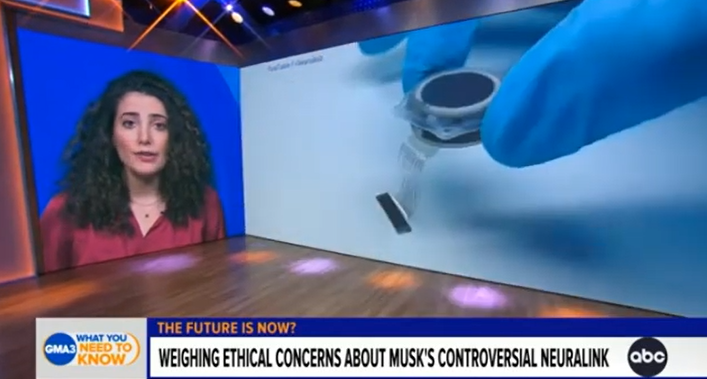
Ethical Concerns Raised Over Elon Musk’s Neuralink

$upport via Cash App👇

Interesting segment on ABC’s GMA show delved into billionaire Elon Musk’s cutting edge brain technology–Neuralink implants–that are supposed to revolutionize how we deal with neurological disorders. The GMA segment came against the backdrop of news reports that the first Neuralink implant on a human had taken place.

The guest, Dr Leah Croll described Neuralink technology thus (0:38): “Basically this is the concept of using a brain machine interface to help people. Neuralink is a device that gets implanted within the brain, and then reads the electrical signals that our brain cells are constantly sending to one another, and then it can translate those signals into actions outside of the body, in this case the ability to control a computer or smartphone.”

Dr Croll added that this is by no means novel technology saying, “It [Neuralink] is absolutely not the first player on this field. This area of research really started back in the 90s but in recent years the pace of that research has just accelerated immensely…”

But as we know all too well, with every cutting edge technology, there are bound to be negative effects, and to that, Dr Jen Ashton popped this million dollar question (1:50): “Physically, what are the risks, and ethically, what are the risks that you can see with this type of technology?”

Dr Croll responded that because we are dealing with brain implants here, we should treat Neuralink procedures as any other brain surgery, and worry about all the physical risks we normally associate with such surgeries–bleeding, damage to brain tissue etc. As for the ethical concerns raised by Neuralink, she said (2:26): “When we get into the ethical realm, that raises so many questions because we are in completely uncharted territory here. There’s concerns about the data that this device is collecting and how secure it might be, there’s potential for privacy concerns to come into play, bad actors could potentially come into play and hack these devices. So there’s a lot of discussions that the medical community is going to have to have with the legal community, the ethical community, the technological community, so we can work together to figure out how we regulate something like this.”

Any reasonable person watching this GMA segment would conclude that even though Elon Musk’s Neuralink technology, on its face,exhibits the potential for significantly improving how we treat neurological disorders, the technology comes with serious ethical concerns that necessitate guardrails before proceeding.

This also means time has finally come for the government to come clean regarding the plight of targeted individuals, who have complained for decades about being the subjects of these “mind reading” technologies while being laughed out of the room as some crazy conspiracy theorists. This GMA segment establishes conclusively that we do indeed have technology that can read minds and more importantly, that this research has been going on since the 90s. It’s also worth pointing out that while Dr Croll correctly insists that there must be guardrails put in place before this technology is deployed to the public, targeted individuals have endured this very invasive technology with zero ethical guardrails. Should they be compensated for the irreparable harm this invasive technology has subjected them to? Should Congress hold hearings into government research projects in this field such as DARPA, to ensure that there have not been abuses? These are the questions one hopes the media will pose to the government as we delve deeper into the Neuralink era.

For those of you very happy with @Emolclause’s activism don’t shy away from the CashApp “tip jar” below👇 on your way out.

Email author at admin@grassrootsdempolitics.com