A Vice President Campaigning Abroad

When Elise Jordan pointed out that J.D. Vance is expected to travel to Hungary to campaign on behalf of Viktor Orbán, she highlighted something that feels deeply out of step with longstanding American political tradition. It is not merely unusual—it is almost without precedent—for a sitting U.S. vice president to actively campaign for a foreign leader, particularly one widely characterized as an authoritarian-leaning figure with close ties to Vladimir Putin. The optics alone raise serious questions about priorities, alliances, and the broader message being sent about the United States’ role in the world.

At its core, the vice presidency is an office rooted in representing American interests—domestically and abroad. When U.S. officials travel internationally, it is typically to strengthen diplomatic ties, negotiate agreements, or reinforce shared democratic values. Campaigning for a foreign political figure crosses into a different realm entirely. It blurs the line between diplomacy and political endorsement in a way that risks undermining the principle of national sovereignty—a principle the United States has historically emphasized in its foreign policy rhetoric. If it is inappropriate for foreign leaders to interfere in American elections, the inverse should raise equal concern.

What makes this situation even more striking is the nature of Orbán’s governance. His tenure in Hungary has been marked by repeated clashes with the European Union over democratic backsliding, restrictions on press freedom, and consolidation of power. While supporters argue he represents a model of nationalist governance, critics view his leadership as emblematic of the erosion of liberal democratic norms. For a sitting U.S. vice president to lend political support—symbolically or otherwise—to such a figure risks signaling a departure from America’s traditional role as a global advocate for democratic institutions and practices.

There is also a strategic dimension that cannot be ignored. Orbán’s perceived alignment with Putin complicates matters further, especially given ongoing tensions between the United States and Russia. Even if the intent of the trip is framed as ideological alignment or coalition-building among like-minded political movements, the broader geopolitical context makes the move difficult to separate from implications about U.S. foreign policy posture. Allies may question whether Washington is shifting its stance, while adversaries may interpret the gesture as a sign of division or inconsistency.

Defenders of the trip might argue that in an increasingly interconnected political landscape, ideological alliances transcend borders, and leaders have a right to engage with counterparts who share their worldview. They may also point out that American politicians frequently attend international conferences or speak at global forums hosted by foreign leaders. But there is a meaningful distinction between participating in dialogue and actively campaigning for someone seeking or maintaining power in another country. The latter carries a level of endorsement that goes beyond mere engagement—it is political intervention in spirit, if not in law.

Ultimately, the unease surrounding this development stems from a broader concern about precedent. If it becomes normalized for high-ranking U.S. officials to campaign for foreign leaders, it opens the door to a new kind of political entanglement—one where domestic politics and international power struggles become increasingly intertwined. That is a shift that could erode trust, both at home and abroad, in the impartiality and integrity of American leadership.

Jordan’s observation captures more than just a surprising headline—it underscores a moment that forces a reconsideration of what is expected from those who hold the highest offices in the United States. Whether one views the trip as strategic outreach or a troubling deviation, it undeniably challenges the norms that have long defined the boundaries between American governance and global political influence.

Jordan’s Queen Rania Slams The West Over “Glaring Double Standard” Regarding Israel-Palestine Conflict

$upport via Cash App

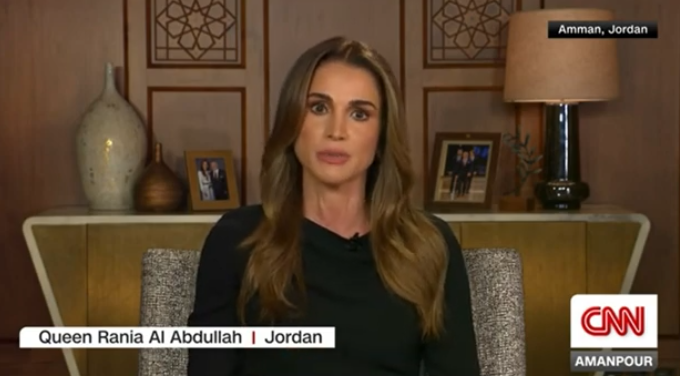
In an interview with CNN’s Christian Amanpour( 10/24/23), Jordan’s Queen Rania Al Abdullah took issue with the way the West (read United States) has handled the Israel-Palestine conflict, after the terrorist attacks by Hamas on 10/07/23. Queen Rania, who is of Palestinian descent, slammed the West over what she called a “glaring double standard” in the way they treat Israel vis a vis Palestine.

Queen Rania specifically said: “The people all around the Middle-East, including in Jordan, we are just shocked and disappointed by the world’s reaction to this catastrophe that is unfolding. In the last couple of weeks we have seen a glaring double standard in the world. When October 7th happened, the world immediately and unequivocally stood by Israel and…condemned the attacks that happened. But what we’re seeing the last couple of weeks, we are seeing silence in the world. Countries have stopped expressing concern, or acknowledging the casualties, but always with the preface of declaration of support for Israel. Are we being told that it is wrong to kill an entire family at gunpoint, but it’s okay to shell them to death? I mean there is a glaring double standard here, and it is just shocking to the Arab world. This is the first time in modern history that there is such human suffering, and the world is not even calling for a ceasefire, so the silence is deafening, and to many in our region, it makes the Western world complicit…Many in the Arab world are looking at the Western world as not just tolerating this, but as aiding and abetting it…and this is just horrendous, and deeply deeply disappointing to all of us.”

There is no other way to interpret Queen Rania’s remarks other than, she is calling for cessation of hostilities by both sides (Hamas and Israel) so that the world can focus on the humanitarian conditions of the desperate millions of people trapped in Gaza. It is a concern shared by many, including Yours Truly, who reflexively side with Israel. Simply put, every reasonable person wants the eradication of the terrorist group Hamas from the region. Let’s however do it in a way that does not also wipe away millions of innocent Palestinians.

For those of you very happy with @Emolclause’s activism don’t shy away from the “tip jar” below on your way out. You may also Cash App

Email author at admin@grassrootsdempolitics.com

Become an Octapharma Plasma donor. Make up to $200 in one week and help save lives too! Learn More

Dem Rep Jayapal Questions FBI Director Wray Over Warrantless Searches

$upport via Cash App

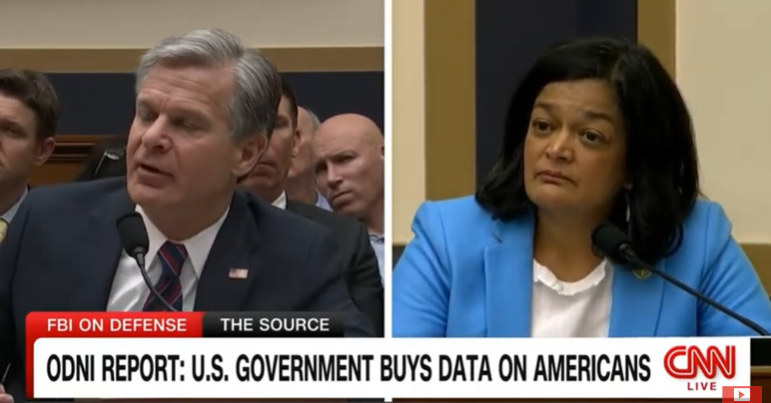
Rep Pramila Jayapal (D-WA) appeared on CNN’s The Source show (07/12/23) where she discussed among other things, her questioning of FBI Director Christopher Wray about warrantless searches at a recent House hearing. Specifically, Rep Jayapal wanted to know why the FBI and other federal agencies are buying vast quantities of personal data from data brokers, and how the agencies use this warrantless search data.

Rep Jayapal dropped a bombshell during her interview, telling host Kaitlan Collins that if the FBI doesn’t provide a satisfactory answer to this important question, she will have no other choice but to vote against reauthorizing the Foreign Intelligence Surveillance Act (FISA) when it expires later this year–a very big deal.

What makes this a very big deal, you ask? Well, Rep Jayapal heads the House Progressive Caucus. If she decides to vote against reauthorizing FISA, you can rest assured that nearly all House Progressives will vote with her, killing FISA.

Asked by host Kaitlan Collins whether she was satisfied by the answers she got from FBI Director Wray, Rep Jayapal said she wasn’t, adding( 1:29), “We do have significant concerns, It’s not just I. The Office of Director of National Intelligence(ODNI) is where the report came from, that said that the FBI is purchasing large amounts of data from these data brokers, and that information contains everything, from your location information, your medical information, it could contain information about all kinds of private things that American people understandably don’t want the FBI to have…These are warrantless searches…they are backdoor searches. The information is used in ways we don’t know…”

Bottom line folks, Rep Jayapal is absolutely correct that warrantless surveillance by the FBI and other federal agencies is out of control, and in serious need of a fix. We’ve become accustomed to hearing members of Congress threatening to block FISA reauthorization over the same surveillance abuses, only to have them cave at the end due to pressure from the national security establishment. Something however tells me (not exactly sure what that is), that 2023 may be the year members of Congress finally drop the hammer on FISA, or as legal eagle Jonathan Turley puts it, the year they decide against being “chumps”.

For those of you very happy with @Emolclause’s activism don’t shy away from the “tip jar” below on your way out. You may also Cash App

Email author at admin@grassrootsdempolitics.com

Become an Octapharma Plasma donor. Make up to $200 in one week and help save lives too! Learn More

Rep Jim Jordan’s Shifty Answers About His Convos With Trump On January 6th

$upport via Cash App

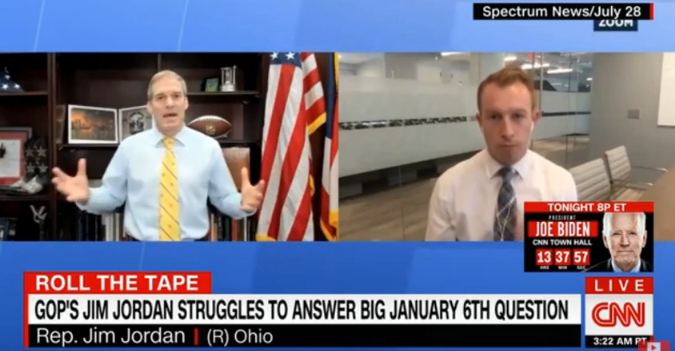
CNN’s Brianna Keilar did an interesting segment on her New Day show (10/21/2021), where she explored Rep Jim Jordan’s very shifty answers to questions about his conversations with then President Trump on January 6th 2021. It appears Rep Jim Jordan’s accounts of his conversations with Trump on that fateful day appear to be changing with every subsequent interview, meaning he may be hiding, or attempting to hide some details about his interactions with Trump on that day.

After stating categorically in previous interviews that he spoke to Trump on January 6th, but only after the insurrection, the Ohio Congressman appears to be changing his tune lately, suggesting that he spoke to Trump on January 6th, but he doesn’t know “when those conversations happened.” Basically, he now doesn’t remember whether he spoke to Trump before or after the insurrection.

Any reasonable person presented with Rep Jim Jordan’s conflicting statements as to whether he spoke to Trump before or after the January 6th insurrection will arrive at the same conclusion, and that is, Rep Jim Jordan is attempting to hide details of his January 6th conversations with Trump from the public. Rep Jordan’s phone records on January 6th can solve this mystery instantly.

Bottom line folks, one doesn’t have to be an experienced investigator to deduce from the CNN segment that Rep Jordan should be a person of interest for the January 6th Commission. Maybe, just maybe, he’ll remember the exact time he spoke to Trump on January 6th, if he is forced to testify under oath.

For those of you very happy with @Emolclause’s activism don’t shy away from the “tip jar” below on your way out. You may also Cash App

Email author at admin@grassrootsdempolitics.com

Become an Octapharma Plasma donor. Make up to $200 in one week and help save lives too! Learn More