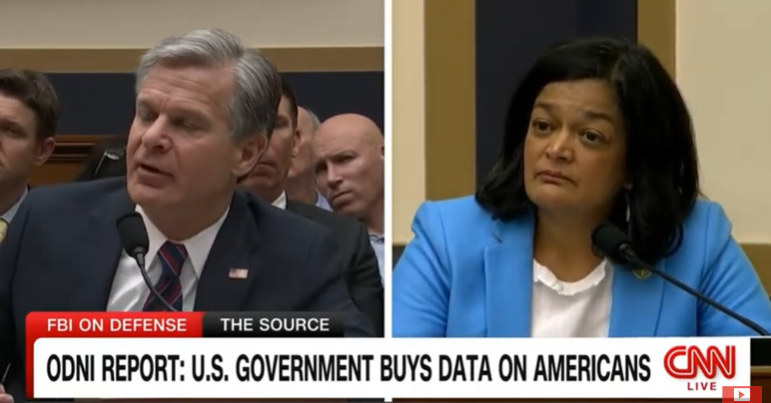
The news that 42 House Democrats voted to reauthorize surveillance powers under Foreign Intelligence Surveillance Act is almost guaranteed to land poorly with a sizable portion of the party’s grassroots. For activists who have spent years warning about civil liberties, executive overreach, and the potential for abuse—especially under polarizing figures like Donald Trump—this kind of vote feels less like a technical policy decision and more like a betrayal of core principles. It cuts directly against a narrative that Democrats often use to distinguish themselves: that they are the party more skeptical of unchecked surveillance power and more protective of individual rights. When that expectation collides with reality, frustration tends to spill out quickly and loudly.
That frustration is likely to be amplified online, where simplified interpretations take hold fast. The idea that “if all Democrats had voted no, the measure would have failed” creates a clean, emotionally resonant storyline—one where a unified opposition could have stopped something unpopular, but didn’t. That gap between what could have happened and what did happen becomes fertile ground for accusations of hypocrisy or complicity. It also feeds directly into the long-running “uniparty” critique—the belief that, despite rhetorical differences, both major parties ultimately converge on key issues like national security and surveillance when it matters most. For critics who already suspect that partisan divides are overstated, this vote becomes exhibit A.
At the same time, the motivations behind those 42 votes are likely far more complicated than the online backlash suggests. Members of Congress don’t operate in a vacuum; they represent districts with very different political compositions and priorities. For Democrats in competitive or purple districts—places where elections are decided on the margins—national security votes can carry particular weight. A “no” vote on surveillance authorities can be framed by opponents as being weak on security, even if that framing oversimplifies the policy. In tightly contested races, that kind of vulnerability can be decisive, and lawmakers know it.
There’s also the institutional pressure that comes with governing. Intelligence agencies, leadership figures, and bipartisan committees often emphasize the importance of maintaining surveillance capabilities, arguing that they are essential tools for counterterrorism and foreign intelligence. Lawmakers who sit on relevant committees or receive classified briefings may come away with a different sense of urgency than the public sees. Even if they have reservations about privacy implications, they may weigh those concerns against what they are told are real-world risks. In that context, a vote to reauthorize isn’t always an endorsement of the status quo—it can be a reluctant calculation shaped by information that isn’t fully visible to voters.
Political incentives inside Congress also play a role. Party leadership sometimes encourages members to support certain measures to maintain negotiating leverage or to secure concessions elsewhere. For newer members or those seeking committee assignments or leadership favor, breaking with the party line—or with a bipartisan consensus—can carry costs. Even in a party that often emphasizes ideological cohesion, there are layers of strategic decision-making that complicate what might otherwise look like a straightforward vote.
None of that is likely to fully satisfy grassroots critics, though. From their perspective, the broader pattern matters more than the internal reasoning. Each vote like this reinforces a sense that campaign rhetoric about protecting civil liberties doesn’t always translate into legislative action. Over time, that perception can erode trust, dampen enthusiasm, and create tension between the party’s base and its elected officials. It also gives political opponents—and internal critics—an easy talking point: that when it comes to certain core powers of government, the differences between the parties narrow considerably.
What emerges, then, is a familiar dynamic in American politics: elected officials navigating complex, often conflicting pressures, while voters—especially highly engaged ones—demand clearer adherence to stated principles. The gap between those two realities doesn’t just produce moments of backlash like this one; it shapes the broader narrative about what each party stands for, and whether those distinctions hold up when the stakes are highest.