Elites Largely Escaping Consequences Of Enabling Epstein

As the fallout from the release of the Epstein Files continues to unfold, a familiar and deeply troubling pattern is coming into focus. In the United States, powerful elites who once minimized, dismissed, or obscured their ties to Jeffrey Epstein are largely skating past meaningful consequences, even as newly released emails shed light on just how close and sustained some of those associations were. Titles may be adjusted, statements may be issued, but real accountability remains elusive. Very few figures have truly relinquished power, prestige, or access as a result of what has been revealed.

MSNOWโ€™s Lisa Rubin captured this dynamic perfectly in her recent segment, using the Paul Weiss situation as a textbook example of cosmetic accountability masquerading as reform. Rubin rightly pointed out the absurdity of portraying Alex Karpโ€™s removal as chairman as a serious sanction while the firm simultaneously retains him as a partner in good standing. In any meaningful sense, this is not punishment at all. It preserves his status, income, and institutional legitimacy, while allowing the firm to claim it has โ€œtaken action.โ€ As Rubin emphasized, accountability that leaves power and privilege fundamentally untouched is not accountabilityโ€”itโ€™s reputation management.

What makes this moment especially jarring is how often these gestures are presented as sufficient in elite American circles. The message, implicit but unmistakable, is that association with Epstein may cost you a title, but not your standing. Not your access. Not your seat at the table. That pattern repeats across industries, from law to finance to politics, reinforcing the idea that consequences in the United States are calibrated not to wrongdoing, but to optics.

Adding to the unease is the manner in which the Epstein Files themselves have been released. Numerous emails detailing communications with Epstein on deeply disturbing topics have surfaced with the sendersโ€™ names conspicuously redacted. This stands in direct tension with the stated goals of transparency and has fueled the perception that the Department of Justice is selectively shielding certain powerful individuals. Whether intentional or not, the effect is the same: the public is left with the sense that there remains a protected class for whom full exposure, let alone accountability, is off-limits.

The contrast with Europe is striking. While not perfect and hardly immune to elite self-protection, several European governments have moved more decisively when Epstein-related connections came into view. In the United Kingdom and France, authorities have reopened or expanded investigations into citizens tied to Epsteinโ€™s network, with public figures stepping aside pending review rather than clinging to their roles. In other cases, individuals have issued unequivocal apologies and withdrawn from public or professional life altogether, acknowledging that proximity to Epsteinโ€”regardless of criminal liabilityโ€”raises serious ethical questions incompatible with positions of trust. This approach reflects a broader European norm: that the appearance of impropriety itself can warrant real consequences, not just symbolic ones.

That difference matters. Accountability is not only about legal culpability; it is about institutional integrity. When firms and governments act swiftly and decisively, they signal that power does not exempt anyone from scrutiny. When they stall, deflect, or offer half-measures, they send the opposite messageโ€”that elite networks will always protect their own.

Whether the accountability emerging in Europe will eventually pressure American institutions to follow suit remains an open question. But Lisa Rubin is undeniably right to call out the hollowness of moves like the one at Paul Weiss. If major firms in the United States want to be taken seriously in the post-Epstein era, they must move beyond cosmetic fixes and confront the uncomfortable truth that real accountability requires real sacrifice. Until that happens, the gap between rhetoric and reality will continue to grow, and public trust will continue to erode.

Three Questions Alex Acosta Must Answer Re Epstein

MSNBCโ€™s Legal Analyst Lisa Rubin appeared on the 09/19/25 edition of Deadline White House show where she made a compelling argument as to how Congress can and should go about getting Jeffrey Epstein-related information from former U.S. Attorney Alex Acosta.

Rubin said that there are a bunch of Epstein-related documents that Acosta either saw, or was involved in creating. This, she argued, meant the said documents were either currently in the possession of the Department of Justice, or even by Acosta himself.

The first question Congress needs to ask Acosta is about the 60-count federal indictment drafted by prosecutor Ann Marie Villafaรฑa in 2007. DOJ definitely has this document, and the allegations therein, may shed a lot of light as to Epsteinโ€™s illicit operation, and potentially, the actions of his his co-conspirators, most of who were later granted immunity.

The second question regards the lengthy prosecution memo that aforementioned Villafaรฑa wrote regarding the federal case re Epstein. Rubin says this can shed a lot of light as to the evidence the feds had against Epstein to support the 60-count indictment

Finally, Rubin says Congress should ask Acosta about his own interview transcript from the office of professional responsibility investigation that was conducted at DOJ in 2020. That was an investigation started at the instigation of Republican Senator Ben Sasse. Rubin argues that Acosta must have that transcript in his possession because he and his lawyers were given an opportunity to review it and suggest any corrections.

Long story short, the lingering questions about Jeffrey Epstein and his child sex trafficking operation must be answered, and key players like Acosta must not be allowed to come before Congress and just gaslight the public. These crucial documents are currently in the possession of the DOJ and/or Acosta, and the public deserves to see them.

An alternative route would be to have Ann Marie Villafaรฑa testify before Congress. Who knows, she might have โ€œkept receiptsโ€.

The Best Case For Jailing Trump Over The Hush Money Case

$upport viaย Cash App

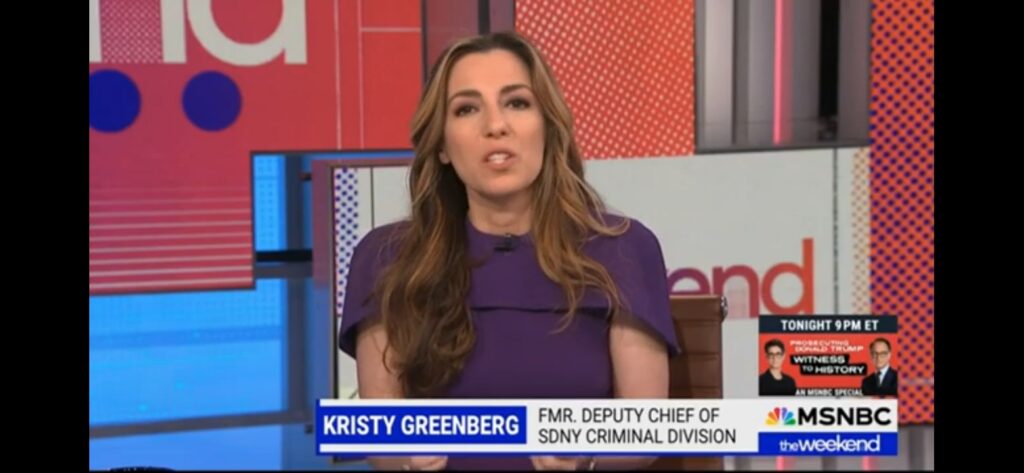
Kristy Greenberg, Former Deputy Chief at SDNY’s Criminal Division, appeared on MSNBC’s The Weekend show (06/09/24) where she made quite a compelling case as to why former President Trump should be imprisoned after being found guilty of 34 felony counts in the hush money case–the best case yet, as far as Yours Truly is concerned.

Kristi Greenberg: “I think that if you objectively look at all of the factors that are taken into account in sentencing, the prosecutors here should be seeking a jail sentence, and the judge should impose one. Look at the nature and the seriousness of the conduct…This was about the subversion of democracy. This was about depriving the voter of information that they would need when they go to the ballot box and decide who to vote for. What is more important than that?”

She also knocked down the argument one regularly hears on Fox News and other pro-Trump media outlets–that Trump should be accorded some deference and spared prison time, simply because he’s a former president. She argued instead that, because Trump wrote the hush money checks from the Oval Office, the judge should treat that as “an aggravating factor” for sentencing purposes.

In conclusion, she made the case that because Michael Cohen went to jail for the same conduct, Trump should likewise be imprisoned, especially given the fact that he was directing the criminal scheme–a slam dunk argument in my opinion. She specifically told the MSNBC hosts (1:09): “Michael Cohen went to jail for the same conduct, and he was less culpable than Donald Trump, who was directing him to do it. So if it’s serious enough for Michael Cohen to go to jail, it is certainly serious enough for Donald Trump to go to jail as well.”

For those of you very happy withย @Emolclauseโ€™s activism donโ€™t shy away from the โ€œtip jarโ€ below on your way out. You may also Cash App

Email author at admin@grassrootsdempolitics.com

Become an Octapharma Plasma donor. Make up to $200 in one week and help save lives too!ย Learn More