How Long Will The U.S. Keep Boots On The Ground In Venezuela?

Please consider $upporting GDPolitics by scanning the QR code below or clicking on this link

Rep. Anna Paulina Luna (R-FL) appeared on MSNOW this weekend to discuss the rapidly unfolding developments surrounding the U.S. capture of Venezuelan President Nicolás Maduro. When pressed by one of the hosts on how long Americans should expect U.S. military boots to remain on the ground in Venezuela, Luna offered little beyond a hope—saying she “hopes” the deployment won’t last long. That answer may sound reassuring, but history gives us little reason to share her optimism.

Hope is not a strategy, especially when it comes to U.S. regime-change operations. If there is one consistent lesson from America’s modern military interventions, it is that removing a leader is usually the easiest part. What follows—stabilization, governance, security, and reconstruction—is where things unravel, drag on, and become vastly more expensive in both blood and treasure. Libya and Iraq loom large as cautionary tales, and Venezuela shows every sign of following the same grim script.

Iraq is perhaps the clearest example of this delusion. Military planners and television pundits alike once spoke confidently of a war that would be over in days or weeks. And indeed, the initial invasion was swift and overwhelming, culminating in the rapid toppling of Saddam Hussein. But the fall of a dictator did not produce the democratic transformation Washington promised. Instead, the United States found itself mired in a prolonged occupation, battling insurgencies, sectarian violence, and political chaos that cost hundreds of thousands of lives and trillions of dollars. Libya followed a similar trajectory: regime change first, disorder and state collapse afterward.

There is little reason to believe Venezuela will be any different. Removing Maduro does not magically resolve deep political divisions, economic collapse, or regional instability. Those problems do not disappear when a strongman is captured; they intensify. The idea that U.S. forces can simply step in, flip a switch, and then quickly depart belongs more to fantasy than to serious strategic thinking. The smart money says that once boots are on the ground, they stay—often far longer than anyone publicly admits at the outset.

This reality also collides head-on with “America First” rhetoric. An unprovoked military incursion into Venezuela, paired with open threats toward other governments in the region, hardly aligns with a foreign policy supposedly focused on rebuilding at home. Every dollar spent sustaining an open-ended military presence abroad is a dollar not spent addressing America’s own crumbling infrastructure, healthcare gaps, or economic inequality. And as history has shown, these ventures rarely remain bloodless. Casualties are not an unfortunate possibility; they are an almost inevitable outcome.

Americans should therefore be clear-eyed about what is unfolding. If past is prologue, the United States is not heading for a brief, tidy mission in Venezuela, but for a long and costly entanglement. Congress cannot simply defer to vague hopes or executive assurances. It has a constitutional obligation to demand accountability, debate the mission honestly, and decide whether this path truly serves the nation’s interests—before yet another “quick intervention” turns into a generational tragedy.

Trump Admin’s Troubling Art Of The Label

Please consider $upporting GDPolitics by scanning the QR code below or clicking on this link

An illuminating segment on MSNOW’s Weekend Primetime examined how the Trump administration has refined what can only be described as the art of the label—an exercise in branding human beings as threats and then using that label alone to justify the application of overwhelming military force. Host James Sample walked viewers through how this practice operates in real time: individuals or groups are branded with ominous-sounding designations, and those designations, largely untested and unchallenged, become sufficient grounds for detention, deportation, or death. The alarming part is not merely the labeling itself, but how seamlessly these hollow classifications are converted into acts of state violence, often without any discernible legal foundation or meaningful oversight.

For a country that endlessly invokes the rule of law and treats “due process” as a sacred principle, it is chilling to watch how easily government officials can, on little more than assertion, affix a label to a person and render that individual a legitimate military target. Once the label is applied, the usual safeguards—evidence, hearings, accountability—simply vanish. Even more disturbing is the near-total absence of resistance from Congress or sustained scrutiny from the media, allowing the executive branch to operate as judge, jury, and executioner based on nothing more than its own say-so.

Sample illustrated how this tactic has evolved and expanded. It began, he explained, with migrants being labeled as members of the dangerous gang Tren de Aragua, a claim often unsupported by evidence, and then using that unvetted designation to justify sending them to CECOT, where they were subjected to brutal conditions and torture. The label alone did the work; no adjudication was required, no proof demanded. From there, the administration escalated, branding people aboard boats in the Caribbean as “narcoterrorists” and then using that designation to justify blowing the vessels out of the water, killing those on board. Beyond the invocation of the narcoterrorism label itself, the administration offered little to persuade the public that the people killed actually met that definition.

According to Sample, the most recent and perhaps most dangerous iteration of this practice has emerged in Africa, where the administration has labeled certain regions in Nigeria and Somalia as ISIS-controlled areas and then relied solely on that characterization to carry out military strikes. In Nigeria, one such attack reportedly occurred on Christmas Day, underscoring the moral numbness that accompanies this kind of empty labeling. When entire regions can be reduced to a single word—“ISIS”—and that word becomes a license to kill, the line between lawful military action and lawless violence all but disappears.

At some point, Congress must intervene and reclaim its constitutionally mandated role. That intervention should begin with demanding answers about these labels: how they are defined, what evidence supports them, and what legal reasoning is used to transform them into justifications for lethal force. The military lawyers who sign off on these actions should be required to testify publicly and explain their rationale to the American people. Only sustained oversight and transparency can halt the dangerous slide toward governance by label, where words replace law and accountability is an afterthought. One can only hope Congress acts before more lives are lost to this reckless and hollow exercise of power.

Corruption Becoming A Central Theme In Trump Admin 2.0

Please consider $upporting GDPolitics by scanning the QR code below or clicking on this link

On the 12/22/25 edition of MSNBC’s Rachel Maddow Show, Maddow zeroed in on what is rapidly emerging as a defining feature of Trump administration 2.0: corruption. There is a bitter irony here. Trump first rode to power on the promise to “drain the swamp,” arguing that his personal wealth insulated him from influence peddling and that his outsider status would free Washington from its culture of self-dealing. Instead, one year into his second term, corruption is no longer a peripheral criticism of Trump’s presidency — it is becoming the central storyline.

Maddow opened the segment not in Washington, but in Bulgaria. There, a government recently collapsed under sustained public pressure over endemic corruption. Maddow’s choice was deliberate. By beginning abroad, she framed corruption not as an abstract moral failing, but as a destabilizing force capable of toppling governments when it becomes too blatant to ignore. The lesson was implicit but unmistakable: corruption has political consequences, and no democracy is immune. Only after establishing that broader context did she pivot back to the United States — and to Trump administration 2.0.

What followed was a catalogue of ethically dubious dealings that, taken together, have led many observers to already label this administration as the most corrupt in modern American history. Maddow focused first on Donald Trump Jr., whose proximity to power appears to be translating directly into extraordinary financial opportunities. One case involves a little-known drone company that placed Trump Jr. on its board and awarded him company shares, only to subsequently land a $15 million Pentagon contract. The timing alone raises obvious questions, and Maddow bluntly asked the one many Americans are already asking: was the contract awarded on merit, or because the president’s son now sat inside the company’s boardroom?

That deal, troubling as it is, appears to be only part of a much larger pattern. Maddow reported that another company tied to Trump Jr. received a staggering $620 million loan or contract from the Pentagon — the largest loan ever issued by the Department of Defense. The scale of that award, coupled with Trump Jr.’s personal financial stake, moves the story beyond appearances and into territory that looks like textbook influence trading. Even by Washington’s historically lax standards, this is extraordinary.

The corruption narrative does not stop with the president’s family. Maddow also revisited the case of Tom Homan, now serving as Trump’s Border Czar. Before assuming his current role, Homan reportedly accepted $50,000 in cash — money allegedly intended to influence how DHS contracts would be steered once he reentered government. What makes the episode particularly striking is the level of foresight involved. Both Homan and those paying him appeared confident not only that Trump would return to power, but that Homan would land in a specific, strategically valuable position within the administration. It suggests corruption that is not opportunistic, but premeditated — a system anticipating power and positioning itself to exploit it.

Department of Homeland Security Secretary Kristi Noem has also found herself at the center of corruption allegations. Maddow detailed how DHS steered lucrative advertising contracts to a little-known firm with longstanding political ties to Noem, dating back well before her appointment as secretary. The pattern again feels familiar: public money flowing toward private entities connected to powerful figures, with little transparency and even less accountability. These are not isolated incidents; they form a mosaic of governance that treats the federal government as an extension of a political and personal network.

Hovering over all of this is the unresolved legacy of Jared Kushner. His dealings during the first Trump administration — particularly his post-White House financial windfall tied to foreign governments — were never fully reckoned with. Now, Maddow noted, Kushner is once again positioned to profit, this time through involvement in discussions surrounding the rebuilding of Gaza. The reemergence of Kushner in a role adjacent to foreign policy and massive reconstruction funding reinforces the sense that Trumpworld never truly left its transactional mindset behind. It simply paused, regrouped, and returned more emboldened.

All of this is unfolding as the country barrels toward the 2026 midterm elections. Historically, corruption has been one of the few issues capable of cutting through partisan loyalty, particularly when it becomes this overt and this personal. Democrats are clearly betting that the accumulation of these scandals — not one, but many — will erode public trust and mobilize voters who may be exhausted by chaos but still responsive to clear abuses of power. For Republicans, the question is whether they can continue to normalize or deflect these stories without paying an electoral price.

The Bulgarian example Maddow opened with now feels less like a foreign curiosity and more like a cautionary tale. Corruption, when left unchecked, does not merely stain reputations — it destabilizes governments and reshapes political futures. Whether Trump administration 2.0 faces similar consequences will be decided not just in courtrooms or congressional hearings, but at the ballot box in November 2026.

Machado Leaves No Doubt This Has Always Been About Regime Change

Maria Corina Machado’s appearance on CBS’ Face The Nation all but confirmed what many Americans have suspected as President Trump escalates pressure on Venezuela: regime change, not narcotics enforcement, is the true objective. While the administration continues to frame its military buildup and aggressive posture as a necessary response to so-called “narco-terrorists,” Machado’s own words exposed that justification as little more than political cover.

For months, President Trump has insisted that his actions toward Venezuela are narrowly focused on combating drug trafficking networks that he claims threaten U.S. national security. The administration’s repeated use of the term “narco-terrorism” is meant to evoke urgency and legitimacy, suggesting a defensive posture rather than an interventionist one. Yet this explanation has always strained credulity, particularly given Venezuela’s vast oil reserves and strategic importance. Those realities have inevitably fueled skepticism that Washington’s true aim is to remove Nicolás Maduro and install a government far more amenable to U.S. economic and geopolitical interests.

That skepticism has only grown sharper because Trump himself campaigned aggressively in 2024 on a “no regime change” platform. It was a message designed to reassure a war-weary electorate and an America First base deeply suspicious of foreign entanglements. Many of those same supporters are now openly questioning how a military buildup, veiled threats, and constant escalation toward Caracas square with the promises they were sold. The administration’s narco-terrorism rationale has functioned as a convenient way to bridge that contradiction—until Machado spoke plainly.

During her interview with Margaret Brennan, Machado did not merely criticize Maduro or call for international pressure. She openly discussed preparations for governance after his removal. In doing so, she revealed that plans are already in place for what comes once Maduro is toppled. That single admission dismantled the White House’s stated rationale. You do not develop detailed post-Maduro contingencies unless regime change is not only desired, but anticipated and actively pursued.

Brennan never had to explicitly ask whether the Trump administration is seeking regime change because Machado answered the question unprompted. She spoke about how a future Venezuelan government would manage destabilization efforts by foreign powers such as Russia and China—an extraordinary acknowledgment that she views Maduro’s fall not as hypothetical, but as imminent. That kind of forward-looking strategizing does not occur in a vacuum. It only makes sense if Washington has signaled, implicitly or explicitly, that removing the current regime is the goal.

Machado’s remarks effectively stripped away the last fig leaf of the narco-terrorism argument. If the mission were truly limited to drug interdiction, the discussion would center on law enforcement cooperation, intelligence sharing, and regional partnerships. Instead, what emerged was a clear blueprint for political transition. Her interview made it obvious that the Trump administration’s posture toward Venezuela has never been about drugs alone, and certainly not about restraint.

As this saga unfolds, the political consequences may prove just as significant as the geopolitical ones. Republicans who loudly embraced the “no regime change” mantra in 2024 will soon face voters again in the 2026 midterms. Machado’s candid interview has made it far harder for them to reconcile their past rhetoric with present reality. What was once denied outright is now being openly discussed by the very opposition leader the U.S. appears poised to empower.

In the end, Face The Nation did more than host an interview—it pulled back the curtain. And what was revealed leaves little room for doubt: regime change in Venezuela is not a byproduct of Trump’s policy. It is the policy.

Gov Pritzker Blasts DHS Sec Noem on CNN’s State of the Union

Illinois Governor J.B. Pritzker appeared on CNN’s State of the Union (10/05/25), where he sharply criticized DHS Secretary Kristi Noem over the conduct of federal officials in Chicago.

Pritzker disputed Noem’s earlier claim that Chicago residents were “clapping” for DHS agents—calling it a misleading portrayal meant to suggest public support. He argued that DHS is turning Chicago into a “war zone” by targeting peaceful protesters instead of focusing on “the worst of the worst.”

The clash may soon land in court. Illinois Attorney General Kwame Raoul has warned that if federal troops are deployed to Chicago, the state will file suit.  Raoul is already suing over the administration’s withholding of public safety funds from states that refuse to cooperate with federal immigration enforcement. 

The question now: will the courts permit President Trump to deploy military forces in Chicago over Gov. Pritzker’s objections?

President Trump’s Interview On MTP 050425

President Trump sat down for an extensive interview with NBC Meet The Press’ Kristen Welker on 05/04/25. As expected the interview covered all the major topics of the day—economy, immigration, military, foreign affairs, and in typical Trump fashion, even some humorous moments. Hey, he’s not a tv ratings magnet for nothing.😂🤷‍♀️

One of the most humorous moments for me, came when host Kristen Welker asked him when problems in the economy can be attributed to his actions—ostensibly referring to the damage the tariffs are doing to the economy. President Trump responded by saying that when the economy does good, he should get the credit, and when it struggles, his predecessor Biden should bare the blame.😂

It will be interesting to see how this position holds, as the effects of tariffs become visibly evident from the empty store shelves. Will MAGA blame the empty shelves on Biden’s economic policies? Hmm, as Trump famously says, “We’ll see what happens.”

President-Elect Trump Promises Massive Crackdown On The Deep State

Support via CashApp👇

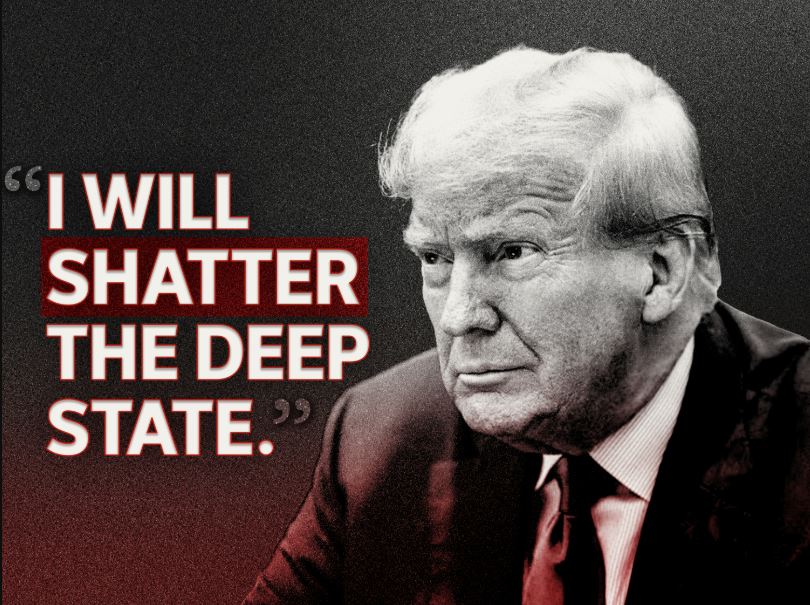
In one of his post election posts on X, President-Elect Donald Trump promised to “dismantle the Deep State.” This as you know, was a central theme of his presidential campaign so it should come as no surprise to anyone. The question now is whether he will actually deliver on this seemingly tall order that may play well on the campaign trail, but prove very difficult in terms of actually pulling it off.

https://twitter.com/elonmusk/status/1854765949582299508?t=PsN08HAds0I2dmwxljVlmg&s=19

Different people have different notions as to what the Deep State actually means, or whether it even exists, but the general consensus is that they are powerful but unelected bureaucrats, who control the levers of power behind the scenes, and span different administrations (both Democrat and Republican)–essentially a permanent unelected ruling class, who ruthlessly protect their power from “outsiders”–ambitious people they don’t approve of/like. They use the instruments of government(the ABC agencies we shall not name) to crush their perceived enemies.

Trump has cast himself as one of those outsiders, and he points to his endless criminal prosecutions as proof of the Deep State coming after him. He has repeatedly singled out the FBI as one of the key instruments of the Deep State that he wants hollowed out.

Whether or not the FBI has become an instrument of the Deep State as Trump alleges, is a question Yours Truly chooses to sidestep for now–way above my pay grade. What Yours Truly finds very encouraging about Trump’s proclamation however, is that during his 4 years, maybe, just maybe, we may achieve something I have begged and prayed for for quite a long time now, and that is, a Church-type Committee to look into the abuses of our intelligence agencies.

The last time we did an audit of our intelligence agencies was way back in the 1960s so reasonable people will agree that a fresh audit is way past due. A lot of “dirt” was uncovered in the previous audit (cointelpro being the main one) so smart money is that 70 years after that, there are bound to be some let’s just say, “interesting” new programs to be “unearthed”. I for one, would keep my eyes open for the notorious Targeted Individual program, which our intelligence agencies have categorically dismissed as a conspiracy theory. A Church-type committee would be the perfect venue to get to the bottom of this supposed “conspiracy theory”.

Yours Truly has long advocated for the enactment of a new Church-type commission to investigate the abuses of power by our intelligence agencies. Though President-Elect Trump doesn’t outrightly call for the creation of such a commission, reasonable people will agree that his recent post on X is the most serious attempt yet by a modern American president to rein in our out of control intel agencies, and for that, he deserves a lot of praise. Whether he will keep his promise is a different matter altogether.

President-Elect Trump is known to desire things/issues that cast him aside from other American presidents in terms of greatness. Well, 70 years later, historians are still talking about the historic Church Committee hearings, and the administration that was in charge then. If Trump pushes for a new Church-type committee during his four years, historians will also be talking favorably about his administration 100 years from now, especially if a lot of illegal government activity is uncovered.

President-Elect Trump should also know that a much overdue audit of our intelligence agencies is an issue that enjoys tremendous bipartisan support despite the media’s depiction of it as a partisan MAGA issue.

Trump Wants To Reinstate Eisenhower’s Infamous “Operation Wetback” Immigration Policy

$upport via Cash App

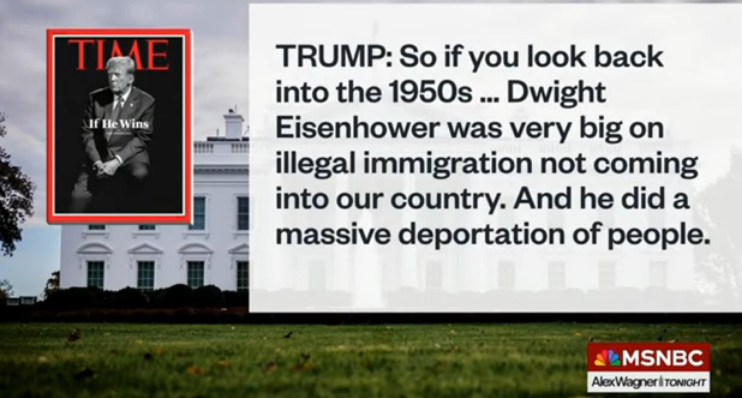
A bombshell segment on MSNBC’s Alex Wagner Tonight show (04/30/24) delved into a recent interview Republican presidential candidate Donald Trump had with Time Magazine. As host Alex Wagner correctly pointed out, the biggest bombshell from the Time interview was Trump’s admission that if elected president again, he would be open to a draconian immigration policy that mirrors former President Eisenhower’s infamous “Operation Wetback.”

Time Magazine’s Eric Cortellessa(2:35): “You’ve said you’re gonna do this massive deportation operation. I want to know specifically how you plan to do that.”

Trump: “So, if you look back to the 1950s, [President] Dwight Eisenhower was very big on illegal immigration not coming to our country. And he did a massive deportation of people.”

Any reasonable person presented with Trump’s response would conclude, as host Alex Wagner did, that if elected president again, Trump intends to craft a draconian immigration policy that mirrors Eisenhower’s “Operation Wetback”.

It will be interesting to see how Hispanics, who Trump has successfully peeled off from the “reliable Democrats” tent, will react to this bombshell revelation. As host Wagner correctly pointed out, a lot of U.S. citizens of Mexican descent also got swept up in Eisenhower’s militarized “Operation Wetback” raids, and got deported illegally to Mexico.

Will a potential “Operation Wetback 2.0” be a game-changer with MAGA Hispanics in 2024, making them pull the lever for Biden? Hmm, as Trump famously says, “We’ll see what happens.”

I’d be remiss if I didn’t point out the fact that in the interview, Trump also appeared eager to expand law enforcement’s “qualified immunity” to a point where it is practically “absolute immunity”. This would dramatically roll back progress that has been made–and there has been progress–in the fight against police brutality, especially as it pertains to Black and Brown communities. Will this be a game-changer for the so-called BlacksForTrump? Hmm, we shall see.

For those of you very happy with @Emolclause’s activism don’t shy away from the “tip jar” below on your way out. You may also Cash App

Email author at admin@grassrootsdempolitics.com

Become an Octapharma Plasma donor. Make up to $200 in one week and help save lives too! Learn More

Ethical Concerns Raised Over Elon Musk’s Neuralink

$upport via Cash App👇

Interesting segment on ABC’s GMA show delved into billionaire Elon Musk’s cutting edge brain technology–Neuralink implants–that are supposed to revolutionize how we deal with neurological disorders. The GMA segment came against the backdrop of news reports that the first Neuralink implant on a human had taken place.

The guest, Dr Leah Croll described Neuralink technology thus (0:38): “Basically this is the concept of using a brain machine interface to help people. Neuralink is a device that gets implanted within the brain, and then reads the electrical signals that our brain cells are constantly sending to one another, and then it can translate those signals into actions outside of the body, in this case the ability to control a computer or smartphone.”

Dr Croll added that this is by no means novel technology saying, “It [Neuralink] is absolutely not the first player on this field. This area of research really started back in the 90s but in recent years the pace of that research has just accelerated immensely…”

But as we know all too well, with every cutting edge technology, there are bound to be negative effects, and to that, Dr Jen Ashton popped this million dollar question (1:50): “Physically, what are the risks, and ethically, what are the risks that you can see with this type of technology?”

Dr Croll responded that because we are dealing with brain implants here, we should treat Neuralink procedures as any other brain surgery, and worry about all the physical risks we normally associate with such surgeries–bleeding, damage to brain tissue etc. As for the ethical concerns raised by Neuralink, she said (2:26): “When we get into the ethical realm, that raises so many questions because we are in completely uncharted territory here. There’s concerns about the data that this device is collecting and how secure it might be, there’s potential for privacy concerns to come into play, bad actors could potentially come into play and hack these devices. So there’s a lot of discussions that the medical community is going to have to have with the legal community, the ethical community, the technological community, so we can work together to figure out how we regulate something like this.”

Any reasonable person watching this GMA segment would conclude that even though Elon Musk’s Neuralink technology, on its face,exhibits the potential for significantly improving how we treat neurological disorders, the technology comes with serious ethical concerns that necessitate guardrails before proceeding.

This also means time has finally come for the government to come clean regarding the plight of targeted individuals, who have complained for decades about being the subjects of these “mind reading” technologies while being laughed out of the room as some crazy conspiracy theorists. This GMA segment establishes conclusively that we do indeed have technology that can read minds and more importantly, that this research has been going on since the 90s. It’s also worth pointing out that while Dr Croll correctly insists that there must be guardrails put in place before this technology is deployed to the public, targeted individuals have endured this very invasive technology with zero ethical guardrails. Should they be compensated for the irreparable harm this invasive technology has subjected them to? Should Congress hold hearings into government research projects in this field such as DARPA, to ensure that there have not been abuses? These are the questions one hopes the media will pose to the government as we delve deeper into the Neuralink era.

For those of you very happy with @Emolclause’s activism don’t shy away from the CashApp “tip jar” below👇 on your way out.

Email author at admin@grassrootsdempolitics.com

OathKeepers Indictment Raises Serious Questions About Higher Up Involvement

$upport via Cash App

The bombshell seditious conspiracy indictment of 11 members of the militia group OathKeepers following their involvement in the January 6th insurrection, is raising serious questions as to how far up the law enforcement, military, and intelligence food chain, the conspiracy went. Specifically, given the level of tactical military sophistication they displayed on January 6th, there are valid questions as to whether Trump-allied senior members of U.S. law enforcement, military, and intelligence apparatus, gave material support, or even worse, are still members of this dangerous militia group that attempted to violently overthrow the government. A segment on CNN’s Outfront with Erin Burnett(01/13/22) delved into this very topic.

Host Erin Burnett said in relevant part: “Prior planning, coordination, sedition, weapons. The 11 people charged today, were[in a]conspiracy, and they are not small fish, like many of the more than 700 people already charged, some of who may have been wrapped up in the moment. Not the case with these individuals. This group had a level of combat training, they were prepared to use force, they had a stash of weapons that they brought for that specific intent, and the question tonight is…now you’ve got a conspiracy, you’ve got planning, you’ve got it all laid out. How much higher does that go?”

Any reasonable person presented with the OathKeepers indictment would reasonably conclude, as host Erin Burnett did, that given the sophistication of their January 6th operation, people higher up in the law enforcement, military, intelligence and even political food chain, were providing material support to the OathKeepers. Providing material support to this dangerous militia group would also necessarily imply that they are members of the group–a scary thought indeed.

CNN’s Sara Sidner followed up with an in depth look at OathKeepers leader Stewart Rhodes in an appearance on New Day (01/14/22), where she dropped a bombshell that further bolsters the troubling prospect that the OathKeepers may have enjoyed material support from insiders within our law enforcement, military and intelligence ranks.

Sara Sidner said: “One of the things the OathKeepers do, is they try and recruit either current or former military, current or former members of law enforcement, current or former people who have been part of the intelligence apparatus in the United States, whether it be the FBI , CIA, anybody that they can get and bring into the organization, and when you think about that, it means that they have tactical training to do something like this[January 6th], and to plan something like this.”

This raises serious questions including but not limited to, what kind of arms and illegally acquired intelligence the OathKeepers currently have, whether in light of this indictment, it’s still okay to have active members of our law enforcement, military, and intelligence apparatus being active members of this violent militia group, etc.

Bottom line folks, Erin Burnett’s question as to how high up this conspiracy goes, is a very serious one, that needs to be seriously addressed by Congress, especially the January 6th Committee, and the mainstream media. For the record, this question has been raised before by concerned members of the public, including Yours Truly, but always treated as one requiring a voluntary answer from our law enforcement, military and intelligence brass. Given the seriousness of this OathKeepers indictment, this question should no longer be one that requires a voluntary answer. The mainstream media and Congress, preferably the January 6th Committee, must demand an answer from leaders in our law enforcement, military and intelligence agencies, as to how much the OathKeepers have infiltrated their ranks. This is a serious national security problem, and it should be treated as such. A major part of the January 6th Committee’s mission is to prevent another January 6th-type insurrection. Reasonable people will agree that rooting out extremism within our law enforcement, military, and intelligence ranks will go a long way in fulfilling that mission.

Specific emphasis should be placed on Trumper states like Texas, which has a heavy OathKeepers presence, and was involved all the way to the top(AG Paxton and other political leaders) in Trump’s efforts to overturn the 2020 election results. What other nefarious activities are the OathKeepers enlisted for in such states? Did the Texas political establishment provide material support to the OathKeepers, for their January 6th operation?

For those of you very happy with @Emolclause’s activism don’t shy away from the “tip jar” below on your way out. You may also Cash App

Email author at admin@grassrootsdempolitics.com

Become an Octapharma Plasma donor. Make up to $200 in one week and help save lives too! Learn More