Minneapolis ICE Shooting Deepens the Trump Administration’s Credibility Crisis

Please consider $upporting GDPolitics by scanning the QR code below or clicking on this link

The fatal shooting of a 37-year-old American woman in Minneapolis by an ICE agent has once again thrown a harsh spotlight on a problem that has increasingly defined Trump administration 2.0: a deepening credibility crisis. What began as a disturbing law-enforcement encounter quickly metastasized into something larger—another episode in which the public was asked to accept an official account that appeared to conflict with what many people could see with their own eyes.

This credibility gap did not emerge overnight. Over the past year, Americans have grown increasingly skeptical of information coming from the administration, including economic data once treated as authoritative, public-health guidance from HHS, representations made in court filings, and on-the-record statements from senior officials. Americans have always practiced a degree of “trust but verify” when it comes to government pronouncements, but the level of doubt now surrounding official statements is markedly different—more pervasive, more reflexive, and more corrosive.

In the Minneapolis case, video of the encounter circulated quickly on social media, allowing the public to assess the incident independently. To many observers, the footage appeared to show a verbal confrontation between the woman and ICE agents, followed by her attempt to leave the scene in her vehicle. Based on the available video, critics argued that the use of deadly force was unnecessary and disproportionate, raising immediate questions about judgment, training, and accountability.

Those questions intensified when DHS Secretary Kristi Noem addressed the incident publicly. Her description of events sharply diverged from what many believed the video showed. She claimed the woman had “run over” an ICE agent, sending him to the hospital, and went further by characterizing the incident as an act of domestic terrorism. These assertions were widely challenged and fueled accusations that the administration was misrepresenting the facts rather than awaiting a full investigation. President Trump later echoed the secretary’s account on social media, amplifying a narrative that many Americans had already begun to doubt.

While the president relied on information provided by his cabinet, the responsibility for accuracy rested squarely with the Department of Homeland Security. It is the job of senior officials to verify facts from agents on the ground before presenting a definitive account to the public—particularly in cases involving lethal force. When that process fails, the damage extends far beyond a single incident.

As a result, what might have remained a grave but contained use-of-force controversy instead became another data point in the administration’s broader credibility problem. MSNBC contributor Eddie Glaude captured this sentiment on Deadline: White House, noting that the administration now faces a public conditioned to doubt its word. Minnesota Governor Tim Walz echoed similar concerns, emphasizing the importance of transparency and factual accuracy as the situation unfolded.

If this were an isolated misstatement—an early briefing that later required correction—the public might have been more forgiving. But because the Minneapolis shooting followed a series of prior episodes in which official accounts were revised, contradicted, or quietly abandoned, skepticism hardened almost instantly. Each incident compounds the last, reinforcing a perception that truth is being shaped to fit political needs rather than facts.

In a democratic society, credibility is not a cosmetic asset; it is foundational. When government officials lose the public’s trust, even accurate statements are greeted with suspicion, and accountability becomes harder to achieve. The Minneapolis shooting underscores how urgently the Trump administration must confront this problem. Leveling with the public is not optional—it is essential to restoring confidence in institutions meant to serve, protect, and answer to the people.

Bombshell Intercept Report Exposes DHS’ Mission Creep From Fighting Terrorism To Disinfo

$upport via Cash App

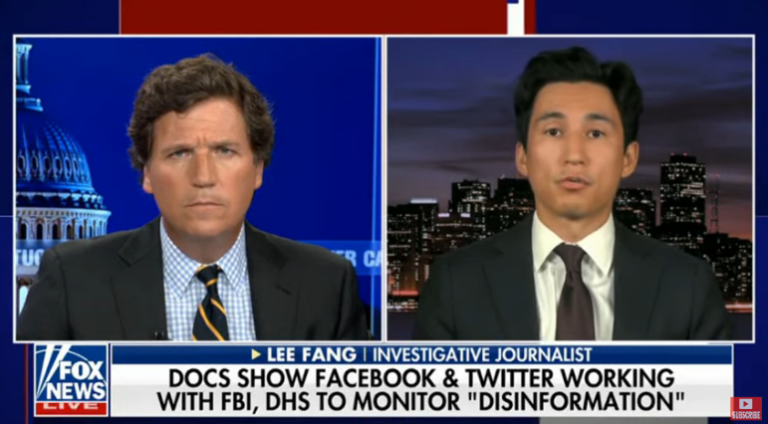
A very interesting segment on Fox News’ Tucker Carlson show(10/31/22) featured a bombshell Pulitzer-worthy report by The Intercept’s Lee Fang, which revealed that the Department of Homeland Security(DHS), has for five years now, been collaborating with Twitter, Facebook, and other social media companies, in determining whose speech needs to be suppressed. This of course flies in the face of the “private company” defense usually used to justify questionable speech infringement practices by the social media giants.

More importantly, Lee Fang’s bombshell also touched on the apparent “mission creep”(his words) of DHS, where over the last five years, the powerful agency had unilaterally(without congressional approval) shifted from its stated focus of combating terrorism and terrorist groups like Al-Qaida, to combating disinformation online.

Asked whether the Biden administration was working with tech companies to censor people, Lee Fang responded (1:10): “Yeah, that’s right Tucker. We looked at really hundreds of documents that paint a vivid picture of the FBI, the DHS, closely collaborating with top social media platforms, Twitter and Facebook, to censor various forms of content under the banner of fighting disinformation, and the story shows a couple of things, one, it shows what you just mentioned, a very cozy relationship between the government and these tech giants. There’s those monthly meetings that you just mentioned, but also, just very cozy emails and texts, not a very adversarial relationship. We looked at one text where a Microsoft executive texts Jen Easterly, the top disinfo director at DHS, appointed by[President]Biden, basically saying that the private sector needs to get more comfortable with the government closely collaborating on reports, talking about the expanded role for DHS in censoring a really broad collection of topic areas of policy and political topics.”

Lee Fang then touched on what I believe is by far, the biggest bombshell from his piece, and that is, the “mission creep” aspect. Fang said(2:11): “Just broadly speaking, the story also just looks at the mission creep of DHS. This is an agency that was founded in the aftermath of 9/11 to combat foreign terror threats of Al-Qaeda and the like, but over the last five years, it’s kind of evolved in its mission, its move towards fighting disinfo, and their justification is disinfo radicalizes the homeland, it can lead to disruptions in public health, or political violence…”

Even given DHS’ understandable explanation for going after online disinformation, no reasonable person can ever conclude that Congress would have approved the same powerful tools/tactics used to counter terrorist groups like Al-Qaeda, to be applied against U.S. residents for basically saying the “wrong things” on social media. Sadly however, this is exactly where we find ourselves today, with DHS’ speech police designating people they deem “misinformers” as terrorists, and then mercilessly destroying their lives and livelihoods using among other things, the military. This is shameful conduct which most Americans have always associated with third world dictatorships.

It is because of DHS’ mission creep, that Yours Truly believes Lee Fang’s bombshell piece deserves a Pulitzer. Simply put, DHS’ mission creep, which at the very least should have been run through Congress for approval prior to enforcement, has not only seriously impacted the lives and livelihoods of many U.S. residents who have nothing to do with terrorism, but has also robbed them of their rights under the first amendment.

Congress needs to immediately step in to not only address DHS’ mission creep, but also to hold the officials involved accountable, preferably, via referral for criminal prosecution given the way their unconstitutional actions upend innocent people’s lives

It’s also important to point out here what history has taught us, and that is, not everything the government labels “misinformation” is necessarily so. Often times, there are topics the government simply doesn’t want out there, being discussed in public. One recent classic example is directed energy weapons. For decades, government agents, and their surrogates in the mainstream media, went out of their way to label people who expressed concerns about these weapons as delusional conspiracy theorists. In 2022 however, we not only have the same directed energy weapons being openly discussed by the same mainstream media channels who denied their existence, but also, the government considers the threat so serious, that Congress swiftly enacted a handsome compensation scheme for victims of such attacks.

Bottom line folks, as host Tucker Carlson correctly stated, this bombshell piece by The Intercept is not only a great story, it’s also a huge public service for which Lee Fang deserves a lot of praise and reward. The only question now is whether Congress will do its job, and rein in Mission Creep DHS, and its unconstitutional speech police.

For those of you very happy with @Emolclause’s activism don’t shy away from the “tip jar” below on your way out. You may also Cash App

Email author at admin@grassrootsdempolitics.com

Become an Octapharma Plasma donor. Make up to $200 in one week and help save lives too! Learn More