Homeland Security’s $220 Million Ad Controversy: An Objective Look at the Noem Connections

Please consider $upporting GDPolitics by scanning the QR code below or clicking on this link

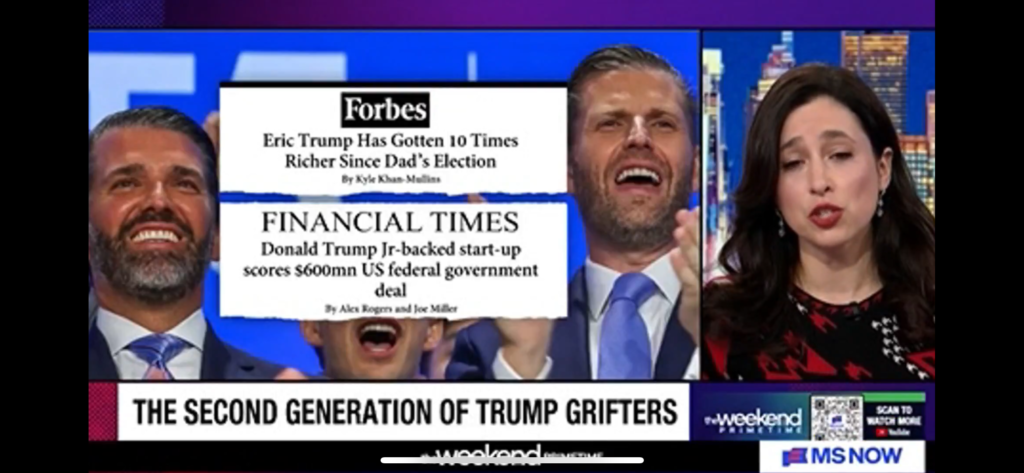
A series of recent investigative reports, first published by ProPublica and later picked up by major outlets including MSNBC, has drawn substantial attention to a large Department of Homeland Security (DHS) advertising campaign and its connections to Secretary Kristi Noem’s political circle. Although the DHS has defended its decisions and denies any improper influence, the scope of the contract, the speed at which funds were awarded, and the involvement of individuals tied to Noem have generated intense public scrutiny. What follows is a fact-based, balanced overview of what is known, what is contested, and why the episode continues to raise questions.

The controversy began with DHS’s launch of a national and international ad campaign intended to deter illegal immigration. According to ProPublica, the campaign totals approximately $220 million and includes television, digital, radio, and social-media placements. DHS has stated that the campaign is aimed at discouraging unauthorized crossings by emphasizing tougher enforcement policies and consequences. One of the signature ads features Secretary Noem at Mount Rushmore delivering a tough-on-immigration message that DHS characterizes as a public service announcement rather than a political communication. DHS has consistently argued that the campaign is justified by pressing national security needs and that it reflects policy objectives rather than partisan motives.

The financial and procedural details surrounding this campaign, however, prompted wider concerns. DHS invoked a “national emergency” at the border to bypass the traditional competitive bidding process, fast-tracking the ad contracts. While legal, this mechanism is typically used for time-sensitive, high-risk situations rather than large-scale media campaigns. Critics argue that employing emergency powers for a communications initiative undermines normal procurement safeguards designed to prevent favoritism and ensure transparency. DHS counters that career procurement officials oversaw the process and that all actions complied with federal law.

The most scrutinized element of the spending is the decision to direct $143 million of the campaign funds to a newly formed Delaware company called Safe America Media. The firm was incorporated only days before receiving the contract, an unusually rapid timeline for a high-value federal agreement. Public contracting databases provide little information about how Safe America Media has allocated its funds or whom it subcontracted. This lack of documentation has fueled questions about the nature of the company, who ultimately benefited from the funds, and why the government selected an entity with virtually no track record.

Those questions intensified when investigators identified personal and professional connections between DHS leadership and political consultants aligned with Noem. Safe America Media’s listed address is linked to Republican operative Michael McElwain, and reporting has highlighted the involvement of the Strategy Group, a Republican consulting firm that played a large role in Noem’s South Dakota gubernatorial campaigns. The firm is led by Benjamin Yoho, who is married to Tricia McLaughlin, DHS’s Assistant Secretary for Public Affairs. That office, which McLaughlin leads, is the same DHS division responsible for funding the ad campaign. This nexus of relationships has raised concerns from ethics experts and watchdog groups, who argue that—even if no laws were broken—the appearance of a conflict of interest is substantial.

Critics, including former federal contracting officials, contend that the overlap between Noem’s political network and the firms connected to the DHS campaign creates significant risk of improper influence. They argue that the lack of publicly available subcontractor information prevents the public from knowing whether politically connected firms benefited from taxpayer funds. Some experts have described the arrangement as highly irregular, and organizations have called for oversight investigations by congressional committees or the DHS Inspector General. Others have pointed out that the political tone of some of the ads, particularly those referencing Trump-era border policies, may blur the line between public service messaging and partisan promotion, although DHS maintains the messaging is policy-driven.

Defenders of Noem and DHS present a different picture. They note that DHS officials, not political appointees, handled the contracting and that emergency procurement authority exists precisely to allow rapid responses to urgent national issues. McLaughlin has publicly stated that she fully recused herself from decisions related to these contracts, emphasizing that professional ethics protocols were followed. Supporters also argue that the intent of the campaign is clear: to deter migration through communication, a tool that has been used by multiple administrations. They also point out that no concrete evidence has surfaced proving that any funds were intentionally steered to Noem’s allies for political purposes.

Despite those defenses, the situation remains complicated. The unusual contracting timeline, the lack of transparency surrounding subcontractors, and the close personal ties between DHS leadership and outside political consultants make the story difficult to dismiss. Even if every action taken was technically compliant with procurement rules, the optics invite skepticism. In matters of public spending—especially on such a large scale—appearance alone can erode public trust, particularly when political figures and their associates are involved. At a minimum, the episode underscores the importance of transparent procurement processes, clear public reporting on subcontractors, and robust safeguards to prevent even the perception of conflicts of interest.

Ultimately, the controversy exposes a broader tension at the intersection of government communication, national security policy, and political influence. DHS insists the campaign is essential to its mission and was executed properly. Critics argue that the process lacked the transparency and arm’s-length separation needed to ensure public confidence. As calls for additional oversight continue, the resolution of this issue may set important precedents for how federal agencies handle large-scale communications campaigns—especially when those campaigns intersect with the political networks of their leaders.

VP Vance Pushes Back On The Gerald Ford Comparison

Please consider $upporting GDPolitics by scanning the QR code below or clicking on this link

On the 11/12/25 edition of The Last Word with Lawrence O’Donnell, host Lawrence O’Donnell made a striking observation: current Vice President J.D. Vance’s near-silence on the swirling Jeffrey Epstein files scandal mirrors the posture then-Vice President Gerald Ford assumed as Richard Nixon’s presidency was collapsing under the weight of Watergate. O’Donnell pointed out that Ford, sensing the sinking of Nixon’s Presidency, deliberately kept his head down—he knew the ghosts of Nixon would dog his tenure if he didn’t distance himself.

By the same logic, O’Donnell argued, Vance appears to be doing exactly that: he knows the Epstein files may blow up and run Donald Trump out of office, and thus is doing everything he can to not get sucked into the scandal, to avoid becoming the next Ford.

As expected, social media erupted following O’Donnell’s segment. I posted a clip of the show, and to my surprise the reaction came from none other than the Vice President himself. That’s how provocative the comparison proved.

In his response, Vance strongly objected to O’Donnell’s suggestion that he was intentionally silent about the Epstein scandal. Vance pointed out that he had addressed the issue in prior TV appearances—citing his interview on Hannity scheduled for 11/13/25, which coincided with the date I posted the segment.

Interestingly, in that very 11/13/25 show O’Donnell claimed Vance had in fact ignored the Epstein issue entirely—and reaffirmed: “He’s still Gerald Ford.”

Now that the “Gerald Ford” comparison has caught Vance’s attention—and by implication, the President’s—it will be fascinating to watch how it plays out going forward.

Rep. Khanna Accuses Trump of Protecting the “Epstein Class”

Please consider $upporting GDPolitics by scanning the QR code below or clicking on this link

Appearing on MSNBC’s All In with Chris Hayes, Congressman Ro Khanna (D-CA) leveled a blistering charge at President Donald Trump — accusing him of protecting what he called the “Epstein class” rather than standing up for working Americans struggling to make ends meet. The phrase quickly caught fire online, and it’s now taking on new weight amid fresh controversy in Washington and inside the federal prison system.

Khanna’s remarks came as pressure mounts on House Speaker Mike Johnson (R-LA) over his continued delay in swearing in Congresswoman-elect Adelita Grijalva of Arizona. Grijalva, a progressive Democrat, has been open about her plan to become the decisive 218th vote to compel the Trump administration to release the long-withheld Epstein files. Johnson’s refusal to seat her — even after certification of her election — has drawn criticism from both Democrats and watchdog groups who see the move as an attempt to block her role in advancing the Epstein disclosure measure.

After weeks of backlash, Johnson has now committed to swearing Grijalva in on Wednesday, November 12, 2025, when the House reconvenes to deliberate on a Senate measure to reopen the government. The timing has only intensified speculation that the Speaker’s delay was politically motivated.

Meanwhile, another development has reignited public scrutiny over how the powerful continue to benefit from special treatment. Ghislaine Maxwell — Epstein’s longtime associate who is serving a 20-year sentence for her role in his sex-trafficking network — was quietly transferred from a Florida federal facility to a much softer minimum-security prison camp in Bryan, Texas. The transfer raised immediate red flags, as such privileges are rarely extended to those convicted of serious sex crimes.

Reports from inside the Texas prison suggest Maxwell is enjoying unusually favorable treatment, including lenient oversight and staff attention that other inmates say border on favoritism. Members of Congress are now demanding a formal investigation into possible corruption or political interference in the Bureau of Prisons’ decision-making.

For Khanna and others calling for transparency, the timing couldn’t be more damning. A president who campaigned on exposing Epstein’s network has yet to release the files; his allies in Congress have stalled the one member most eager to force disclosure; and the central figure in Epstein’s trafficking ring appears to be enjoying preferential treatment behind bars.

Until those Epstein files are made public — as Trump once promised — the perception that his administration is shielding the powerful rather than serving the people will only deepen. As Khanna put it, Trump looks less like the champion of the “forgotten man,” and more like the guardian of the “Epstein Class.”

MSNBC’s Nicolle Wallace Brands Trump Team the “Marie Antoinette Administration”

Please consider $upporting GDPolitics by scanning the QR code below or clicking on this link

On a recent episode of Deadline: White House, MSNBC host Nicolle Wallace didn’t hold back in her criticism of former President Donald Trump’s administration. She called it the “Marie Antoinette Administration” — a cutting comparison to the infamous French queen remembered for her decadence, detachment, and the apocryphal phrase, “Let them eat cake.”

Marie Antoinette became a symbol of a ruling class oblivious to the suffering of ordinary people — a monarch who partied in Versailles while her citizens starved outside the palace gates. Wallace’s jab draws on that same image, suggesting the Trump administration has been indulging in luxury and self-congratulation while Americans face economic hardship.

The comparison lands especially hard when you look at Mar-a-Lago, Trump’s Palm Beach estate turned private club — his modern-day Versailles. While millions of Americans struggle to put food on the table amid a grinding government shutdown that has halted SNAP payments, reports continue to surface of glittering soirées, Champagne toasts, and high-society dinners taking place under Mar-a-Lago’s gilded chandeliers. Even some of Trump’s own allies have privately admitted the optics are terrible: the image of Washington elites sipping cocktails on the oceanfront while federal workers and low-income families line up at food banks is a PR nightmare.

Adding insult to injury, a federal judge recently ordered the administration to tap the USDA’s contingency funds to keep SNAP benefits flowing. Instead of complying, the administration chose to fight the order in court — literally arguing for the right to let poor Americans go hungry. It’s a move that only deepens the “Marie Antoinette” parallel: power waging legal battles over crumbs while the public goes without bread.

As the shutdown drags on, the economic pain is becoming unbearable for working families. Most analysts expect the government to reopen soon, likely before the Thanksgiving holidays, if only to stem the political fallout. But even after the lights come back on, the damage — both human and reputational — will linger.

The “Marie Antoinette Administration” label may stick as one of Trump’s most unflattering legacies. It’s a sharp irony for a president who rose to power promising to champion the “forgotten man” — rural, blue-collar Americans who felt abandoned by Washington. The image of Mar-a-Lago’s ballrooms glittering while those same Americans tighten their belts is one that no amount of political spin can erase.

In the end, Wallace’s analogy hits its mark. For many watching from the outside, the Trump administration doesn’t just look out of touch — it looks like it’s dancing while the country burns.

Chief Justice Roberts Slammed As Biggest Enemy To Voting Rights Act

Please consider $upporting GDPolitics by scanning the QR code below or clicking on this link

In the October 19, 2025, edition of MSNBC’s Velshi, legal commentator Elie Mystal delivered a striking critique, telling host Ali Velshi that U.S. Supreme Court Chief Justice John Roberts has, in many respects, become the most formidable obstacle to the enforcement of the landmark 1965 Voting Rights Act (VRA)—and, by extension, a significant impediment to protecting the voting rights of communities of color.

Mystal’s remarks were prompted by the high-profile redistricting case currently before the Supreme Court, Louisiana v. Calais. Experts warn that the Court’s ruling could fundamentally undermine the VRA, effectively allowing racially motivated redistricting and diluting the electoral power of Black and minority voters. The stakes are enormous: analysts suggest that, if the Court rules in favor of Louisiana’s approach, Republicans could gain as many as 19 additional House seats in the 2026 elections alone.

The case raises critical questions under the VRA’s Section 2, which prohibits voting practices that result in racial discrimination, and Section 5, which historically required jurisdictions with a documented history of voter suppression to obtain federal approval before changing voting laws. Louisiana v. Calais centers on whether the state’s proposed redistricting plan unfairly diminishes the influence of Black voters in certain congressional districts. Proponents of the challenge argue that the plan reflects legitimate political considerations, while opponents contend it is a transparent attempt to circumvent the VRA and dilute minority voting power.

This moment is reminiscent of a discussion I initiated back in 2018, when I criticized what I then termed the “unjust Roberts Supreme Court” for systematically chipping away at the VRA’s protections. At the time, such a stance was considered controversial. Today, with mainstream voices like Mystal echoing similar concerns, it appears those warnings have entered the broader public discourse.

As the Supreme Court deliberates Louisiana v. Calais, the implications extend far beyond a single state. The decision could redefine the legal contours of voting rights protections nationwide, setting a precedent that either reinforces or weakens decades of civil rights progress. Observers on both sides of the political spectrum will be watching closely, as the Court’s ruling could reshape congressional representation and influence the trajectory of American democracy for years to come.

Speaker Johnson Called Out For Not Swearing In Adelita Grijalva

House Speaker Mike Johnson is under growing fire after a tense exchange with Senator ___ (D-AZ), who publicly accused him of deliberately refusing to swear in newly elected Democratic Representative Adelita Grijalva. The senator alleged that Johnson’s delay is a calculated move to stall an upcoming House vote on whether to release the long-suppressed Epstein files—documents that could expose the full extent of Jeffrey Epstein’s powerful network of associates.

The confrontation reportedly took place during a joint leadership meeting on Capitol Hill, where the Arizona senator pressed Johnson on the delay. Witnesses say Johnson attempted to deflect, citing “procedural timing issues,” but the senator shot back that the Speaker was “weaponizing procedure to shield the guilty.”

Johnson, who has cultivated an image as a devout Christian and moral conservative, now finds himself in an increasingly awkward position—forced to reconcile his public faith with what critics see as a willingness to protect the powerful at the expense of truth and transparency. “You can’t claim to walk in the light while covering for people who trafficked in darkness,” one Democratic aide remarked after the exchange.

The late financier Jeffrey Epstein was famously connected to some of the most influential figures in politics, business, and entertainment. Among them was Donald Trump, then a New York real estate mogul and now President of the United States. The Trump administration’s handling of the Epstein files has only fueled suspicion that critical evidence—particularly anything implicating high-level figures—is being withheld from public view. Officials have repeatedly promised a “measured” release, but months of delays have left watchdogs, journalists, and victims’ advocates convinced the White House is hiding something.

Privately, some insiders suggest that Speaker Johnson may personally favor full transparency. However, given the Trump administration’s well-documented record of punishing perceived disloyalty, Johnson is said to be under immense pressure to toe the line. The Speaker, they claim, fears political retaliation—or worse, a full-scale MAGA backlash—if he defies the administration’s wishes and allows the House to move forward on the Epstein vote.

For now, the standoff continues. Representative-elect Grijalva remains in limbo, waiting to be officially sworn in while the partisan tug-of-war plays out behind the scenes. Whether Johnson’s delay is a procedural quirk or a deliberate act of political obstruction, one thing is certain: the issue isn’t going away. At some point, Speaker Johnson will have no choice but to seat the incoming Democrat from Arizona—and when he does, the House may finally be forced to confront the explosive truth behind the Epstein files.

Three Questions Alex Acosta Must Answer Re Epstein

MSNBC’s Legal Analyst Lisa Rubin appeared on the 09/19/25 edition of Deadline White House show where she made a compelling argument as to how Congress can and should go about getting Jeffrey Epstein-related information from former U.S. Attorney Alex Acosta.

Rubin said that there are a bunch of Epstein-related documents that Acosta either saw, or was involved in creating. This, she argued, meant the said documents were either currently in the possession of the Department of Justice, or even by Acosta himself.

The first question Congress needs to ask Acosta is about the 60-count federal indictment drafted by prosecutor Ann Marie Villafaña in 2007. DOJ definitely has this document, and the allegations therein, may shed a lot of light as to Epstein’s illicit operation, and potentially, the actions of his his co-conspirators, most of who were later granted immunity.

The second question regards the lengthy prosecution memo that aforementioned Villafaña wrote regarding the federal case re Epstein. Rubin says this can shed a lot of light as to the evidence the feds had against Epstein to support the 60-count indictment

Finally, Rubin says Congress should ask Acosta about his own interview transcript from the office of professional responsibility investigation that was conducted at DOJ in 2020. That was an investigation started at the instigation of Republican Senator Ben Sasse. Rubin argues that Acosta must have that transcript in his possession because he and his lawyers were given an opportunity to review it and suggest any corrections.

Long story short, the lingering questions about Jeffrey Epstein and his child sex trafficking operation must be answered, and key players like Acosta must not be allowed to come before Congress and just gaslight the public. These crucial documents are currently in the possession of the DOJ and/or Acosta, and the public deserves to see them.

An alternative route would be to have Ann Marie Villafaña testify before Congress. Who knows, she might have “kept receipts”.

Is FHFA Boss Targeting Dems?

Bombshell segment on the 09/18/25 edition of MSNBC’s All In w/Chris Hayes delved into the current head of the Federal Housing Finance Authority (FHFA), William Pulte, and specifically whether he is the source of all the mortgage fraud allegations currently leveled at prominent Democrats

Hayes correctly pointed out that it does appear odd, that Democrats who President Trump has publicly feuded with, and expressed contempt for, are suddenly facing accusations of mortgage fraud. Importantly, the person who President Trump has appointed to head FHFA, which among other things, overseas the U.S. mortgage market, is a diehard MAGA and a major donor to the Trump campaign. Per Hayes, he’s an heir to a major construction company.

Could he be the one digging into Trump opponents’ mortgage files for “dirt”? Hayes certainly seems to be making that argument in this segment. If true, this would not only be a blatant abuse of power, but could potentially also be a legal infraction pertaining to privacy. 

But let’s not put the cart before the horse here. The prudent thing is to first confirm that it is indeed Mr Pulte who is leaking people’s mortgage files. After that, we can consider the potential legal ramifications

 Bottom line, this is the classic issue that begs for congressional oversight. Americans are already struggling to keep up with their mortgage payments. The last thing they need is some politically-motivated fat cat rummaging through their mortgage files digging for “political dirt”. There are federal agencies already in place to independently deal with mortgage fraud.

New Questions About Trump And His Former Labor Secretary Alex Acosta

As the Jeffrey Epstein scandal continues to heat up, new questions are being raised about the infamous 2008 sweetheart plea deal he received from then U.S. Attorney Alex Acosta, who later joined the Trump administration as Labor Secretary in 2017

The running narrative thus far, has been that after details of the sweetheart plea deal started getting a lot of media coverage, the Trump administration was forced to cut ties with Acosta—he became a liability, if you will.

However according to Kristy Greenberg, herself a former federal prosecutor, President Trump might have known all along about Alex Acosta’s shady Epstein deal when he made him his labor secretary. As Greenberg further put it, “he [President Trump] didn’t seem to care.”

If Greenberg’s account holds up, it would reflect very poorly on the president as America’s moral leader. Republicans have for decades, put a premium on moral values, so it will be interesting to see how they navigate this Trump-Acosta relationship. 

Epstein Survivor Press Conference Set For 090325

Rep Ro Khanna (D-CA) appeared in a segment of MSNBC’s The Briefing with Jen Psaki (08/14/25) where he confirmed that together with Rep Thomas Massie (R-KY), they had arranged a 09/03/25 press conference with the survivors of Jeffrey Epstein and Ghislaine Maxwell.

It cannot be understated just how important this presser may turn out to be , not just for curious public, but also for the victims. Reps Massie and Khanna are giving them an avenue to vent out their grievances and frustrations, something they were denied when Epstein died before his criminal trial. They were robbed of an excellent opportunity to confront their abuser publicly in a court of law.

The presser will of course serve another very important function, and that is, bring back the media’s focus to the heinous crimes committed by Epstein and Maxwell, and how both shared a close relationship with Donald Trump, now President.

The Trump administration has moved heaven and earth to keep the Epstein story away from the mainstream media’s focus, so it will be very interesting to see what “shiny object” they dangle out there on 09/03/25.