MSNOWโ€™s Lawrence Slams Treasury Secretary Bessentโ€™s Hypocrisy

An unusually pointed moment on MSNBCโ€™s Last Word with Lawrence Oโ€™Donnell saw Oโ€™Donnell step into territory most of cable news has long treated as a no-go zone: the personal and political contradiction embodied by an openly gay Cabinet secretary who serves as a vocal defender of an administration and movement that has spent years portraying marriages like his as immoral, illegitimate, or worse. Oโ€™Donnellโ€™s target was Treasury Secretary Scott Bessent, a Senate-confirmed Cabinet official and one of the most prominent openly gay figures to rise within MAGA-aligned economic circles. The charge was blunt and uncomfortable: Bessent is an apologist for a political project that, if fully empowered, would gladly undermine the very legal foundations that make his family possible.

What made the segment so jarring wasnโ€™t simply the criticism, but the fact that Bessentโ€™s marriage and family life have largely been treated as invisible by the mainstream press. Bessent is married to his husband, and together they are raising childrenโ€”an arrangement that would have been legally impossible not very long ago. Yet media profiles have gone out of their way to sanitize or sidestep this reality, even as Bessent aligns himself with a movement that openly champions โ€œtraditional marriage,โ€ entertains rolling back marriage equality, and elevates figures who describe same-sex unions as an abomination. Oโ€™Donnell shattered that silence, arguing that this contradiction isnโ€™t incidental or private, but central to understanding Bessentโ€™s role and moral posture within the administration.

Oโ€™Donnell went further, explicitly crediting Democratic presidents Bill Clinton and Barack Obama with laying the groundwork that ultimately made Bessentโ€™s marriage and family legally possible. The history is complicated but undeniable. Clinton signed the Defense of Marriage Act in 1996, a political concession to the era that barred federal recognition of same-sex marriage. But it was the Democratic legal and judicial ecosystem that later dismantled DOMAโ€™s core. The Obama administration declined to defend the law in court, supported the plaintiffs in United States v. Windsor, and appointed Supreme Court justices who formed the backbone of the majority in Obergefell v. Hodges, which finally recognized marriage equality nationwide. Whatever one thinks of Bessentโ€™s economic views, Republican administrations did not create the legal scaffolding for his marriage. Democrats did.

That context is what gives Oโ€™Donnellโ€™s critique its sting. This wasnโ€™t a cheap shot about sexuality. It was an indictment of political ingratitude and moral compartmentalization: enjoying the protections secured by one political tradition while actively defending another that relies on demonizing people like you to energize its base. Oโ€™Donnell framed Bessent not as a passive beneficiary or a token figure, but as a powerful participant in sustaining a coalition that has shown little hesitation in sacrificing LGBTQ rights when it suits broader ideological goals.

Still, the segment raises an unavoidable question: did Oโ€™Donnell cross a line? Some viewers recoiled, arguing that invoking Bessentโ€™s sexuality so directly veered into something uncomfortably close to gay-bashing. That concern deserves to be taken seriously. Historically, the media has weaponized sexuality in ways that reinforce stigma rather than challenge power. But intent and framing matter. Oโ€™Donnell was not mocking Bessentโ€™s marriage or questioning its legitimacy. He was highlighting that others in Bessentโ€™s political camp do exactly thatโ€”and that Bessent chooses to excuse, rationalize, or ignore it. The critique was not โ€œyou are gay,โ€ but โ€œyou know precisely what is at stake, and you are still carrying water for people who believe your family should not exist under the law.โ€

Whether Bessent responds remains to be seen. He may argue that economic policy outweighs cultural hostility, or that working within the movement offers a path to moderation from the inside. But Oโ€™Donnellโ€™s segment forced an overdue reckoning. Visibility cuts both ways. You donโ€™t get to quietly enjoy the fruits of marriage equality while energetically defending a political project that has made clearโ€”through rhetoric, policy, and judicial ambitionโ€”that it would gladly uproot the tree that bore them.

Is MAGA Trumpism A Form Of Political Religion?

$upport via Cash App

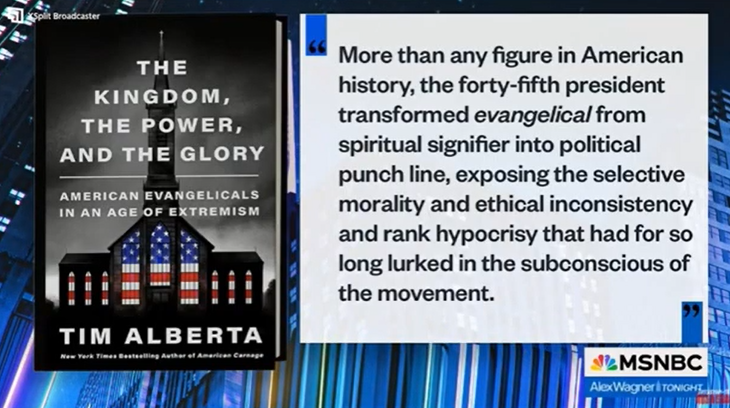
An interesting segment on MSNBC’s Alex Wagner Tonight (01/1624) show delved into the strange daliance between Evangelical Christians(predominantly White), and the politics of former President Donald Trump, often referred to as Trumpism, or MAGA Trumpism. The alliance between these two strange bedfellows has led many to question whether MAGA Trumpism has become some sort of political/civil religion.

The MSNBC segment came against the backdrop of Trump’s massive win in the Iowa Republican presidential primary, and specifically, his command of the White Evangelical vote, which polls placed at 53%. Back in 2016, when Trump first ran for president, he only received 21% of the White Evangelical vote in Iowa, a clear sign that he has now consolidated the White Evangelical vote in Iowa, and arguably nationwide.

Host Alex Wagner posed this question to her guest, Author Tim Alberta, who’s also a staff writer at The Atlantic (2:07): “I wonder in your estimation, what it means to be an Evangelical in this country, at this moment?”
Tim Alberta responded in relevant part: “We are beginning to flirt with this territory where definitionally speaking, Evangelicalism has far more to do, at least in the perception of the greater public, with political engagement, partisan political identification, than it does with any particular theology or any real religious conviction, and if you take it a step further, if you look at the exit polling, if you look at some of the social science around this, if you look at the fact that during Donald Trump’s presidency, more and more of Donald Trump’s supporters were self-identifying as Evangelicals even though they were simultaneously attending Church less and less often, I think one might reach the uncomfortable conclusion that perhaps the best definition now for what it means to be an Evangelical, is to be a conservative White Republican Trump supporter, and that is a tragedy on any number of different levels, but I think most profoundly, it’s a tragedy for the Gospel of Jesus Christ.”

Host Alex Wagner then interjected with this profound question (3:50): “If the Gospel is no longer part of the equation, what is it replaced by…do you think MAGA-ism has become a placeholder for a certain kind of religion?”

Tim Alberta: “Yes…I don’t want to paint with too broad a brush, the Evangelical community is large, it’s huge, and it’s complicated…but…we are reaching a place where we are being confronted with some uncomfortable realities about what it means to be a part of the Evangelical movement and frankly, where the line blurs between sort of religious identity and political identity, and is there a merging of the two, and frankly I think that there’s always a danger in politics…of sort of turning political conviction into religious conviction, or worshipping at a certain altar that is not an altar to God, but is an altar to political idolatry or to political identity. That is a danger that has always been there, but it is I think uniquely dangerous in this moment, and to be clear…we have examples from the not so distant past, of a sort of political religion, or at least a civil religion, supplanting, competing with actual religion, and I don’t think that we’re all that far removed from that in this country now, looking at just what happened…in Iowa.”

To conclude the segment, Tim Alberta floated this interesting scenario, which gets right to the fallacy of the Evangelical-MAGA Trumpism alliance. He said (8:19): “If during Barack Obama’s presidency, or while he was running for president, if you had heard him talking with, or promoting a video saying that he was a shepherd to all of mankind, the Evangelical movement would have been up in arms [and rightly so], I mean this is heretical, this is blasphemous and yet, Donald Trump seems to get a pass time and time again for doing these things that no other politician, Republican or Democrat frankly, would get a pass for doing, and we should ask ourselves why. If the answer does not at least start to flirt with this terrain of civil religion, or political religion, then I think that we’re not being honest with ourselves, and if we are being honest with ourselves, if we are willing to engage with the very uncomfortable topic around what happens when Trumpism becomes civil religion in this country for millions of millions of people, and what that might imply moving forward, then we are doing a disservice to our prularistic democracy.”

Bottom line folks, we’ve always operated on the separation of church and state doctrine, and have for decades, shunned foreign theocracies like the ones in Afghanistan and Iran. Author Tim Alberta is absolutely correct when he says, we need to be honest with ourselves, and admit that there is no difference between the Evangelical-MAGA dalliance in the American political scene, and the theocracies in Iran and Afghanistan. Simply put, we need to make a decision as to whether we want to continue with the separation of church and state doctrine, or whether, that time-honored tradition has also been sacrificed at the altar of MAGA Trumpism.

For those of you very happy with @Emolclauseโ€™s activism donโ€™t shy away from the โ€œtip jarโ€ below on your way out. You may also Cash App

Email author at admin@grassrootsdempolitics.com

Become an Octapharma Plasma donor. Make up to $200 in one week and help save lives too! Learn More