Trumpโ€™s Stimulus Checks: Promises Made, Promises Broken

A revealing segment on MSNOWโ€™s Weekend Primetime took a hard look at the sweeping stimulus payments President Trump pledged throughout 2025 โ€” payments that, nearly a year later, have yet to materialize. The promises were not vague talking points. They were specific dollar amounts, repeated publicly, and framed as imminent relief for Americans struggling with rising costs.

As laid out on the program by co-host Catherine Rampell, Trump promised a $2,000 payment to Americans supposedly funded by revenue generated from his new tariffs. The pitch was simple: foreign countries would โ€œpay,โ€ tariff revenue would surge, and American households would receive direct checks. Economists warned at the time that tariffs function as taxes on consumers, not foreign governments, but the political message was clear โ€” relief was coming. It never did.

Then came the much larger promise tied to the administrationโ€™s Department of Government Efficiency initiative โ€” commonly branded as DOGE. Trump claimed that cost-cutting measures would generate so much savings that roughly $5,000 could be returned to every American household. The math was always questionable, hinging on speculative savings projections rather than enacted, audited reductions. No such checks have been issued.

Another pledge involved replacing or offsetting Affordable Care Act subsidies with direct payments of roughly $1,000 to $2,000 per family. The idea was presented as a more flexible alternative that would put cash directly into Americansโ€™ pockets. But as with the other stimulus proposals, there is no evidence of payments being distributed, no legislative framework that funded them, and no administrative mechanism that ever processed them.

Even beyond what was discussed on air, there was the highly publicized $1,776 โ€œmilitary 1776 paymentโ€ โ€” a proposed one-time check for military families in honor of Americaโ€™s 250th anniversary. It was marketed as a patriotic Christmas 2025 gift to service members and their families. Yet there has been no confirmation of funds being appropriated or delivered. Like the others, it appears to have remained rhetorical.

Taken together, these promises would have amounted to roughly $8,000 or more for many households โ€” a substantial sum for families grappling with rent increases, grocery inflation, child care costs, and mounting credit card debt. For people budgeting around the expectation of relief, the absence of these payments is not an abstract political issue; itโ€™s a tangible financial blow.

This pattern feeds directly into a longstanding vulnerability for Trump: credibility. No one compelled these specific dollar figures. No emergency legislation forced rushed commitments. These were self-generated promises, delivered with confidence and repetition. When they evaporate without explanation, it reinforces an already entrenched perception that Trumpโ€™s word is elastic โ€” bold in announcement, unreliable in execution.

It also deepens the narrative that this is a โ€œbillionairesโ€™ clubโ€ administration โ€” a government staffed and advised by ultra-wealthy insiders whose policy experiments and grand promises often feel detached from the day-to-day pressures of working families. When promised stimulus checks fail to appear while tax and regulatory policies favor high earners and corporate interests, the contrast becomes politically combustible.

Heading into the 2026 midterms, that gap between promise and reality could become a defining issue. Voters can tolerate partisan combat and even ideological swings. What they tend to punish is perceived deception โ€” especially when it involves their own bank accounts. If Americans conclude that the much-touted stimulus windfall was never real to begin with, the political cost may not be theoretical. It could be measured at the ballot box.

Grifting Nepo-Babies In Trump Admin 2.0?


Please consider $upporting GDPolitics by scanning the QR code below or clicking on this link

An interesting segment on MSNOWโ€™s Weekend Primetime show delved into the staggering corruption emerging in Trump administration 2.0 โ€” even coining the phrase โ€œGrifting Nepo-Babiesโ€ to capture the growing concern about the financial windfalls reportedly enjoyed by the children of several senior Trumpโ€“era officials. Co-host Catherine Rampell laid out what she called a pattern of politically connected offspring cashing in during the second Trump presidency. According to the segment, Secretary of Commerce Howard Lutnickโ€™s sons were among those observers have flagged as benefiting enormously from their fatherโ€™s presence in government โ€” and in their case, the benefits come via the Wall Street powerhouse their father built, Cantor Fitzgerald.

Specifically: when Lutnick stepped into the Cabinet, ownership and control of Cantor Fitzgerald were formally transferred to his two oldest sons, Brandon Lutnick (now Chairman & CEO) and Kyle Lutnick (Executive Vice-Chairman). Under their leadership, the firm is on track for a 2025 revenue haul that reportedly represents its most profitable year ever โ€” a jump of more than a quarter over last year. Much of that windfall stems from Cantorโ€™s aggressive crypto-investment banking, SPAC dealmaking, stablecoin custody and other high-risk, high-reward operations that the firm has doubled down on since the crypto boom took off. Critics argue that this close alignment between a senior Cabinet official and a high-performing Wall Street firm controlled by his children constitutes a textbook example of revolving-door conflicts of interest โ€” especially given the firmโ€™s deep involvement in sectors (like crypto) where regulatory and trade policy decisions may directly affect their bottom line. The optics are stark: a firm once headed by the Commerce Secretary is now raking in record profits under the leadership of his sons, just as policies that shape global trade and regulation are being decided by that same Secretary.

The segment also highlighted another striking example beyond the Lutnicks: Alex Witkoff, the son of Steve Witkoff โ€” himself appointed by Trump as a Middle East envoy. According to multiple recent reports, Alex has aggressively pursued large-scale investments from sovereignโ€wealth funds and Gulf-state investors. In 2024 he pitched a $4 billion U.S. real-estate credit fund to the Qatar Investment Authority, promising returns and sizeable management fees; while Qatar reportedly declined, sources say Alex continued courting investors from Qatar, the United Arab Emirates, and Kuwait through at least August 2025. As his father negotiated cease-fire and hostage-release deals across the Middle East under the auspices of the Trump administration, Alex was quietly soliciting money โ€” a convergence of diplomacy and real-estate finance that ethics experts argue raises serious conflict-of-interest concerns. Indeed, GULF-state investment vehicles have already backed several properties owned or developed by the family firm (known as the Witkoff Group), including major assets in New York and Florida. While a spokesperson for the firm has since claimed the specific real-estate fund proposal was โ€œpreliminaryโ€ and will not move forward, critics maintain that even the attempt โ€” coming alongside high-stakes diplomatic negotiations โ€” exemplifies the growing problem of political power being leveraged for private enrichment.

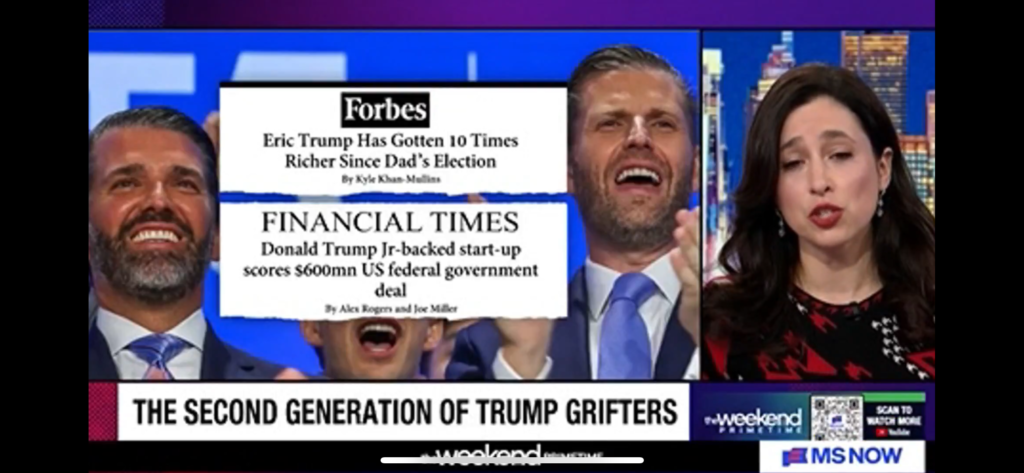
Rampell then pivoted to Trumpโ€™s own children, where the accusations grow louder and the optics far more politically potent. She cited a Forbes report claiming Eric Trumpโ€™s wealth has increased dramatically since his father returned to office โ€” with critics arguing that this level of enrichment while a parent is in the White House reflects the same ethical vulnerabilities that plagued Trumpโ€™s first term. She also referenced reporting about a startup associated with Donald Trump Jr. that has reportedly secured a major Pentagon-related deal โ€” figures like the oft-circulated โ€œ$600 millionโ€ have fueled alarm among ethics experts and bipartisan government watchdogs who argue that such arrangements warrant far more transparency. And even Trumpโ€™s youngest son, Barron Trump โ€” normally kept out of the political spotlight โ€” was mentioned in the segment due to media chatter about alleged lucrative cryptocurrency-related ventures linked indirectly to his name, though these claims remain murky and largely unverified, further contributing to the perception of a sprawling and loosely monitored financial ecosystem orbiting around the Trump family.

Rampell also revisited the long-running controversies around Trumpโ€™s son-in-law Jared Kushner, whose massive financial gains following Trumpโ€™s first term โ€” including high-profile investments from foreign sovereign funds โ€” continue to be held up by critics as one of the most glaring examples of blurred ethical boundaries. His ongoing business expansions during Trumpโ€™s second presidency only reinforce concerns among ethics observers who argue that the revolving door between political power and personal enrichment is now swinging more freely than ever.

The larger point the MSNOW hosts made was that corruption โ€” whether alleged, implied or documented โ€” has quickly become a defining theme of Trump 2.0. Democrats are already gearing up to make it a core message for the 2026 midterms, framing the administration as a government increasingly captured by the financial ambitions of the presidentโ€™s inner circle and their families. But what may pose a more immediate threat to Trump is that even portions of his MAGA base are beginning to grumble. Online circles that once defended every decision of the Trump family have begun to express frustration at what they see as blatant self-dealing โ€” especially as the administration continues to sideline issues that energized Trumpโ€™s grassroots supporters in the first place: lower prices, avoiding new foreign conflicts, demands for release of the Epstein files, and promises of โ€œdraining the swamp.โ€ For some longtime loyalists, the contrast between those unmet commitments and the constant headlines about politically connected children becoming wealthier has begun to feel impossible to ignore.

How this discontent evolves could have real consequences in the 2026 midterms. If the corruption narrative continues to grow, and if MAGA voters feel increasingly alienated or taken for granted, Republicans could find themselves facing a demoralized base at the very moment Democrats are preparing to campaign on a simple, sharp message: that Trump 2.0 has become a family business masquerading as a government. The question heading into 2026 is not just whether Democrats can capitalize on this narrative, but whether the erosion of enthusiasm among core Trump supporters will quietly do the job for them.