Did FBI Director Patel Lie Under Oath?

In a striking segment on MSNOWโ€™s Last Word with Lawrence Oโ€™Donnell, host Lawrence Oโ€™Donnell raised a provocative and consequential question: did FBI Director Kash Patel mislead Congress under oath during his exchange with Congressman Eric Swalwell about Donald Trumpโ€™s presence in the Jeffrey Epstein files? During that hearing, Swalwell pressed Patel directly on whether Trumpโ€™s name appeared in the Epstein material and sought clarity about the extent and significance of those references. Patel did not provide a numerical estimate, nor did he use the phrase โ€œvery few,โ€ but his answer was widely interpreted as downplaying the frequency and importance of Trumpโ€™s appearance in those records. He framed his response in a way that suggested there was nothing substantial or alarming tied to Trump in the context of the FBIโ€™s investigative findings.

Since that testimony, claims have circulated asserting that Trumpโ€™s name appears in the Epstein files far more extensively than Patelโ€™s response implied. Some reports and political commentators have cited extraordinarily large raw reference counts, arguing that Trumpโ€™s name appears hundreds of thousands or even more than a million times across various forms of Epstein-related material, including emails, contact directories, flight records, investigative notes, and digital indexing systems. Even accounting for duplication, automated references, and database artifacts, such figuresโ€”if accurateโ€”would appear difficult to reconcile with the general impression Patel conveyed during his testimony. The core issue is not whether Patel gave a precise number, because he did not, but whether his answer created a misleading impression that minimized the scale of Trumpโ€™s documented presence.

Whether that impression rises to the level of criminal conduct is a much more complex question. Federal law makes it a crime to knowingly provide false or materially misleading testimony to Congress, but the key word is โ€œknowingly.โ€ Prosecutors would have to prove that Patel was aware, at the time he testified, that his characterization was materially inconsistent with the actual scope of the records. That is a high bar. The Epstein files are massive, technically complex, and include raw, unfiltered material alongside analyzed investigative conclusions. It is entirely possible that Patel relied on summaries prepared by subordinates or focused specifically on references deemed relevant to criminal conduct rather than raw textual mentions. Under that interpretation, his testimony could be defended as reflecting his understanding of investigative significance rather than literal database frequency.

At the same time, Patelโ€™s role as FBI Director weakens any argument that he lacked access to critical information. As head of the bureau, he has the authority to receive detailed briefings on major investigative matters, especially one as high-profile and politically sensitive as Epsteinโ€™s network and its associated records. Critics argue that it strains credibility to believe that the FBI Director would be unaware of the general magnitude of references to a former president in such a consequential investigative archive. If evidence were to surface showing that Patel had been briefed specifically about the scope or frequency of Trump-related references before his testimony, it could support the argument that his answer was not merely cautious or incomplete, but intentionally misleading.

On the other hand, defenders of Patel would likely emphasize the distinction between raw data mentions and meaningful investigative findings. Large digital archives often contain inflated reference counts due to repetitive indexing, duplicate communications, or incidental references that carry no investigative weight. A personโ€™s name might appear thousands of times without indicating wrongdoing or even direct interaction. From that perspective, Patel could argue that his testimony reflected the FBIโ€™s substantive investigative conclusions, not superficial database metrics. Courts have historically been reluctant to criminalize testimony that can reasonably be interpreted as technically accurate or dependent on interpretation, particularly when the witness avoids making precise factual claims.

The political implications of this controversy are significant and could shape how the matter unfolds. If a future Democratic administration were to take office, there would likely be pressure from some quarters to investigate whether Patelโ€™s testimony crossed the legal line. Such an inquiry could take the form of a congressional referral, a Justice Department investigation, or the appointment of a special counsel. Any decision to prosecute would ultimately depend on whether investigators could uncover clear evidence of intentโ€”such as internal communications, briefing documents, or witness testimony showing that Patel knowingly conveyed a misleading impression. Without that level of proof, the matter would likely remain in the realm of political controversy rather than criminal prosecution.

At the same time, the broader political climate has changed dramatically in recent years. Actions that were once considered unthinkableโ€”such as investigating or prosecuting senior federal law enforcement officialsโ€”are now part of the modern political landscape. That reality cuts both ways. Any future administration pursuing such a case would face accusations of political retaliation, while declining to act could fuel claims of unequal accountability. Ultimately, the question of whether Patel misled Congress may hinge less on public debate over document counts and more on what evidence exists about his state of mind when he testified. Without clear proof that he knowingly created a false impression, the controversy may never evolve into a criminal caseโ€”but it will remain a potent flashpoint in the ongoing struggle over truth, accountability, and political power at the highest levels of government.

Less Than One Percent Of The Epstein Files Have Been Released Thus Far

Please consider $upporting GDPolitics by scanning the QR code below or clicking on this link

A recent segment on MSNBCโ€™s Weeknight featured Rep. Robert Garcia (D-CA), who joined the program to discuss his ongoing efforts to force the release of the Epstein files. What he revealed caught many viewers off guard. Despite the passage of the Epstein Transparency Act, Garcia said the Department of Justice has released less than one percent of the total body of material related to Jeffrey Epstein. For an audience that assumed the law had jump-started a meaningful disclosure process, the figure landed like a gut punch.

While few people believed the government had released anything close to half of the files, most assumed the number was at least significantly higher than one percent. Garcia clarified that even within that already minuscule fraction, extensive redactions further limit what the public can actually see. In other words, the amount of usable, unredacted information is effectively even smaller. The disclosure process, far from accelerating, appears to be stalled almost entirely, raising serious questions about whether the law is being honored in anything more than name.

The segment also revisited Attorney General Pam Bondiโ€™s recent appearance before the U.S. Senate, including pointed questioning from Sen. Sheldon Whitehouse. Bondiโ€™s posture during the hearing was notably defiant, offering little indication that the Justice Department feels compelled to move faster or provide fuller transparency. If that testimony is any guide, expectations for a voluntary release of the Epstein files remain exceedingly low, regardless of statutory requirements.

Garcia noted that House Democrats are now planning to call Bondi before the House Oversight Committee to explain why the DOJ continues to withhold the vast majority of the files despite the clear intent of the Epstein Transparency Act. That hearing could become a pivotal moment, not only in determining whether the law has any real enforcement power, but also in testing whether congressional oversight will be allowed to function at all. The looming question is whether Bondi will bring the same combative resistance to the Houseโ€”and whether House Republicans will once again enable stonewalling rather than demand answers the public has been waiting years to hear.

How Long Will The U.S. Keep Boots On The Ground In Venezuela?

Please consider $upporting GDPolitics by scanning the QR code below or clicking on this link

Rep. Anna Paulina Luna (R-FL) appeared on MSNOW this weekend to discuss the rapidly unfolding developments surrounding the U.S. capture of Venezuelan President Nicolรกs Maduro. When pressed by one of the hosts on how long Americans should expect U.S. military boots to remain on the ground in Venezuela, Luna offered little beyond a hopeโ€”saying she โ€œhopesโ€ the deployment wonโ€™t last long. That answer may sound reassuring, but history gives us little reason to share her optimism.

Hope is not a strategy, especially when it comes to U.S. regime-change operations. If there is one consistent lesson from Americaโ€™s modern military interventions, it is that removing a leader is usually the easiest part. What followsโ€”stabilization, governance, security, and reconstructionโ€”is where things unravel, drag on, and become vastly more expensive in both blood and treasure. Libya and Iraq loom large as cautionary tales, and Venezuela shows every sign of following the same grim script.

Iraq is perhaps the clearest example of this delusion. Military planners and television pundits alike once spoke confidently of a war that would be over in days or weeks. And indeed, the initial invasion was swift and overwhelming, culminating in the rapid toppling of Saddam Hussein. But the fall of a dictator did not produce the democratic transformation Washington promised. Instead, the United States found itself mired in a prolonged occupation, battling insurgencies, sectarian violence, and political chaos that cost hundreds of thousands of lives and trillions of dollars. Libya followed a similar trajectory: regime change first, disorder and state collapse afterward.

There is little reason to believe Venezuela will be any different. Removing Maduro does not magically resolve deep political divisions, economic collapse, or regional instability. Those problems do not disappear when a strongman is captured; they intensify. The idea that U.S. forces can simply step in, flip a switch, and then quickly depart belongs more to fantasy than to serious strategic thinking. The smart money says that once boots are on the ground, they stayโ€”often far longer than anyone publicly admits at the outset.

This reality also collides head-on with โ€œAmerica Firstโ€ rhetoric. An unprovoked military incursion into Venezuela, paired with open threats toward other governments in the region, hardly aligns with a foreign policy supposedly focused on rebuilding at home. Every dollar spent sustaining an open-ended military presence abroad is a dollar not spent addressing Americaโ€™s own crumbling infrastructure, healthcare gaps, or economic inequality. And as history has shown, these ventures rarely remain bloodless. Casualties are not an unfortunate possibility; they are an almost inevitable outcome.

Americans should therefore be clear-eyed about what is unfolding. If past is prologue, the United States is not heading for a brief, tidy mission in Venezuela, but for a long and costly entanglement. Congress cannot simply defer to vague hopes or executive assurances. It has a constitutional obligation to demand accountability, debate the mission honestly, and decide whether this path truly serves the nationโ€™s interestsโ€”before yet another โ€œquick interventionโ€ turns into a generational tragedy.

Trump Lashes Out At Rep MTG Over Epstein Files

Please consider $upporting GDPolitics by scanning the QR code below or clicking on this link

A segment on CNNโ€™s OutFront with Erin Burnett on December 29, with Brianna Keilar filling in, unpacked a stunning New York Times report describing an explosive phone call between President Trump and Rep. Marjorie Taylor Greene. According to the report, Trump erupted in anger during a September conversation after learning that Greene was pressing to expose the names of powerful individuals allegedly implicated in Jeffrey Epsteinโ€™s sexual exploitation of children. What makes the exchange so consequential is not just the intensity of Trumpโ€™s reaction, but what he is said to have yelled at Greene: that her efforts would โ€œhurt his friends.โ€

Greene, who has increasingly positioned herself as an advocate for Epsteinโ€™s victims, had warned that she was prepared to publicly name individuals connected to Epstein if the Department of Justice continued to stall on releasing the files. Many of the victims, most of them poor and lacking political or legal protection, have long expressed fear of retaliation if they come forwardโ€”fear not only of lawsuits, but of intimidation and physical harm from extraordinarily powerful people. That imbalance of power has been one of the central reasons the Epstein network has remained shrouded in secrecy for so long.

Unlike the victims themselves, Greene occupies a unique legal position. Under the Constitutionโ€™s Speech or Debate Clause, statements made by members of Congress during official proceedings are protected from civil liability. In other words, Greene can say things on the House floor that would expose an ordinary person to crushing lawsuits. That protection gives her leverage few others have, and it explains why her threat to name names carried real weight.

According to Greene, Trump berated her during the call, warning that continuing down this path would damage people close to him. That claim immediately collides with Trumpโ€™s long-standing public posture. For years, he has dismissed the Epstein files as a โ€œDemocrat hoax,โ€ suggesting there is nothing real or consequential to be found in them. But if the files are meaningless fiction, then why the panic? Why the shouting? And why the concern that unnamed โ€œfriendsโ€ would be harmed by their release?

That contradiction is the heart of the story. Trump cannot simultaneously argue that the Epstein files are a baseless hoax and privately warn that exposing them would hurt people he knows. The two positions are mutually exclusive. If there is nothing there, no one should be worried. If, however, the revelations are dangerousโ€”to reputations, careers, or worseโ€”then the hoax narrative collapses under its own weight.

The most plausible explanation left is that Trump does not want the files released because they contain information that would cast him and people in his orbit in an extremely negative light. Whether that information rises to the level of criminal exposure is a separate question, but reputational damage alone would be reason enough to fight disclosure at every turn. At a minimum, the reported phone call suggests that Trump takes the contents of the Epstein files far more seriously in private than he does in public.

The White House dismissed Greeneโ€™s account by waving it off as bitterness and attacking her credibility, effectively portraying her as unstable rather than addressing the substance of the allegation. But that response does little to resolve the glaring inconsistency at the center of the story. If Greene is lying, the administration could directly deny the call or the quote attributed to Trump. Instead, it chose mockery and dismissalโ€”an approach that raises more questions than it answers, and only deepens suspicion about what, exactly, remains buried in the Epstein files.

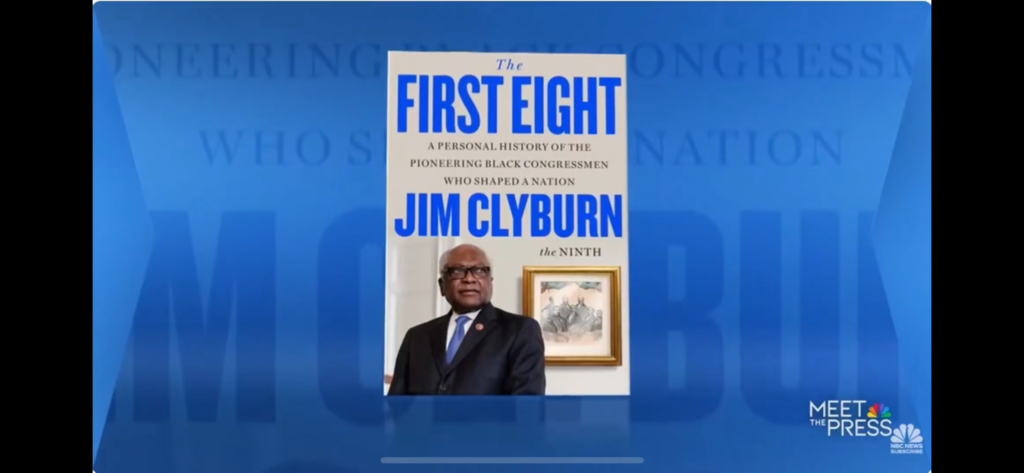
Rep Clyburnโ€™s New Book Looks At How SCOTUS Is Taking Us Back To Jim Crow Era


Please consider $upporting GDPolitics by scanning the QR code below or clicking on this link

An important new book by Rep. James Clyburn (D-SC), The First Eight, warns that disturbing signs suggest we may be sliding back toward a modern form of Jim Crow. In it, Clyburn examines the lives and careers of the first eight Black men to serve in Congress from South Carolina โ€” all elected in the period after the Civil War during Reconstruction. He recalls that after the last of those eight left Congress in 1897, there was no Black representation from South Carolina for 95 years, until Clyburn himself was elected in 1992.

Clyburn uses their stories not just to spotlight that lost legacy, but to warn that many of the same forces that disenfranchised Black voters at the turn of the 20th century are resurfacing today. He draws parallels between the backlash that ended Reconstruction โ€” Jim Crow laws, restrictive state constitutions, poll taxes, literacy tests, and violence โ€” and current efforts to redraw voting districts and suppress minority voting power. A key part of his argument is the role the Supreme Court played then and now. He notes that foundational decisions like the Slaughterhouse Cases narrowed the scope of the 14th Amendment almost immediately after its ratification, stripping federal protections from formerly enslaved people and allowing Southern states to impose discriminatory laws. That judicial retreat set the stage for later rulings such as Plessy v. Ferguson, which constitutionally sanctioned segregation and cemented the legal framework that enabled Black disenfranchisement for generations.

In particular, Clyburn argues that modern partisan and racial gerrymandering โ€” especially in his home state of South Carolina โ€” resembles the โ€œold Jim Crow power playโ€ that erased a century of Black political representation. He points to recent attempts by the State Legislature to redraw congressional districts in a way that moved tens of thousands of Black voters out of his district, a practice a federal court found to be an unconstitutional racial gerrymander. When the map was challenged, however, it was the current Supreme Court that stepped in and reversed the lower court, making it significantly harder for voting-rights advocates to block discriminatory district maps. To Clyburn, this echoes the pattern of the past: when state governments use race to manipulate electoral maps, and the Court either narrows protections or declines to intervene, the result is the same erosion of political power that once produced the 95-year gap between the eighth Black congressman from South Carolina and himself.

Clyburn does not merely retell history โ€” he warns that history is repeating. He argues the country is in the early stages of what he calls a โ€œThird Reconstruction,โ€ threatened by political forces determined to dilute or suppress the votes of people of color. In his view, the stakes are nothing less than the integrity of democracy itself: the story of those first eight Black congressmen is a reminder that gains in political power and representation can be undone โ€” and undone intentionally. The book emerges not just as history, but as a timely call-to-action to defend voting rights, safeguard fair representation, and resist any revival of Jim Crow-era disenfranchisement.

Clyburn closes with a telling reminder that the first eight Black congressmen from South Carolina were routinely assigned racist and belittling nicknames by their opponents โ€” a tactic meant to diminish their legitimacy, sow disrespect, and discourage those they represented. He notes that the weaponization of mockery and demeaning labels is not a relic of the past; it echoes loudly in todayโ€™s political climate, where leaders of color are again targeted with derisive nicknames designed to undercut their standing and weaken the communities they serve. For Clyburn, these parallels โ€” from state laws to Supreme Court decisions to symbolic attacks โ€” underscore his broader warning: the architecture of disenfranchisement is being rebuilt piece by piece, and the patterns of the past are reappearing in unmistakably familiar ways.

Rep. Khanna Accuses Trump of Protecting the โ€œEpstein Classโ€

Please consider $upporting GDPolitics by scanning the QR code below or clicking on this link

Appearing on MSNBCโ€™s All In with Chris Hayes, Congressman Ro Khanna (D-CA) leveled a blistering charge at President Donald Trump โ€” accusing him of protecting what he called the โ€œEpstein classโ€ rather than standing up for working Americans struggling to make ends meet. The phrase quickly caught fire online, and itโ€™s now taking on new weight amid fresh controversy in Washington and inside the federal prison system.

Khannaโ€™s remarks came as pressure mounts on House Speaker Mike Johnson (R-LA) over his continued delay in swearing in Congresswoman-elect Adelita Grijalva of Arizona. Grijalva, a progressive Democrat, has been open about her plan to become the decisive 218th vote to compel the Trump administration to release the long-withheld Epstein files. Johnsonโ€™s refusal to seat her โ€” even after certification of her election โ€” has drawn criticism from both Democrats and watchdog groups who see the move as an attempt to block her role in advancing the Epstein disclosure measure.

After weeks of backlash, Johnson has now committed to swearing Grijalva in on Wednesday, November 12, 2025, when the House reconvenes to deliberate on a Senate measure to reopen the government. The timing has only intensified speculation that the Speakerโ€™s delay was politically motivated.

Meanwhile, another development has reignited public scrutiny over how the powerful continue to benefit from special treatment. Ghislaine Maxwell โ€” Epsteinโ€™s longtime associate who is serving a 20-year sentence for her role in his sex-trafficking network โ€” was quietly transferred from a Florida federal facility to a much softer minimum-security prison camp in Bryan, Texas. The transfer raised immediate red flags, as such privileges are rarely extended to those convicted of serious sex crimes.

Reports from inside the Texas prison suggest Maxwell is enjoying unusually favorable treatment, including lenient oversight and staff attention that other inmates say border on favoritism. Members of Congress are now demanding a formal investigation into possible corruption or political interference in the Bureau of Prisonsโ€™ decision-making.

For Khanna and others calling for transparency, the timing couldnโ€™t be more damning. A president who campaigned on exposing Epsteinโ€™s network has yet to release the files; his allies in Congress have stalled the one member most eager to force disclosure; and the central figure in Epsteinโ€™s trafficking ring appears to be enjoying preferential treatment behind bars.

Until those Epstein files are made public โ€” as Trump once promised โ€” the perception that his administration is shielding the powerful rather than serving the people will only deepen. As Khanna put it, Trump looks less like the champion of the โ€œforgotten man,โ€ and more like the guardian of the โ€œEpstein Class.โ€

Epstein Survivor Press Conference Set For 090325

Rep Ro Khanna (D-CA) appeared in a segment of MSNBCโ€™s The Briefing with Jen Psaki (08/14/25) where he confirmed that together with Rep Thomas Massie (R-KY), they had arranged a 09/03/25 press conference with the survivors of Jeffrey Epstein and Ghislaine Maxwell.

It cannot be understated just how important this presser may turn out to be , not just for curious public, but also for the victims. Reps Massie and Khanna are giving them an avenue to vent out their grievances and frustrations, something they were denied when Epstein died before his criminal trial. They were robbed of an excellent opportunity to confront their abuser publicly in a court of law.

The presser will of course serve another very important function, and that is, bring back the mediaโ€™s focus to the heinous crimes committed by Epstein and Maxwell, and how both shared a close relationship with Donald Trump, now President.

The Trump administration has moved heaven and earth to keep the Epstein story away from the mainstream mediaโ€™s focus, so it will be very interesting to see what โ€œshiny objectโ€ they dangle out there on 09/03/25.

Rep AOC Calls For Senate Probe Into Supreme Court Justice Samuel Alito

$upport viaย Cash App๐Ÿ‘‡

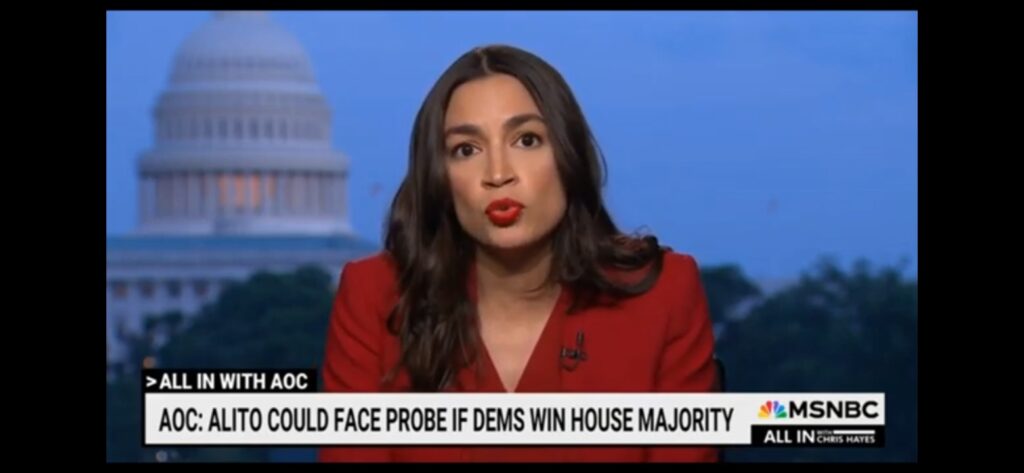
Rep Alexandria Ocasio-Cortez (D-NY) appeared on the 05/22/24 edition of MSNBC’s All In w/Chris Hayes show, where she dropped a bombshell by calling for a U.S. Senate probe into the affairs of Supreme Court Justice Samuel Alito. Rep AOC’s call for an investigation is of course related to recent news reports that say a flag known to be sympathetic to the January 6th insurrection, was spotted flying at Justice Alito’s residence.

Asked by host Chris Hayes what she thought about the Alito news reports, Rep AOC replied(2:22): “I don’t even think that we have to wait until we have a Democratic House majority, because we have a Democratic Senate majority. This is an alarm that I have been sounding for quite some time now. I think that what we’re seeing here, is an extraordinary breach of not just the trust and the stature of the Supreme Court, but we’re seeing a fundamental challenge to our democracy. [Justice] Samuel Alito has identified himself with the same people who raided the Capitol on January 6th, and is now going to be presiding over court cases that have deep implications over the participants of that rally.”

Rep AOC went on to add that Democrats cannot just keep on sitting on power after getting elected. They actually have to use the power that voters bestow upon them, to start addressing this runaway Supreme Court, and other burning voter concerns.

Rep AOC specifically told host Chris Hayes(3:13): “Democrats have a responsibility for defending our democracy, and in the Senate, we have gavels. There should be subpoenas going out, there should be active investigations that are happening, and I believe that when House Democrats take the majority, we are preparing and ensuring to support the broader effort to stand up our democracy…When Democrats have power, we have to use it. We cannot be in perpetual campaign mode. We need to be in governance mode, we need to be in accountability mode, with every lever that we have…”

As you know, Yours Truly has for a long time lamented weakness by congressional Dems. It was therefore quite refreshing to see Rep AOC calling it out too.

https://twitter.com/Emolclause/status/1648761419251302401?t=IYMJDz7UPSwfOtKhLULw9w&s=19

For those of you very happy withย @Emolclauseโ€™s activism donโ€™t shy away from the CashApp โ€œtip jarโ€๐Ÿ‘‡ below on your way out.

Email author at admin@grassrootsdempolitics.com

Russia Behind GOP’s Opposition To Ukraine Funding

$upport viaย Cash App

Rep Marjorie Taylor-Greene(R-GA), the loudest opponent to Ukraine funding

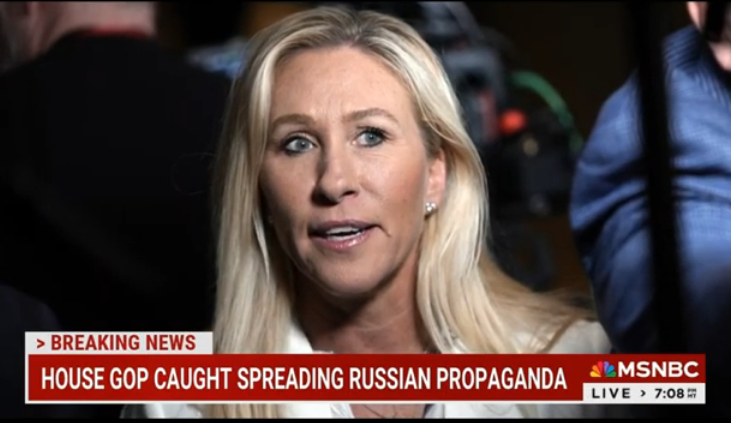
A bombshell segment on Alex Wagner Tonight show (04/17/24), citing a Washington Post piece, confirmed what we’ve suspected all along, and that is, Putin’s Russia is behind the Republican Party’s opposition to efforts by Congress to provide funding for Ukraine, as it defends itself against a Russian invasion. The bombshell report essentially says that Rep Marjorie Taylor-Greene(R-GA), aptly nicknamed “Moscow Marge”, and other congressional Republicans currently opposed to Ukraine funding, are either willing or unwilling participants in Vladimir Putins propaganda campaign–a sad state of affairs indeed.

Host Alex Wagner(5:43): “…Ukraine and the vote for Ukraine funding has become a leverage point for Russia. The Washington Post has some explosive reporting…on newly revealed documents from inside Vladimir Putin’s government, documents which show how Russia is seeking to subvert western support for Ukraine and disrupt the domestic politics of the United States and European countries through propaganda campaigns and supporting isolationist and extremist policies. Russia is formenting division over Ukraine because it wants to weaken America’s role in the world. In particular, one Russian policy expert cited in one of these documents, specifically calls on Russia to continue to facilitate the coming to power of isolationist right-wing forces in America.”

Host Wagner then got very specific, adding, “Russia very much wants the Marjorie Taylor Greene’s to continue doing exactly what they are doing, because it serves Russia’s interests.”

Bottom line folks, host Alex Wagner and the Washington Post are absolutely correct. Trump GOP’s opposition to Ukraine funding is not rooted in some legitimate conservative ideology as they would like the public to believe. Instead, it is a shameless assist to Russia’s strongman Vladimir Putin, who they are banking on to help them win Congress and possibly the White House in 2024. You read that right, a win for Trump in 2024 is a win for Vladimir Putin.

For those of you very happy withย @Emolclauseโ€™s activism donโ€™t shy away from the โ€œtip jarโ€ below on your way out. You may also Cash App

Email author at admin@grassrootsdempolitics.com

Become an Octapharma Plasma donor. Make up to $200 in one week and help save lives too!ย Learn More

Rep Troy Nehl’s Shocking Hypocrisy Re J6 Caught On Camera

$upport viaย Cash App

Rep Troy Nehls (R-TX) in a verbal altercation with insurrectionists on 01/06/2021

Rep Troy Nehls (R-TX) has created a reputation for himself as one of former President Donald Trumpโ€™s loudest advocates in Congress, right up there with Trumpโ€™s most trusted lieutenants Marjorie Taylor Greene (R-GA), Matt Gaetz (R-FL) and others.

A major part of being one of former President Trumpโ€™s trusted lieutenants is of course, oneโ€™s willingness to go out in public and declare the 2020 election โ€œrigged/stolenโ€, and also playing down the violent January 6th insurrection as some kind of โ€œpeaceful protest gone wrongโ€. Rep Troy Nehls has of course, done his part to satisfy the prerequisites for appeasing former President Trumpโ€”election denialism and playing down January 6th.

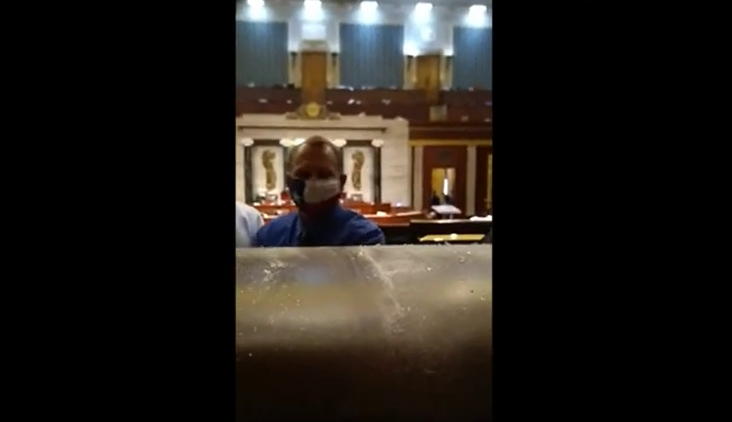
Well, a new video has been released, which exposes Rep Troy Nehlโ€™s shocking hypocrisy regarding the events that happened on January 6th 2021. In the video, Rep Nehls can be seen and heard arguing with some of the January 6th insurrectionistsโ€”who are apparently trying to violently break into Congressโ€”and swearing that in his 30 years as a law enforcement officer in Texas, he had never witnessed what he was witnessing that day. Reasonable people will agree that this doesnโ€™t jive with the โ€œpeaceful protestโ€ narrative Rep Nehls and other Trump lieutenants have diligently dished out since 01/06/21.

Rep Nehls(0:53): โ€œIโ€™ve been in law enforcement for 30 years, and Iโ€™ve never had people like this.โ€ One of the insurrectionists interjected, asking Rep Nehls to speak louder so he/they can hear what heโ€™s trying to say.

Rep Nehls repeated: โ€œIโ€™ve been in law enforcement in Texas for 30 years, and Iโ€™ve never seen people act like thisโ€ฆIโ€™m ashamedโ€ฆโ€ One of the insurrectionists even tells Rep Nehls that if this insurrection doesnโ€™t happen today, thereโ€™s going to be a bigger civil war down the road. That clearly doesnโ€™t jive with the โ€œpeaceful protestโ€ narrative Rep Nehls, et al, have helped Trump push since 01/06/21.

Bottom line folks, itโ€™s about time the media, and especially the Texas media, start demanding that Rep Nehls come clean and clarify his record regarding the January 6th insurrection. Simply put, he needs to apologize to the public for all the misleading statements he has made, trying to play down the violent January 6th insurrection. Simply put, the good folks of Fort Bend County (TX-22) deserve better.

For those of you very happy withย @Emolclauseโ€™s activism donโ€™t shy away from the โ€œtip jarโ€ below on your way out. You may also Cash App

Email author at admin@grassrootsdempolitics.com

Become an Octapharma Plasma donor. Make up to $200 in one week and help save lives too!ย Learn More