As America approaches the 25th anniversary of the September 11 attacks, one of the more striking changes in our politics is not what happened on that terrible morning, but what has happened to the politics surrounding it. On the September 9, 2026 edition of MSNOW’s All In with Chris Hayes, Hayes examined what he portrayed as a remarkable Republican metamorphosis: ideas once treated on the right as career-ending “9/11 truther” conspiracies are now being entertained publicly by prominent Republicans. The episode itself advertised a report on “the 9/11 truther sitting in the United States Senate,” making the contrast between then and now the centerpiece of the segment.
#BREAKING: On the 25th anniversary of 9/11, Chris Hayes highlighted a stunning Republican metamorphosis: “truther” conspiracies were once so politically radioactive that Glenn Beck helped drive Van Jones from Obama’s White House merely over his name appearing on a 9/11… pic.twitter.com/IUUWGxwvDu
The most illuminating historical example is Van Jones. In 2009, Jones was serving in the Obama administration as a special adviser on green jobs when conservative media—most prominently Glenn Beck—hammered him over his name appearing on a 2004 petition associated with the 9/11 Truth movement. Beck went considerably further, claiming Jones believed the Bush administration had “blew up the World Trade Center and covered it up.” PolitiFact later rated that characterization only Half True: Jones’s name did appear on the petition, but the document called for further investigation and raised questions about whether officials might have allowed the attacks to happen; it did not say Bush officials blew up the towers. Jones repudiated the petition’s implications, saying they did not represent his views, and his name was subsequently removed. The controversy was not the only issue dogging Jones—his past political activism and other inflammatory remarks were also under fire—but amid that broader conservative campaign, he resigned from the White House.
That history makes Sen. Ron Johnson’s more recent rhetoric remarkable. In April 2025, the Wisconsin Republican discussed 9/11 on a podcast, questioned the accepted explanation for the collapse of World Trade Center Building 7, suggested it may have been a “controlled demolition,” and spoke of pursuing Senate hearings. Johnson, who chaired the Senate Permanent Subcommittee on Investigations, also suggested that the government knew more about 9/11 than it had disclosed. These are not fringe comments from an anonymous internet poster; they came from a sitting United States senator with investigative authority. Yet Johnson did not experience anything resembling the immediate political exile that association with the “truther” movement could produce in the post-9/11 political era.
There is an important qualification to Hayes’s comparison. The Van Jones controversy cannot fairly be reduced to only 9/11: conservatives were simultaneously attacking his previous radical politics and controversial remarks, and Jones’s precise connection to the petition was disputed. Likewise, Johnson says he is asking questions and seeking evidence, rather than simply adopting every claim associated with the sprawling 9/11 Truth movement. And questioning government findings is not inherently illegitimate. But the political contrast remains difficult to miss. In 2009, merely being linked to a petition that raised conspiratorial questions about 9/11 helped make a White House official politically radioactive. Sixteen years later, a Republican senator could himself publicly raise one of the movement’s signature theories—controlled demolition of Building 7—and contemplate congressional investigation.
That may be the most fascinating takeaway from Hayes’s segment as September 11, 2026 approaches. The underlying evidence about the attacks has not undergone some comparable revolution; the National Institute of Standards and Technology’s investigation concluded that uncontrolled fires caused the progressive collapse of Building 7, not explosives. What has unmistakably changed is the political ecosystem in which conspiratorial claims circulate. Glenn Beck once wielded the “truther” label as a devastating indictment against Van Jones. Today, Ron Johnson can venture into territory once considered politically toxic and remain a powerful senator. Twenty-five years after 9/11, perhaps the story is not simply that conspiracy theories survived. It is that the political price for entertaining them has changed dramatically—and, depending on who is doing the entertaining, may barely exist at all.
In reference to my previous post on the Hope Florida money trail, there is one defense from Florida officials that deserves a closer examination because, on its face, it sounds compelling: if the Hope Florida affair really involved fraud, corruption or the misuse of taxpayer money, why didn’t the grand jury indict anyone? In that earlier piece, I traced how $10 million connected to Florida’s $67 million Medicaid settlement with Centene went to the Hope Florida Foundation—the charitable arm associated with First Lady Casey DeSantis’ signature initiative—then through two nonprofits and ultimately into political organizations advancing Gov. Ron DeSantis’ agenda. I also raised the question of whether Vice President JD Vance’s highly publicized anti-fraud crusade would be applied with the same intensity when allegations involving public health-care money lead into the political orbit of a powerful Republican governor. But the absence of indictments presents a separate question, and former Republican congressman and Democratic gubernatorial nominee David Jolly offered an important answer during an appearance with Jen Psaki on MSNOW: you cannot fairly evaluate the lack of indictments without examining why the grand jury said it was unable to indict anyone. The jury did not investigate the transaction and conclude that nothing improper happened. According to the leaked report, it concluded that $10 million in taxpayer money had been “misappropriated,” called the diversion part of a “sophisticated scheme to fund political activities,” and nevertheless found insufficient evidence to charge a particular person criminally because investigators could not establish who made the critical decision to send the money to Hope Florida.
#BREAKING: Psaki: “This completely crazy level of corruption is happening in a state you are hoping to lead. What do you think is most important for people just tuning into the story, trying to digest it, to really understand?”
That distinction changes the entire meaning of the “no indictments” defense. There is an enormous difference between a grand jury saying, we examined what happened and found no wrongdoing, and a grand jury saying, we found wrongdoing but cannot establish which individual can be criminally charged for it. The latter is much closer to what the Hope Florida report says. The grand jury concluded that the entire Centene settlement represented taxpayer reimbursement and rejected the characterization that the disputed $10 million was simply some extra “bonus” that could be directed elsewhere. It identified the decision to send that money to Hope Florida as the original misappropriation. But when jurors attempted to determine who actually made that decision, they encountered a remarkable problem: according to the report, “Nobody will take responsibility” for deciding that the $10 million would go to Hope Florida, and witnesses either could not identify or did not remember who made the decision. The jury therefore found itself in the unusual position of saying it could see that taxpayer money had been misused for political purposes while being unable to establish who, individually, could be prosecuted for causing it to happen.
That is not a minor technical distinction. Criminal prosecution requires prosecutors to do more than demonstrate that something improper happened. They must connect specific conduct to specific defendants and establish the elements of a particular criminal offense. Depending on the alleged crime, that can require evidence showing who authorized an action, what that person knew, whether there was criminal intent and what role that individual played. Investigators can therefore trace money from point A through points B, C and D, establish that its ultimate disposition was improper, and still find themselves unable to prosecute if they cannot prove who ordered the crucial first step. That appears to be the fundamental problem the Hope Florida grand jury encountered. The jury’s inability to identify who made the original decision is therefore not evidence that the decision was proper. In fact, the grand jury expressly reached the opposite conclusion about the money itself. As the report put it, despite finding that the money was misappropriated, jurors found “insufficient evidence to charge anyone criminally.”
The circumstances that produced that evidentiary gap are precisely what make Jolly’s argument so significant. According to the grand jury, virtually everyone involved was a lawyer, and many witnesses said they were acting based upon the advice of other lawyers. Jurors explicitly recognized that this created an impediment to criminal prosecution. Yet the jury still concluded that it could “plainly see” taxpayer money had been misused for political purposes. That is a remarkable statement. It essentially means the grand jury believed it could identify the improper disposition of the money but could not penetrate the decision-making structure sufficiently to assign prosecutable responsibility to an individual. Rather than resolving the scandal, the absence of charges therefore leaves perhaps its most important question unanswered: Who decided that $10 million belonging to Florida taxpayers should be sent to Hope Florida in the first place?
That question becomes even more consequential when considering who reportedly never testified before the grand jury. Gov. DeSantis was not called. Then-Attorney General Ashley Moody, now a U.S. senator, was not called. James Uthmeier, who was DeSantis’ chief of staff at the time and is now Florida’s attorney general, was not called either. Yet the report concluded that Uthmeier was “in a position of authority” over officials involved in settling with Centene, and testimony identified him as having involvement in directing the money after it reached Hope Florida. His Keep Florida Clean political committee ultimately became the principal recipient of most of the disputed $10 million. The grand jury also concluded that Moody knew about the diversion plan and authorized her chief deputy to sign the settlement, although Moody says her office had no knowledge of how Hope Florida or subsequent recipients would ultimately spend the money. None of these facts establishes criminal guilt by DeSantis, Moody, Uthmeier or anyone else. But when the central reason for not bringing charges is the inability to establish who made the critical decision, the fact that several of the highest-ranking officials connected to the episode never testified is hardly irrelevant.
This is where the claim that the grand jury “cleared” everyone becomes particularly difficult to sustain. Imagine how different the situation would be if the grand jury had heard sworn testimony from every major participant, obtained all relevant communications and records, established who made the decision to direct the $10 million to Hope Florida, reconstructed what everyone knew at the time, determined whether anyone anticipated its subsequent political use, and then concluded that no crime had occurred. Such a finding would represent powerful evidence in favor of DeSantis and the officials involved. Critics would have to reckon seriously with it. But that is not what happened according to the report. Instead, investigators were left with a central decision for which nobody would accept responsibility and witnesses could not—or would not—identify a decision-maker. To take the resulting absence of charges and transform it into proof that nothing improper occurred is to omit the very reason the grand jury gave for its inability to bring charges.
Jolly’s argument goes further. Speaking with Psaki, he described a situation in which some of the officials connected to the controversy subsequently rose into even more powerful positions in Florida and federal government. Moody, who was attorney general when the settlement was approved, was later appointed by DeSantis to the United States Senate. Uthmeier moved from DeSantis’ chief of staff to attorney general. John Guard, Moody’s chief deputy, who signed the settlement despite concerns described in the grand jury report about the arrangement’s compliance with Florida law, was subsequently appointed by DeSantis to the Second District Court of Appeal. Those appointments do not prove bribery, a quid pro quo or a criminal conspiracy, and they should not be presented as if they do. But they add to the institutional problem: people connected to the underlying events have subsequently occupied some of the very positions from which Floridians might ordinarily expect governmental accountability. That is one reason Jolly says the investigation should be reopened and additional facts pursued.
And that is why independence matters so much. The issue is not that the existing grand jurors themselves should be presumed partisan, compromised or corrupt. There is no basis for making such an accusation. The issue is whether a new investigation, conducted by an independent special counsel or similarly insulated authority with the ability to pursue the unanswered questions, could reach a much more definitive conclusion. Such an investigation could seek testimony from the central officials who did not appear before the grand jury, obtain relevant communications and records, reconstruct the decision-making process surrounding the Centene settlement, determine who authorized the $10 million transfer, establish what state officials knew about its intended destination, and examine whether its subsequent movement into political organizations was anticipated or coordinated. The objective should not be to find a way to prosecute DeSantis or anyone else. It should be to obtain the answers that the first investigation was unable to obtain.
That point is important because a truly independent investigation could just as easily vindicate the officials involved. Suppose an independent special counsel obtained testimony from every central figure, established exactly who authorized the transfer and why, examined communications surrounding the settlement, followed the subsequent movement of the money, tested every legal argument offered by the administration and ultimately concluded that no individual committed a crime. That would be a substantially different—and far more powerful—finding than the one Florida has today. It would mean investigators knew who made the decisions, understood why they were made, possessed the relevant evidence and nevertheless determined that criminal prosecution was unwarranted. If an independent investigation produced that conclusion, it should carry enormous weight. The existing grand jury report cannot provide the same vindication precisely because it says the jury could not determine who made the crucial decision. The unanswered question is not incidental to its failure to indict; it is central to it.
The grand jury’s recommendations make the claim of complete exoneration even harder to reconcile with what jurors actually found. The jury recommended that Florida lawmakers establish clearer requirements governing money received by the state and impose tracking, monitoring and consequences governing how state-affiliated entities such as Hope Florida may use taxpayer dollars. That is significant. A grand jury persuaded that the entire controversy was imaginary would have little reason to recommend laws designed to prevent something similar from happening again. Instead, the jurors concluded taxpayer money had been misappropriated, said they could plainly see that it had been misused for political purposes, and then urged the Legislature to create safeguards against a recurrence. Those are the findings of a grand jury frustrated by the limits of its ability to assign criminal responsibility, not the findings of one announcing that everything was aboveboard.
DeSantis, Uthmeier, Moody and the other officials involved are nevertheless entitled to have their defenses presented fairly. DeSantis strongly disputes the grand jury’s characterization of the $10 million, saying there was “no diversion of any Medicaid funds” and describing the money as a private contribution connected to a legally sound settlement. Uthmeier calls the controversy a politically motivated witch hunt and says nobody did anything wrong. Moody says her office was only one of several agencies involved in the settlement and had no knowledge of how Hope Florida or other organizations would subsequently spend the money. Those are not arguments that should simply be brushed aside because critics distrust the officials making them. They should be tested against evidence. If the $10 million really was a private contribution rather than money owed to Florida taxpayers, establish that conclusively. If state officials properly possessed the legal authority to structure the settlement this way, demonstrate it. If the subsequent political spending was entirely disconnected from the people responsible for directing the money to Hope Florida, establish that through testimony and records. An independent investigation could ultimately substantiate those defenses.
But “nobody was indicted” cannot substitute for those answers. Attorney General Uthmeier himself had emphasized the absence of an indictment even before the report became public, saying that he had not been indicted, had not been a suspect or target and had not engaged in criminal activity. After the report emerged, he again emphasized that there was not even probable cause to proceed. Yet the grand jury’s findings complicate that argument enormously. The relevant question is not merely whether an indictment emerged at the end of the process. It is whether investigators possessed sufficient evidence to identify and prove who was responsible for conduct the grand jury itself considered improper. According to the report, they did not—and the report tells us why.
This is ultimately why Jolly’s call to reopen the investigation deserves serious consideration regardless of one’s political affiliation. Indeed, Jolly has challenged his Republican opponent for governor, Byron Donalds, to commit to doing the same. The principle should be straightforward: if public money was handled properly, an independent investigation should be capable of demonstrating that. If laws were broken, an independent investigation should identify who broke them. And if something improper occurred but falls short of criminal conduct, Floridians should still know exactly what happened and who made the decisions. Accountability is not limited to criminal indictments. Misuse of public money can raise questions of ethics, governance, statutory compliance and public trust even when prosecutors cannot prove a crime against a particular individual.
The most important question surrounding Hope Florida therefore is not simply, “Where are the indictments?” It is, “Why weren’t there indictments?” If the answer were that investigators established every important fact and found no wrongdoing, the administration would have an exceptionally strong defense. But the grand jury itself supplied a very different explanation: it found the money had been misappropriated, found that taxpayer money had been used for political purposes, could not determine who made the original decision to send it to Hope Florida, encountered witnesses who would not accept responsibility or could not remember who had done so, and recognized those evidentiary problems as an impediment to criminal prosecution. The absence of an indictment under those circumstances is a failure to establish individual criminal liability. It is not the same thing as a finding that nothing improper happened.
There is therefore a straightforward way to settle the competing narratives. Put the matter before investigative authority sufficiently independent from the people and institutions implicated in the controversy. Obtain testimony from the central decision-makers. Examine the communications and financial records. Determine who authorized the transfer. Establish what that person believed the money represented and why it was directed to Hope Florida. Determine what officials knew about its subsequent disposition. Test the administration’s legal explanation against the grand jury’s conclusion that the entire $67 million represented taxpayer reimbursement. Follow the evidence without regard to whether the result helps Democrats or Republicans. If that investigation ultimately concludes that no crime occurred, DeSantis and his allies would have something far more persuasive than the talking point they have today: a complete, independent investigation that answered the outstanding questions and cleared them.
Until then, the Hope Florida grand jury’s failure to indict should not be mistaken for vindication. In some respects, the reasons it gave for not indicting are among the strongest arguments for continuing the investigation. A grand jury concluded that $10 million belonging to taxpayers was misappropriated and ultimately used for political purposes, yet it could not establish who was criminally responsible because nobody would take responsibility for the crucial decision that put the money on that path. That finding demands caution about accusing any individual of a crime, but it also demands something more than a declaration that the case is closed. If a genuinely independent investigation hears from the principal players, obtains the missing evidence, answers the unanswered questions and still concludes that no charges are warranted, that would be meaningful vindication. Florida does not have that finding today. What it has is an unresolved question sitting at the center of $10 million in taxpayer money: who made the decision, and why? Until somebody can answer it, “no indictments” should not be the end of the Hope Florida story. It should be the beginning of the demand for an independent accounting.
Please consider $upporting GDPolitics by scanning the QR code below or clicking on this link
In the October 19, 2025, edition of MSNBC’s Velshi, legal commentator Elie Mystal delivered a striking critique, telling host Ali Velshi that U.S. Supreme Court Chief Justice John Roberts has, in many respects, become the most formidable obstacle to the enforcement of the landmark 1965 Voting Rights Act (VRA)—and, by extension, a significant impediment to protecting the voting rights of communities of color.
#BREAKING: Velshi: "One of the crown jewels of the civil rights movement is the Voting Rights Act (VRA). It was signed into law by President LBJ while surrounded by civil rights leaders like MLK…in 1965…It was a key part of ending the Jim Crow era policies of the day, which… pic.twitter.com/7PkcTCwWKK
Mystal’s remarks were prompted by the high-profile redistricting case currently before the Supreme Court, Louisiana v. Calais. Experts warn that the Court’s ruling could fundamentally undermine the VRA, effectively allowing racially motivated redistricting and diluting the electoral power of Black and minority voters. The stakes are enormous: analysts suggest that, if the Court rules in favor of Louisiana’s approach, Republicans could gain as many as 19 additional House seats in the 2026 elections alone.
The case raises critical questions under the VRA’s Section 2, which prohibits voting practices that result in racial discrimination, and Section 5, which historically required jurisdictions with a documented history of voter suppression to obtain federal approval before changing voting laws. Louisiana v. Calais centers on whether the state’s proposed redistricting plan unfairly diminishes the influence of Black voters in certain congressional districts. Proponents of the challenge argue that the plan reflects legitimate political considerations, while opponents contend it is a transparent attempt to circumvent the VRA and dilute minority voting power.
This moment is reminiscent of a discussion I initiated back in 2018, when I criticized what I then termed the “unjust Roberts Supreme Court” for systematically chipping away at the VRA’s protections. At the time, such a stance was considered controversial. Today, with mainstream voices like Mystal echoing similar concerns, it appears those warnings have entered the broader public discourse.
As the Supreme Court deliberates Louisiana v. Calais, the implications extend far beyond a single state. The decision could redefine the legal contours of voting rights protections nationwide, setting a precedent that either reinforces or weakens decades of civil rights progress. Observers on both sides of the political spectrum will be watching closely, as the Court’s ruling could reshape congressional representation and influence the trajectory of American democracy for years to come.
Republicans have for decades advanced this theory that if you give tax cuts to the wealthy (business owners), the wealth they “create” would eventually trickles down to the middle and lower class—the so-called “trickle-down” economic theory.
History however has proven time and time again that the trickle down economic theory never works as promised, and instead, only widens the gap between the rich and the poor. This topic came up in an interesting segment of MSNBC’s Morning Joe show (06/03/25), and as you can tell from the heavy reaction, Americans appear to have caught up to the trickle down lie, as Republicans yet again push the Big Beautiful Bill.
#BREAKING: Morning Mika citing a New Republic piece: "In the 34 years after 1946…The government was spending like crazy…building interstate highways, creating Medicare and Medicaid, expanding the welfare state…and yet, the debt remained under control. What changed after… pic.twitter.com/GtGQX7bDns
House Speaker Mike Johnson appeared on CBS’ Face The Nation (05/25/25) to discuss among other things, the recent House passage of the Trump administration’s budget bill—dubbed “Big Beautiful Bill”. The Bill’s fate now lies with the Republican majority in the U.S. Senate.
#BREAKING: 🔥Margaret to @SpeakerJohnson : "You are eliminating subsidized federal student loans…$500 billion in clean energy subsidies…alongside that, you are carrying out about a trillion in reductions to Medicaid and food stamps…we looked at your home state and the… pic.twitter.com/14q7WpquTz
Among the issues raising concerns with the budget bill, is that it is projected to increase the national debt significantly, something Republican lawmakers lamented throughout the Biden administration. The bill also makes significant cuts to Medicaid and food stamps(SNAP), programs crucial for working families generally, and specifically, the working poor.
Speaker Mike Johnson’s Louisiana is one of the poorest states in the nation, so cuts to Medicaid and food stamps are bound to have relatively more disastrous effects on families there. Asked by host Margaret Brennan how he can justify pushing such cuts knowing full well that his state is one of the poorest in the nation, Speaker Johnson responded that all the bill cuts is waste, fraud and abuse.
It will be interesting to see how Speaker Johnson and other House Republicans use this excuse once their poor constituents start complaining about the cuts. Even more interesting, will be the way Republicans defend this tricky position as we approach the 2026 midterm elections.
For those of you very happy with @Emolclause’s activism don’t shy away from the CashApp “tip jar” below on your way out.
Ever since President Trump beat his Democratic challenger Kamala Harris in the 2024 U.S. presidential election, Democrats have been in disarray, struggling to find a compelling narrative with which to challenge the new Trump administration.
Corruption is slowly becoming the galvanizing issue that is uniting Democrats in their opposition to the Trump administration. My posts on X(formerly Twitter) referencing these corruption stories generate a lot of engagement(retweets, likes, comments) which supports my assertion that corruption is clearly a hot topic for Democrats as we approach the 2026 midterms. Below are examples of such posts.
#BREAKING: 🔥Erin: "Now to our other big story tonight, the Trump family CASHING IN big time. President Trump's son @EricTrump is now arriving in Vietnam. In just hours, he'll be breaking ground on a $1.5 billion golf resort there…and while #EricTrump is in Vietnam receiving a… pic.twitter.com/RHOxxzomE7
#BREAKING: Legendary #Maddow: "The eldest son of POTUS, @DonaldJTrumpJr, has made multiple trips to Serbia to try to shore up their very Trumpy president against [protests] that he resign…WHY…?? In the middle of the capital city of Serbia, there is a ruined building [never… pic.twitter.com/eNqhYcbdID
#BREAKING: Erudite Anne to Morning Mika: "He [Trump] has been involved in an industry, the real estate industry, that relied on secret Russian money coming through anonymous bank accounts buying anonymous properties in his businesses for many years. He's been dealing in that… pic.twitter.com/Hh8VAaXitW
An interesting segment on the 02/10/25 edition of MSNBC’s Rachel Maddow Show revealed that the recent decision by the Trump administration to halt federal subsidies for EV charging stations directly benefits Elon Musk’s Tesla.
#BREAKING: Legendary #Maddow: "Did you notice the little announcement that the Trump admin has ordered a halt to all federal funding for electric vehicle(EV) chargers across the U.S… @elonmusk's company, #Tesla, already has the biggest private charging network in the… pic.twitter.com/cYyivQUbpW
This is a glaring conflict of interest, which once again underscores the need for some congressional oversight regarding the work Musk and his DOGE are doing, ostensibly to identify and eliminate government waste and fraud.
Simply put, Congress needs to step in to ensure that Musk’s “waste cutting” operations are not benefiting his private businesses.
For those of you very happy with @Emolclause’s activism don’t shy away from the CashApp “tip jar” below on your way out.
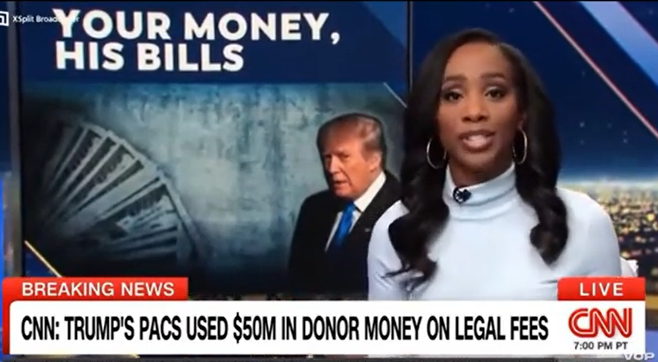
Turns out, per bombshell segment on CNN‘s NewNight Show (01/30/24) that political action committees (PACs) supporting former President Donald Trump are using the $50 million they have raised, to offset Trump’s personal legal bills. As NewsNight host Abby Phillips hastily points out, as shady as this may appear to the general public, it is apparently totally legal.
One would understand why the public would struggle with the legality of this action by Trump’s PACs, given the myriad news stories out there, of people being criminally prosecuted for starting GoFundMe campaigns to ostensibly raise funds for medical bills, only to turn around and use those funds for personal items like new vehicles, rent, jewellery, etc. If that is illegal, then why should it be perfectly legal for a PAC, which ostensibly raises money for Trump’s campaign for the presidency in 2024, to turn around and use the raised funds to offset his personal legal bills?
Host Abby Phillip (0:15): “Sources tell CNN that $50 million, is how much the PACs supporting Trump, have raised and then donated to the cause of keeping Trump out of jail. Now, mind you, this is all legal, but a spokesman for one of those PACs insists tonight to the New York Times, that every dollar being raised by MAGA Inc is going directly to defeating Joe Biden in November. But at least some of those dollars and cents are as of this moment, being siphoned off for courtroom costs.”
Bottom line folks, reasonable people will agree that there is no difference between the financial fraud that GoFundMe scammers are rightly criminally prosecuted for, and what these Trump PACs are engaged in. Simply put, rather than just throwing up our hands in the air and accepting this cheating by Trump’s PACs as “totally legal”, maybe some legal eagle should embark on a novel federal lawsuit arguing that Trump’s PACs are defrauding their donors, and are in essence, no different than the criminal GoFundMe scammers. While this may not fix the issue during this 2024 election cycle, maybe, just maybe, it may spur members of Congress to come up with a legislative fix for these and other PAC loopholes, for future elections.
For those of you very happy with @Emolclause’s activism don’t shy away from the “tip jar” below on your way out. You may also Cash App
Email author at admin@grassrootsdempolitics.com
Become an Octapharma Plasma donor. Make up to $200 in one week and help save lives too! Learn More
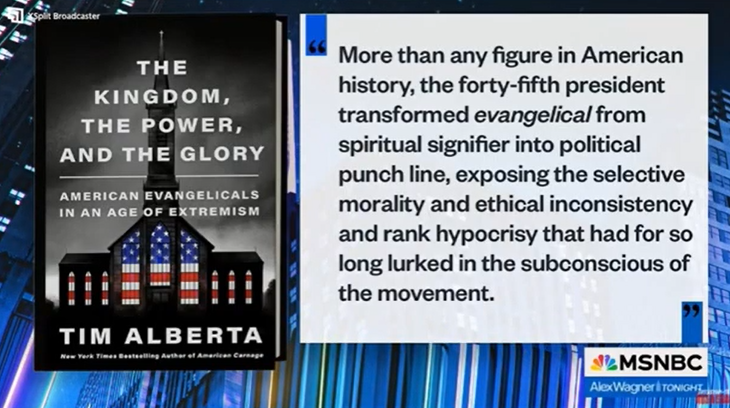
An interesting segment on MSNBC’s Alex Wagner Tonight (01/1624) show delved into the strange daliance between Evangelical Christians(predominantly White), and the politics of former President Donald Trump, often referred to as Trumpism, or MAGA Trumpism. The alliance between these two strange bedfellows has led many to question whether MAGA Trumpism has become some sort of political/civil religion.
The MSNBC segment came against the backdrop of Trump’s massive win in the Iowa Republican presidential primary, and specifically, his command of the White Evangelical vote, which polls placed at 53%. Back in 2016, when Trump first ran for president, he only received 21% of the White Evangelical vote in Iowa, a clear sign that he has now consolidated the White Evangelical vote in Iowa, and arguably nationwide.
#BREAKING:🔥Alex: "In the eight years between those two #IowaCaucuses, Donald Trump has not only more than doubled his support from #Evangelicals, he has also REDEFINED what it means to be one."
Host Alex Wagner posed this question to her guest, Author Tim Alberta, who’s also a staff writer at The Atlantic (2:07): “I wonder in your estimation, what it means to be an Evangelical in this country, at this moment?” Tim Alberta responded in relevant part: “We are beginning to flirt with this territory where definitionally speaking, Evangelicalism has far more to do, at least in the perception of the greater public, with political engagement, partisan political identification, than it does with any particular theology or any real religious conviction, and if you take it a step further, if you look at the exit polling, if you look at some of the social science around this, if you look at the fact that during Donald Trump’s presidency, more and more of Donald Trump’s supporters were self-identifying as Evangelicals even though they were simultaneously attending Church less and less often, I think one might reach the uncomfortable conclusion that perhaps the best definition now for what it means to be an Evangelical, is to be a conservative White Republican Trump supporter, and that is a tragedy on any number of different levels, but I think most profoundly, it’s a tragedy for the Gospel of Jesus Christ.”
Host Alex Wagner then interjected with this profound question (3:50): “If the Gospel is no longer part of the equation, what is it replaced by…do you think MAGA-ism has become a placeholder for a certain kind of religion?”
Tim Alberta: “Yes…I don’t want to paint with too broad a brush, the Evangelical community is large, it’s huge, and it’s complicated…but…we are reaching a place where we are being confronted with some uncomfortable realities about what it means to be a part of the Evangelical movement and frankly, where the line blurs between sort of religious identity and political identity, and is there a merging of the two, and frankly I think that there’s always a danger in politics…of sort of turning political conviction into religious conviction, or worshipping at a certain altar that is not an altar to God, but is an altar to political idolatry or to political identity. That is a danger that has always been there, but it is I think uniquely dangerous in this moment, and to be clear…we have examples from the not so distant past, of a sort of political religion, or at least a civil religion, supplanting, competing with actual religion, and I don’t think that we’re all that far removed from that in this country now, looking at just what happened…in Iowa.”
To conclude the segment, Tim Alberta floated this interesting scenario, which gets right to the fallacy of the Evangelical-MAGA Trumpism alliance. He said (8:19): “If during Barack Obama’s presidency, or while he was running for president, if you had heard him talking with, or promoting a video saying that he was a shepherd to all of mankind, the Evangelical movement would have been up in arms [and rightly so], I mean this is heretical, this is blasphemous and yet, Donald Trump seems to get a pass time and time again for doing these things that no other politician, Republican or Democrat frankly, would get a pass for doing, and we should ask ourselves why. If the answer does not at least start to flirt with this terrain of civil religion, or political religion, then I think that we’re not being honest with ourselves, and if we are being honest with ourselves, if we are willing to engage with the very uncomfortable topic around what happens when Trumpism becomes civil religion in this country for millions of millions of people, and what that might imply moving forward, then we are doing a disservice to our prularistic democracy.”
Bottom line folks, we’ve always operated on the separation of church and state doctrine, and have for decades, shunned foreign theocracies like the ones in Afghanistan and Iran. Author Tim Alberta is absolutely correct when he says, we need to be honest with ourselves, and admit that there is no difference between the Evangelical-MAGA dalliance in the American political scene, and the theocracies in Iran and Afghanistan. Simply put, we need to make a decision as to whether we want to continue with the separation of church and state doctrine, or whether, that time-honored tradition has also been sacrificed at the altar of MAGA Trumpism.
For those of you very happy with @Emolclause’s activism don’t shy away from the “tip jar” below on your way out. You may also Cash App
Email author at admin@grassrootsdempolitics.com
Become an Octapharma Plasma donor. Make up to $200 in one week and help save lives too! Learn More
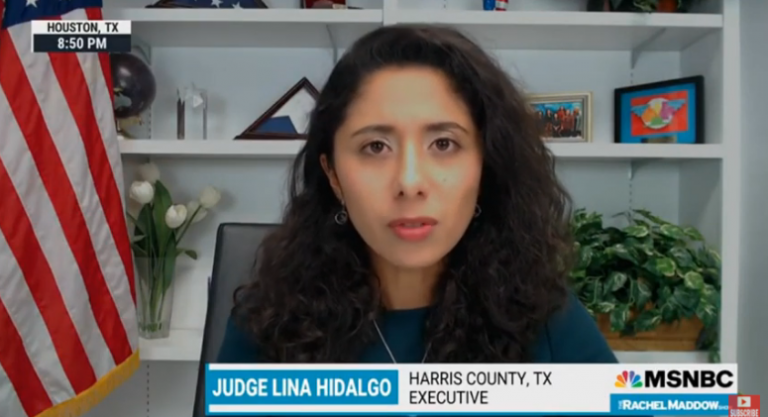
Harris County Judge Lina Hidalgo appeared on MSNBC’s The Rachel Maddow Show (09/24/2021), where she blasted elected Republicans in Texas for giving in to former President Trump’s baseless demands for an audit into the state’s 2020 election results. The decision by the Texas Secretary of State’s office to conduct an audit into the election results of Collin, Dallas, Harris and Tarrant counties, came literally a few hours after Trump’s demand, which led a visibly upset Judge Hidalgo to tell host Maddow that Texas was “being run from Maralago.”
Judge Hidalgo told Maddow:“We have to remember we had incredibly successful elections here in Harris County in 2020. We had innovations that led to record turnouts from both parties, the highest in 30 years, I mean it was beautiful, and since then, no evidence has come out that would in any way cause the need for this kind of audit. All we’ve seen is [former]President Trump exhorting the state, or [Governor]Abbott, to have this audit…The reality of it is Texas is being run from Maralago, and that is dangerous, and it’s not appropriate…it’s extremely concerning.”
Judge Hidalgo added that time had come for politicians in Washington to get off the sidelines, and actively join the fight against voter suppression in the states, telling host Maddow, “We need the federal government to act, I mean, this has gone too far… This should be another call to action. We’ve got the writing on the wall. We’ve got to get off our chairs and get moving on all this.”
Bottom line folks, as Judge Hidalgo correctly pointed out, time has come for some decisive action to be taken against these naked efforts by Republicans at the state level, to restrict the voting rights of minorities. Democrats in Washington cannot just sit on the sidelines, and watch their counterparts in Republican-led states like Texas, go to war against GOP’s efforts to restrict minority voting rights. Simply put, time has come for Democrats in Washington to finally do away with the filibuster, and institute a national voting standard geared towards making it easier for people to vote, as opposed to GOP’s scheme of limiting access to the ballot box. As Judge Hidalgo correctly put it, congressional Democrats need to “get off their chairs and get moving” on a comprehensive federal voting rights law.
For those of you very happy with @Emolclause’s activism don’t shy away from the “tip jar” below on your way out. You may also Cash App
Email author at admin@grassrootsdempolitics.com
Become an Octapharma Plasma donor. Make up to $200 in one week and help save lives too! Learn More