The Steve Bannon–Jeffrey Epstein Connection: What the Newly Released Emails Reveal

A recent segment on the 11/19/25 edition of MSNBC’s The Beat with Ari Melber examined a newly surfaced trove of emails that—according to the program’s reporting—suggest Steve Bannon’s relationship with Jeffrey Epstein was far deeper and more strategic than Bannon has publicly acknowledged. As Melber emphasized, the emails do not indicate that Bannon participated in Epstein’s criminal activities. But they do appear to show that Bannon was fully aware of Epstein’s widely reported misconduct and still worked behind the scenes to help rehabilitate Epstein’s public reputation. If accurate, the correspondence paints a picture of a political strategist engaging with a disgraced financier in ways that raise more questions than answers.

Why Bannon would want to rehabilitate Epstein remains unclear. Bannon’s brief tenure in the first Trump administration fuels speculation: was he attempting to minimize or contextualize Trump’s long-documented association with Epstein? Was he pursuing financial or strategic support from Epstein, who still wielded substantial wealth and elite connections? Or was Bannon trying to leverage Epstein’s deep ties to global power brokers for his own political aims? While none of this is conclusively established, the emails suggest Bannon saw a degree of utility in Epstein that extended well beyond casual acquaintance.

The timeline of Bannon’s public statements only complicates matters further. When the Epstein files controversy re-emerged earlier this year during Trump’s second term, Bannon became one of the loudest figures demanding the release of every Epstein document. He framed Epstein as central to the so-called “Deep State,” arguing that the files were the key to exposing elite corruption and dismantling entrenched power networks. Yet throughout this campaign for transparency, Bannon never disclosed that he had any prior personal or professional interactions with Epstein—let alone that he had reportedly discussed rehabilitating Epstein’s image. That omission now casts his rhetoric in a new light and raises questions about whether his public crusade was also an effort to get ahead of information that might implicate or embarrass him.

The dynamic becomes even more intriguing when considering Bannon’s public clash with Elon Musk over the handling and release of Epstein-related material. What initially looked like another loud, intra-movement skirmish now takes on new weight. If Bannon had undisclosed ties to Epstein, his aggressive posture toward Musk could be interpreted as an attempt to steer the narrative or deflect scrutiny.

If these emails are authentic, they suggest a pattern of engagement with Epstein that conflicts with Bannon’s public posture and demands a fuller explanation. The public deserves to know why Bannon was attempting to reshape Epstein’s image, what he hoped to gain from the relationship, why he hid these interactions while urging transparency from others, and how this impacts the credibility of his broader claims about the Epstein files. Until Steve Bannon provides a transparent and comprehensive accounting of his relationship with Epstein—its scope, its motives, and its implications—there is little reason to take his proclamations at face value. The questions raised by these revelations are serious, and they are not going away.

Little Known FBI’s Race-Based Surveillance

$upport via Cash App

There have been numerous media reports about a very troubling practice by the FBI to designate Black activists as “Black Identity Extremists”, an often bogus designation which is then used to justify subjecting the said activists to all levels of surveillance–private, local, state, federal and even military surveillance in major cities like Houston, LA, Chicago, New York and others. The rationale, a bogus one, is that a “Black Identity Extremist” or BIE is more likely to attack law enforcement officers and thus needs to be placed under 24-hour surveillance.

The controversy surrounding this program, beyond its prima facie racism, centers around the ease with which a Black activist could end up in this designation. Several media reports have said that even mundane activities like organizing or attending a Black Lives Matter rally could in the eyes of the FBI qualify a Black activist as a BIE subjecting them to unjustified long-term government surveillance, the fruits of which could be used in their criminal prosecution. Needless to say, Black activists who support/sympathize with Black Lives Matter on social media (Twitter, Facebook) can also very easily be designated as BIEs. Simply put, this is a very serious problem that is yet to garner the mainstream media attention it deserves.

Yours Truly has ranted and raved about the lack of mainstream media attention surrounding this seemingly–let’s face it–racist surveillance by the FBI for quite a while now, wondering when House Democrats would take up this serious issue with the justice department.

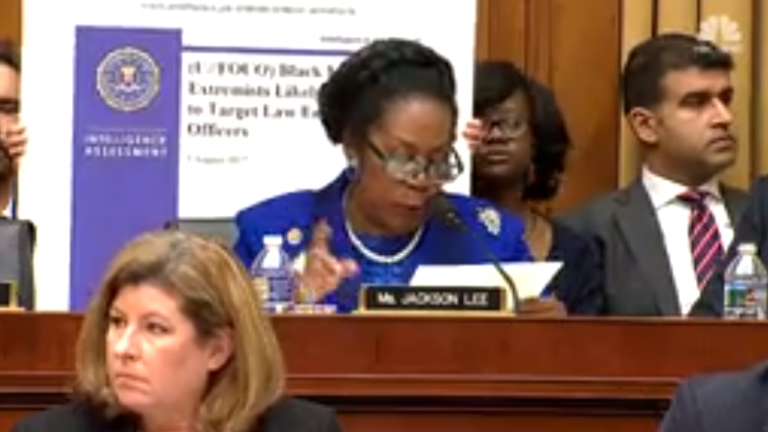
Well, it turns out Rep Sheila Jackson-Lee (R-TX) did indeed raise this issue with then U.S. Attorney General Jeff Sessions at a House hearing on November 14, 2017. Rep Jackson-Lee asked Sessions; “My question is, as I hold up the poster dealing with the report under your jurisdiction–Black Identity Extremists. It is interesting to me that you are opposing [meant targeting] individuals who are opposing lethal force, similar to the attack on Reverend Dr Martin Luther King on Cointelpro, but there seems to be no report dealing with the tiki torch parade in Charlottesville chanting ‘Jews will not replace us’. Why is there an attack on Black activists versus any report dealing with the Alt Right and the White Nationalists?” AG Sessions responded that he was not aware of the report.

Cointelpro which Rep Jackson-Lee referenced in her questioning was a controversial and secret surveillance program the FBI deployed on Black civil rights activists in the 60s, most notably, on the Reverend Martin Luther King, Jr. Historians agree that the primary reason the FBI ran Cointelpro on Black civil rights activists was to scare them into silence. This is precisely why when Black activists hear about “Black Identity Extremists” they are immediately reminded of stories they’ve read about Cointelpro and are justified in questioning whether the FBI has indeed reverted back to its 1960s tactic of stifling Black dissent.

Bottom line the “Black Identity Extremist” debate is one that begs for serious mainstream media attention. The mainstream media and indeed members of Congress must not remain silent as a section of the population is unjustly subjected to heightened levels of government surveillance all in an effort to stifle their first amendment compliant political speech. At moments like these, Martin Niemoller’s famous words come to mind; “First they came for the socialists, and I did not speak out because I was not a socialist, then they came for the trade unionists, and I did not speak out because I was not a trade unionist, then they came for the Jews, and I did not speak out because I was not a Jew. Then they came for me—and there was no one left to speak for me.”

For those of you very happy with @Emolclause’s activism don’t shy away from the “tip jar” below on your way out. You may also Cash App

Email author at admin@grassrootsdempolitics.com

Become an Octapharma Plasma donor. Make up to $200 in one week and help save lives too! Learn More