If Only America Prioritized Domestic Spending Over Foreign Wars

Before leaning too hard into that claim, it’s worth noting that there isn’t any confirmed public record of a U.S. “$25 billion in 30 days” war with Iran or an official Pentagon acknowledgment of such a figure. Numbers like that circulate on social media and can be misleading or pulled from broader defense spending categories. That said, using the $25 billion figure as a hypothetical is still a useful way to understand tradeoffs in federal spending priorities.

If $25 billion were spent in a single month and continued for several months, the scale becomes enormous very quickly. At that pace, you’re looking at $75 billion over three months or $150 billion over six. That’s not abstract money—it’s comparable to or larger than the annual budgets of entire domestic programs that affect tens of millions of people.

To put that into perspective, $25 billion could fund a substantial expansion of Medicaid coverage, the joint federal-state program that already covers around 70+ million Americans. Estimates vary by state, but on average, a few thousand dollars per enrollee per year can provide basic coverage. That means tens of billions could extend coverage to millions more people or significantly improve reimbursement rates for providers, making care more accessible in underserved areas. Instead of emergency rooms absorbing uncompensated care, you’d have a more stable, preventative system that lowers long-term costs.

Childcare is another area where that level of funding would be transformative. One of the biggest barriers for working families is the cost of daycare, which in many parts of the country rivals rent or even college tuition. A $25 billion investment could dramatically expand subsidies, cap costs as a percentage of income, or fund universal pre-K programs across multiple states. Even spreading that money over a few months could stabilize childcare providers, raise wages for workers in the sector, and make it possible for millions of parents to re-enter or stay in the workforce.

Then there’s nutrition assistance. The Supplemental Nutrition Assistance Program, or SNAP, is one of the most efficient anti-poverty programs in the U.S., with administrative costs that are relatively low compared to its impact. Tens of billions of dollars could increase benefit levels, expand eligibility, or ensure consistent access during economic downturns. A temporary $25 billion boost alone could significantly raise monthly benefits for millions of households, directly reducing food insecurity almost overnight.

If that $25 billion monthly pace continued, the cumulative effect becomes even more striking. Three months of that spending—$75 billion—could fund a nationwide childcare affordability initiative and still leave room to expand healthcare access. Six months—$150 billion—could reshape multiple systems at once: stabilizing Medicaid, making childcare broadly affordable, and strengthening food assistance in a way that meaningfully reduces poverty.

The broader point isn’t that defense spending and domestic programs are interchangeable line items; they operate under different political and strategic frameworks. But the comparison highlights how quickly resources can be mobilized when something is treated as urgent. When similar urgency is applied to domestic issues like healthcare, childcare, or food security, the scale of what’s possible looks very different.

Framing it this way makes the tradeoffs clearer. It’s not just about whether a number like $25 billion is large—it’s about what that same amount of money represents in everyday terms: doctor visits people can afford, childcare slots parents can rely on, and groceries families don’t have to skip.


MSNBC’s Nicolle Wallace Brands Trump Team the “Marie Antoinette Administration”

Please consider $upporting GDPolitics by scanning the QR code below or clicking on this link

On a recent episode of Deadline: White House, MSNBC host Nicolle Wallace didn’t hold back in her criticism of former President Donald Trump’s administration. She called it the “Marie Antoinette Administration” — a cutting comparison to the infamous French queen remembered for her decadence, detachment, and the apocryphal phrase, “Let them eat cake.”

Marie Antoinette became a symbol of a ruling class oblivious to the suffering of ordinary people — a monarch who partied in Versailles while her citizens starved outside the palace gates. Wallace’s jab draws on that same image, suggesting the Trump administration has been indulging in luxury and self-congratulation while Americans face economic hardship.

The comparison lands especially hard when you look at Mar-a-Lago, Trump’s Palm Beach estate turned private club — his modern-day Versailles. While millions of Americans struggle to put food on the table amid a grinding government shutdown that has halted SNAP payments, reports continue to surface of glittering soirées, Champagne toasts, and high-society dinners taking place under Mar-a-Lago’s gilded chandeliers. Even some of Trump’s own allies have privately admitted the optics are terrible: the image of Washington elites sipping cocktails on the oceanfront while federal workers and low-income families line up at food banks is a PR nightmare.

Adding insult to injury, a federal judge recently ordered the administration to tap the USDA’s contingency funds to keep SNAP benefits flowing. Instead of complying, the administration chose to fight the order in court — literally arguing for the right to let poor Americans go hungry. It’s a move that only deepens the “Marie Antoinette” parallel: power waging legal battles over crumbs while the public goes without bread.

As the shutdown drags on, the economic pain is becoming unbearable for working families. Most analysts expect the government to reopen soon, likely before the Thanksgiving holidays, if only to stem the political fallout. But even after the lights come back on, the damage — both human and reputational — will linger.

The “Marie Antoinette Administration” label may stick as one of Trump’s most unflattering legacies. It’s a sharp irony for a president who rose to power promising to champion the “forgotten man” — rural, blue-collar Americans who felt abandoned by Washington. The image of Mar-a-Lago’s ballrooms glittering while those same Americans tighten their belts is one that no amount of political spin can erase.

In the end, Wallace’s analogy hits its mark. For many watching from the outside, the Trump administration doesn’t just look out of touch — it looks like it’s dancing while the country burns.

Trump Admin Set To Cut Food Stamps For 3 Million Families

$upport via Cash App

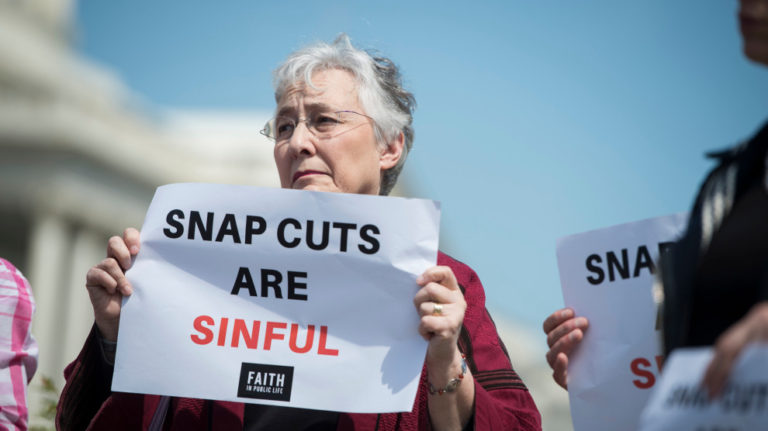
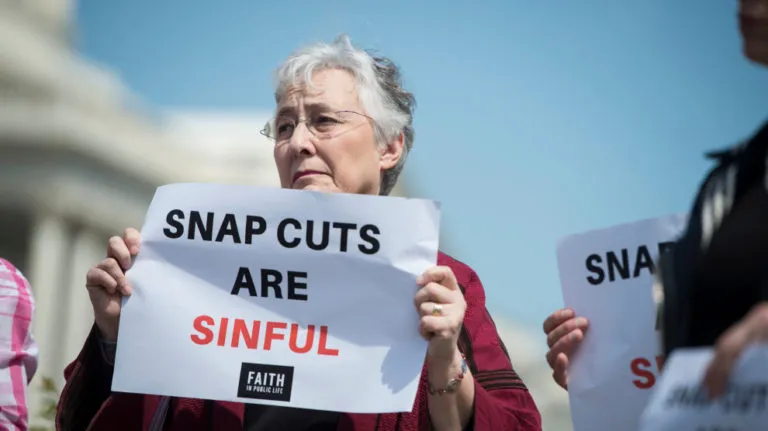
UNITED STATES – MAY 7: Supporters listen as Rep. Donald McEachin, D-Va., holds a news conference with faith leaders to “urge lawmakers to reject proposed cuts to the Supplemental Nutrition Assistance Program (SNAP) in the Farm Bill” on Monday, May 7, 2018. (Photo By Sarah Silbiger /CQ Roll Call)

A troubling Bloomberg piece (shared by Yahoo) says the Trump administration is set to do away with a provision that allowed most states to automatically enroll welfare recipients for food stamps, a move that will lead to more than 3 million poor households losing their food stamps. This is especially troubling given the fact that the Trump administration not only enjoys record Evangelical support but also recently gave extremely generous tax cuts to the wealthiest of Americans, some of whom have recently confessed to some sections of the media that they don’t even know what to do with the extra money–the quintessential war on poverty. As expected, several 2020 presidential candidates have already jumped on this issue.

As it currently stands most states automatically enroll people who qualify for other federally funded welfare programs into food stamps, and rightfully so. In most states for example, people who qualify for federal housing are also automatically enrolled for food stamps. It is this “automatic enrollment” by states that is at issue, with the Trump administration moving to put an end to it. The argument by the Trump administration is that automatic enrollment is leading to a lot of people getting food stamps even though they don’t meet the federal qualification standards. This they argue, is wasteful and you guessed it–a strain on the national debt. Yeah, the same Trump administration which vigorously pushed for deficit-busting tax cuts for the rich is now worried about food stamps for the poor.

Bottom line folks, valid policy differences arise between fiscal conservatives and economic liberals all the time and a forceful argument can be made that the Trump administration is perfectly within its rights to move in and streamline the criteria for determining who qualifies for food stamps. The problem for the Trump administration however and the record number of Evangelical Christians who support it is that it is very hard to defend a policy that strips millions of poor families of food stamps because of worries about the national debt when just recently you supported a trillion dollar tax cut for the wealthiest Americans knowing full well it would put a huge dent on the national debt. This is the epitome of either cruelty, greed, or both.

For those of you very happy with @Emolclause’s activism don’t shy away from the “tip jar” below on your way out. You may also Cash App

Email author at admin@grassrootsdempolitics.com

Become an Octapharma Plasma donor. Make up to $200 in one week and help save lives too! Learn More

Trump Admin Set To Cut Food Stamps For 3 Million Families

$upport via Cash App

A troubling Bloomberg piece (shared by Yahoo) says the Trump administration is set to do away with a provision that allowed most states to automatically enroll welfare recipients for food stamps, a move that will lead to more than 3 million poor households losing their food stamps. This is especially troubling given the fact that the Trump administration not only enjoys record Evangelical support but also recently gave extremely generous tax cuts to the wealthiest of Americans, some of whom have recently confessed to some sections of the media that they don’t even know what to do with the extra money–the quintessential war on poverty. As expected, several 2020 presidential candidates have already jumped on this issue.

As it currently stands most states automatically enroll people who qualify for other federally funded welfare programs into food stamps, and rightfully so. In most states for example, people who qualify for federal housing are also automatically enrolled for food stamps. It is this “automatic enrollment” by states that is at issue, with the Trump administration moving to put an end to it. The argument by the Trump administration is that automatic enrollment is leading to a lot of people getting food stamps even though they don’t meet the federal qualification standards. This they argue, is wasteful and you guessed it–a strain on the national debt. Yeah, the same Trump administration which vigorously pushed for deficit-busting tax cuts for the rich is now worried about food stamps for the poor.

Bottom line folks, valid policy differences arise between fiscal conservatives and economic liberals all the time and a forceful argument can be made that the Trump administration is perfectly within its rights to move in and streamline the criteria for determining who qualifies for food stamps. The problem for the Trump administration however and the record number of Evangelical Christians who support it is that it is very hard to defend a policy that strips millions of poor families of food stamps because of worries about the national debt when just recently you supported a trillion dollar tax cut for the wealthiest Americans knowing full well it would put a huge dent on the national debt. This is the epitome of either cruelty, greed, or both.

For those of you very happy with @Emolclause’s activism don’t shy away from the “tip jar” below on your way out. You may also Cash App

Email author at admin@grassrootsdempolitics.com

Become an Octapharma Plasma donor. Make up to $200 in one week and help save lives too! Learn More