A Strong Case For Trump’s Military Intervention In Venezuela

Please consider $upporting GDPolitics by scanning the QR code below or clicking on this link

An interesting segment on MSNOW featured Hagar Chemali, who made one of the most coherent and intellectually serious cases yet for President Trump’s military posture toward Venezuela. Going into the segment, the prevailing narrative across television news was nearly unanimous: Trump’s actions were framed as a reckless violation of international law, untethered from any legitimate U.S. national security interest. What Chemali did—methodically and without theatrics—was complicate that narrative in a way most pundits either cannot or will not.

Chemali did not dispute that Trump’s actions strain, and may even violate, existing international legal frameworks. Instead, she argued that focusing exclusively on legality misses the more consequential question of national security. According to Chemali, the post–World War II international system—particularly institutions like the United Nations—has become largely incapable of enforcing the very rules it was designed to uphold. That vacuum, she contends, has been aggressively exploited by rogue states and non-state actors who operate with near impunity, often embedding themselves in fragile or hostile regimes much closer to U.S. shores than many Americans appreciate.

What gives Chemali’s argument particular weight is her background. She is not a partisan talking head or an armchair strategist. Chemali served in senior roles at the U.S. Department of the Treasury, including in the Office of Terrorist Financing and Financial Crimes, where she worked directly on counterterrorism, sanctions policy, and efforts to disrupt the financial networks of hostile states and extremist groups. She also held positions during the Obama administration and has worked closely with interagency national security teams, giving her firsthand exposure to how threats are assessed when cameras are not rolling. In other words, she understands how national security doctrine is applied in practice, not just debated on cable news panels.

From that vantage point, Chemali argues that Venezuela cannot be viewed in isolation. It is not merely a failing state or a humanitarian crisis; it has become a strategic foothold for U.S. adversaries seeking influence in the Western Hemisphere. In that context, she suggests, the United States asserting a policing role in the Americas is less about imperial ambition and more about responding to a security architecture that no longer functions. When international bodies fail to act—or selectively enforce rules—power vacuums do not remain empty for long.

Chemali’s analysis effectively provides the Trump administration with a serious national security rationale that goes beyond bluster or appeals to raw power. It offers a framework for countering the charge that the administration is acting lawlessly by arguing that the law itself has become disconnected from enforcement realities. Whether one agrees with that conclusion or not, it is a far more substantive defense than the caricature of Trump acting on impulse or ego.

Trump has occasionally gestured toward the Monroe Doctrine when addressing Venezuela, at times referring to his own version as the “Donroe Doctrine,” but he has rarely articulated the argument with the clarity or discipline Chemali brings to it. Her explanation distills what the administration seems to believe but has struggled to communicate: that American restraint, in a world where enforcement mechanisms are broken, can itself become a liability. Whether Trump adopts this rationale more explicitly going forward remains to be seen, but Chemali’s intervention may well give the administration an opening to reframe the debate on terms that are strategic rather than merely legalistic.

Rep Clyburn’s New Book Looks At How SCOTUS Is Taking Us Back To Jim Crow Era


Please consider $upporting GDPolitics by scanning the QR code below or clicking on this link

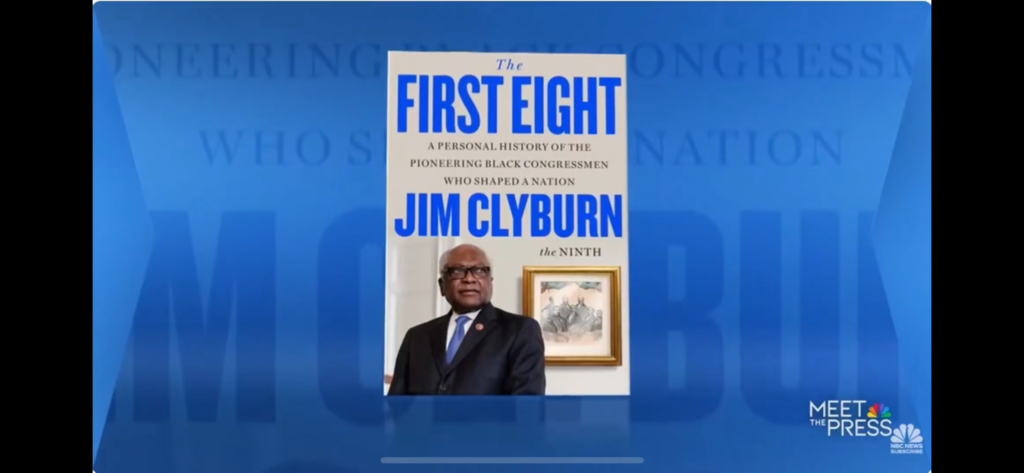
An important new book by Rep. James Clyburn (D-SC), The First Eight, warns that disturbing signs suggest we may be sliding back toward a modern form of Jim Crow. In it, Clyburn examines the lives and careers of the first eight Black men to serve in Congress from South Carolina — all elected in the period after the Civil War during Reconstruction. He recalls that after the last of those eight left Congress in 1897, there was no Black representation from South Carolina for 95 years, until Clyburn himself was elected in 1992.

Clyburn uses their stories not just to spotlight that lost legacy, but to warn that many of the same forces that disenfranchised Black voters at the turn of the 20th century are resurfacing today. He draws parallels between the backlash that ended Reconstruction — Jim Crow laws, restrictive state constitutions, poll taxes, literacy tests, and violence — and current efforts to redraw voting districts and suppress minority voting power. A key part of his argument is the role the Supreme Court played then and now. He notes that foundational decisions like the Slaughterhouse Cases narrowed the scope of the 14th Amendment almost immediately after its ratification, stripping federal protections from formerly enslaved people and allowing Southern states to impose discriminatory laws. That judicial retreat set the stage for later rulings such as Plessy v. Ferguson, which constitutionally sanctioned segregation and cemented the legal framework that enabled Black disenfranchisement for generations.

In particular, Clyburn argues that modern partisan and racial gerrymandering — especially in his home state of South Carolina — resembles the “old Jim Crow power play” that erased a century of Black political representation. He points to recent attempts by the State Legislature to redraw congressional districts in a way that moved tens of thousands of Black voters out of his district, a practice a federal court found to be an unconstitutional racial gerrymander. When the map was challenged, however, it was the current Supreme Court that stepped in and reversed the lower court, making it significantly harder for voting-rights advocates to block discriminatory district maps. To Clyburn, this echoes the pattern of the past: when state governments use race to manipulate electoral maps, and the Court either narrows protections or declines to intervene, the result is the same erosion of political power that once produced the 95-year gap between the eighth Black congressman from South Carolina and himself.

Clyburn does not merely retell history — he warns that history is repeating. He argues the country is in the early stages of what he calls a “Third Reconstruction,” threatened by political forces determined to dilute or suppress the votes of people of color. In his view, the stakes are nothing less than the integrity of democracy itself: the story of those first eight Black congressmen is a reminder that gains in political power and representation can be undone — and undone intentionally. The book emerges not just as history, but as a timely call-to-action to defend voting rights, safeguard fair representation, and resist any revival of Jim Crow-era disenfranchisement.

Clyburn closes with a telling reminder that the first eight Black congressmen from South Carolina were routinely assigned racist and belittling nicknames by their opponents — a tactic meant to diminish their legitimacy, sow disrespect, and discourage those they represented. He notes that the weaponization of mockery and demeaning labels is not a relic of the past; it echoes loudly in today’s political climate, where leaders of color are again targeted with derisive nicknames designed to undercut their standing and weaken the communities they serve. For Clyburn, these parallels — from state laws to Supreme Court decisions to symbolic attacks — underscore his broader warning: the architecture of disenfranchisement is being rebuilt piece by piece, and the patterns of the past are reappearing in unmistakably familiar ways.

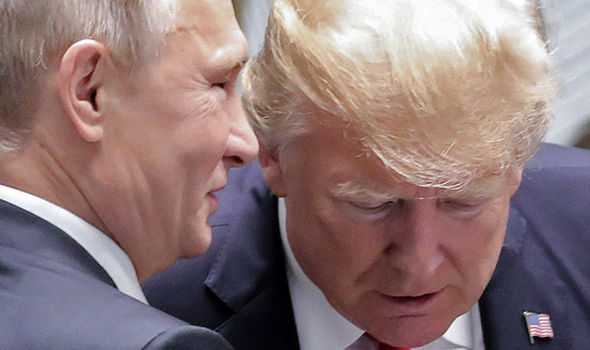
Putin Told Trump To Stop Joint Military Exercises With S. Korea

$upport via Cash App

From the beginning Yours Truly has maintained that there is something very strange/suspicious about the Trump/North Korea deal–that this is a Putin operation designed to help Trump politically, not solve the nuclear crisis

A bombshell 6/25/2018 segment on MSNBC’s Rachel Maddow Show just confirmed Yours Truly’s suspicions. Turns out per Maddow, that Trump had initially wanted to end  joint military operations between the U.S. & South Korea but dropped the idea after pushback from Defense Secretary Mattis.

Later however, following a phone conversation with Putin, Trump abruptly decided to end the crucial joint military exercises that are meant to provide readiness in the unfortunate event North Korea launches a nuclear strike.

Even more troubling, and an issue that Congressional Dems should definitely inquire into, is the shocking revelation by Maddow that prior to Trump making the highly consequential decision on S. Korea joint exercises, neither Sec Def Mattis nor senior White House officials were consulted. In other words Putin simply told Trump to do it and he did it—fast!!

This is a very troubling development given that virtually all U.S. Intel agencies agree that Russia is not only America’s enemy but is actively working to inflict harm on America. The shocking report by Maddow that despite this threat, Putin is literally telling the U.S. President what to do with senior government officials seemingly left in the dark should be cause for great alarm.

Bottom line Congressional Dems must push for hearings on this issue

For those of you very happy with @Emolclause’s activism don’t shy away from the “tip jar” below on your way out. You may also Cash App

Email author at admin@grassrootsdempolitics.com

Become an Octapharma Plasma donor. Make up to $200 in one week and help save lives too! Learn More