Machado Leaves No Doubt This Has Always Been About Regime Change

Maria Corina Machado’s appearance on CBS’ Face The Nation all but confirmed what many Americans have suspected as President Trump escalates pressure on Venezuela: regime change, not narcotics enforcement, is the true objective. While the administration continues to frame its military buildup and aggressive posture as a necessary response to so-called “narco-terrorists,” Machado’s own words exposed that justification as little more than political cover.

For months, President Trump has insisted that his actions toward Venezuela are narrowly focused on combating drug trafficking networks that he claims threaten U.S. national security. The administration’s repeated use of the term “narco-terrorism” is meant to evoke urgency and legitimacy, suggesting a defensive posture rather than an interventionist one. Yet this explanation has always strained credulity, particularly given Venezuela’s vast oil reserves and strategic importance. Those realities have inevitably fueled skepticism that Washington’s true aim is to remove Nicolás Maduro and install a government far more amenable to U.S. economic and geopolitical interests.

That skepticism has only grown sharper because Trump himself campaigned aggressively in 2024 on a “no regime change” platform. It was a message designed to reassure a war-weary electorate and an America First base deeply suspicious of foreign entanglements. Many of those same supporters are now openly questioning how a military buildup, veiled threats, and constant escalation toward Caracas square with the promises they were sold. The administration’s narco-terrorism rationale has functioned as a convenient way to bridge that contradiction—until Machado spoke plainly.

During her interview with Margaret Brennan, Machado did not merely criticize Maduro or call for international pressure. She openly discussed preparations for governance after his removal. In doing so, she revealed that plans are already in place for what comes once Maduro is toppled. That single admission dismantled the White House’s stated rationale. You do not develop detailed post-Maduro contingencies unless regime change is not only desired, but anticipated and actively pursued.

Brennan never had to explicitly ask whether the Trump administration is seeking regime change because Machado answered the question unprompted. She spoke about how a future Venezuelan government would manage destabilization efforts by foreign powers such as Russia and China—an extraordinary acknowledgment that she views Maduro’s fall not as hypothetical, but as imminent. That kind of forward-looking strategizing does not occur in a vacuum. It only makes sense if Washington has signaled, implicitly or explicitly, that removing the current regime is the goal.

Machado’s remarks effectively stripped away the last fig leaf of the narco-terrorism argument. If the mission were truly limited to drug interdiction, the discussion would center on law enforcement cooperation, intelligence sharing, and regional partnerships. Instead, what emerged was a clear blueprint for political transition. Her interview made it obvious that the Trump administration’s posture toward Venezuela has never been about drugs alone, and certainly not about restraint.

As this saga unfolds, the political consequences may prove just as significant as the geopolitical ones. Republicans who loudly embraced the “no regime change” mantra in 2024 will soon face voters again in the 2026 midterms. Machado’s candid interview has made it far harder for them to reconcile their past rhetoric with present reality. What was once denied outright is now being openly discussed by the very opposition leader the U.S. appears poised to empower.

In the end, Face The Nation did more than host an interview—it pulled back the curtain. And what was revealed leaves little room for doubt: regime change in Venezuela is not a byproduct of Trump’s policy. It is the policy.

Rep Clyburn’s New Book Looks At How SCOTUS Is Taking Us Back To Jim Crow Era


Please consider $upporting GDPolitics by scanning the QR code below or clicking on this link

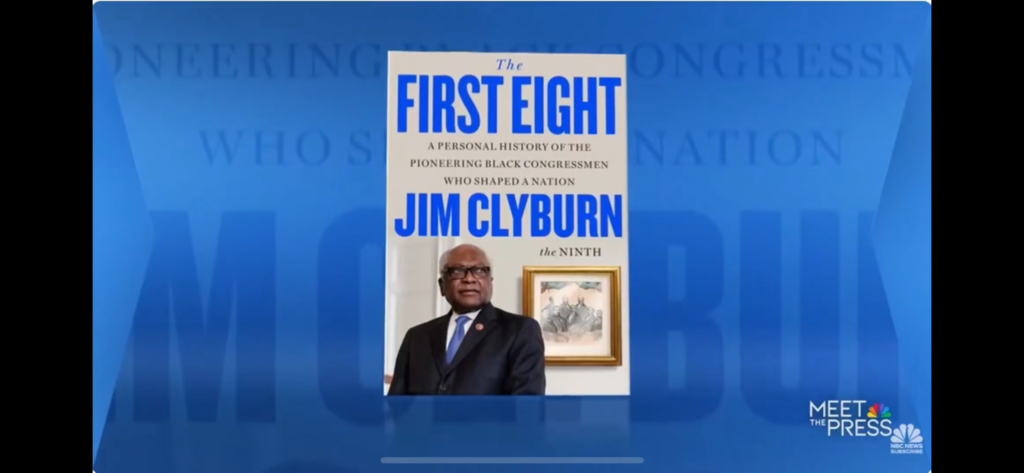
An important new book by Rep. James Clyburn (D-SC), The First Eight, warns that disturbing signs suggest we may be sliding back toward a modern form of Jim Crow. In it, Clyburn examines the lives and careers of the first eight Black men to serve in Congress from South Carolina — all elected in the period after the Civil War during Reconstruction. He recalls that after the last of those eight left Congress in 1897, there was no Black representation from South Carolina for 95 years, until Clyburn himself was elected in 1992.

Clyburn uses their stories not just to spotlight that lost legacy, but to warn that many of the same forces that disenfranchised Black voters at the turn of the 20th century are resurfacing today. He draws parallels between the backlash that ended Reconstruction — Jim Crow laws, restrictive state constitutions, poll taxes, literacy tests, and violence — and current efforts to redraw voting districts and suppress minority voting power. A key part of his argument is the role the Supreme Court played then and now. He notes that foundational decisions like the Slaughterhouse Cases narrowed the scope of the 14th Amendment almost immediately after its ratification, stripping federal protections from formerly enslaved people and allowing Southern states to impose discriminatory laws. That judicial retreat set the stage for later rulings such as Plessy v. Ferguson, which constitutionally sanctioned segregation and cemented the legal framework that enabled Black disenfranchisement for generations.

In particular, Clyburn argues that modern partisan and racial gerrymandering — especially in his home state of South Carolina — resembles the “old Jim Crow power play” that erased a century of Black political representation. He points to recent attempts by the State Legislature to redraw congressional districts in a way that moved tens of thousands of Black voters out of his district, a practice a federal court found to be an unconstitutional racial gerrymander. When the map was challenged, however, it was the current Supreme Court that stepped in and reversed the lower court, making it significantly harder for voting-rights advocates to block discriminatory district maps. To Clyburn, this echoes the pattern of the past: when state governments use race to manipulate electoral maps, and the Court either narrows protections or declines to intervene, the result is the same erosion of political power that once produced the 95-year gap between the eighth Black congressman from South Carolina and himself.

Clyburn does not merely retell history — he warns that history is repeating. He argues the country is in the early stages of what he calls a “Third Reconstruction,” threatened by political forces determined to dilute or suppress the votes of people of color. In his view, the stakes are nothing less than the integrity of democracy itself: the story of those first eight Black congressmen is a reminder that gains in political power and representation can be undone — and undone intentionally. The book emerges not just as history, but as a timely call-to-action to defend voting rights, safeguard fair representation, and resist any revival of Jim Crow-era disenfranchisement.

Clyburn closes with a telling reminder that the first eight Black congressmen from South Carolina were routinely assigned racist and belittling nicknames by their opponents — a tactic meant to diminish their legitimacy, sow disrespect, and discourage those they represented. He notes that the weaponization of mockery and demeaning labels is not a relic of the past; it echoes loudly in today’s political climate, where leaders of color are again targeted with derisive nicknames designed to undercut their standing and weaken the communities they serve. For Clyburn, these parallels — from state laws to Supreme Court decisions to symbolic attacks — underscore his broader warning: the architecture of disenfranchisement is being rebuilt piece by piece, and the patterns of the past are reappearing in unmistakably familiar ways.

The Steve Bannon–Jeffrey Epstein Connection: What the Newly Released Emails Reveal

A recent segment on the 11/19/25 edition of MSNBC’s The Beat with Ari Melber examined a newly surfaced trove of emails that—according to the program’s reporting—suggest Steve Bannon’s relationship with Jeffrey Epstein was far deeper and more strategic than Bannon has publicly acknowledged. As Melber emphasized, the emails do not indicate that Bannon participated in Epstein’s criminal activities. But they do appear to show that Bannon was fully aware of Epstein’s widely reported misconduct and still worked behind the scenes to help rehabilitate Epstein’s public reputation. If accurate, the correspondence paints a picture of a political strategist engaging with a disgraced financier in ways that raise more questions than answers.

Why Bannon would want to rehabilitate Epstein remains unclear. Bannon’s brief tenure in the first Trump administration fuels speculation: was he attempting to minimize or contextualize Trump’s long-documented association with Epstein? Was he pursuing financial or strategic support from Epstein, who still wielded substantial wealth and elite connections? Or was Bannon trying to leverage Epstein’s deep ties to global power brokers for his own political aims? While none of this is conclusively established, the emails suggest Bannon saw a degree of utility in Epstein that extended well beyond casual acquaintance.

The timeline of Bannon’s public statements only complicates matters further. When the Epstein files controversy re-emerged earlier this year during Trump’s second term, Bannon became one of the loudest figures demanding the release of every Epstein document. He framed Epstein as central to the so-called “Deep State,” arguing that the files were the key to exposing elite corruption and dismantling entrenched power networks. Yet throughout this campaign for transparency, Bannon never disclosed that he had any prior personal or professional interactions with Epstein—let alone that he had reportedly discussed rehabilitating Epstein’s image. That omission now casts his rhetoric in a new light and raises questions about whether his public crusade was also an effort to get ahead of information that might implicate or embarrass him.

The dynamic becomes even more intriguing when considering Bannon’s public clash with Elon Musk over the handling and release of Epstein-related material. What initially looked like another loud, intra-movement skirmish now takes on new weight. If Bannon had undisclosed ties to Epstein, his aggressive posture toward Musk could be interpreted as an attempt to steer the narrative or deflect scrutiny.

If these emails are authentic, they suggest a pattern of engagement with Epstein that conflicts with Bannon’s public posture and demands a fuller explanation. The public deserves to know why Bannon was attempting to reshape Epstein’s image, what he hoped to gain from the relationship, why he hid these interactions while urging transparency from others, and how this impacts the credibility of his broader claims about the Epstein files. Until Steve Bannon provides a transparent and comprehensive accounting of his relationship with Epstein—its scope, its motives, and its implications—there is little reason to take his proclamations at face value. The questions raised by these revelations are serious, and they are not going away.

Homeland Security’s $220 Million Ad Controversy: An Objective Look at the Noem Connections

A series of recent investigative reports, first published by ProPublica and later picked up by major outlets including MSNBC, has drawn substantial attention to a large Department of Homeland Security (DHS) advertising campaign and its connections to Secretary Kristi Noem’s political circle. Although the DHS has defended its decisions and denies any improper influence, the scope of the contract, the speed at which funds were awarded, and the involvement of individuals tied to Noem have generated intense public scrutiny. What follows is a fact-based, balanced overview of what is known, what is contested, and why the episode continues to raise questions.

The controversy began with DHS’s launch of a national and international ad campaign intended to deter illegal immigration. According to ProPublica, the campaign totals approximately $220 million and includes television, digital, radio, and social-media placements. DHS has stated that the campaign is aimed at discouraging unauthorized crossings by emphasizing tougher enforcement policies and consequences. One of the signature ads features Secretary Noem at Mount Rushmore delivering a tough-on-immigration message that DHS characterizes as a public service announcement rather than a political communication. DHS has consistently argued that the campaign is justified by pressing national security needs and that it reflects policy objectives rather than partisan motives.

The financial and procedural details surrounding this campaign, however, prompted wider concerns. DHS invoked a “national emergency” at the border to bypass the traditional competitive bidding process, fast-tracking the ad contracts. While legal, this mechanism is typically used for time-sensitive, high-risk situations rather than large-scale media campaigns. Critics argue that employing emergency powers for a communications initiative undermines normal procurement safeguards designed to prevent favoritism and ensure transparency. DHS counters that career procurement officials oversaw the process and that all actions complied with federal law.

The most scrutinized element of the spending is the decision to direct $143 million of the campaign funds to a newly formed Delaware company called Safe America Media. The firm was incorporated only days before receiving the contract, an unusually rapid timeline for a high-value federal agreement. Public contracting databases provide little information about how Safe America Media has allocated its funds or whom it subcontracted. This lack of documentation has fueled questions about the nature of the company, who ultimately benefited from the funds, and why the government selected an entity with virtually no track record.

Those questions intensified when investigators identified personal and professional connections between DHS leadership and political consultants aligned with Noem. Safe America Media’s listed address is linked to Republican operative Michael McElwain, and reporting has highlighted the involvement of the Strategy Group, a Republican consulting firm that played a large role in Noem’s South Dakota gubernatorial campaigns. The firm is led by Benjamin Yoho, who is married to Tricia McLaughlin, DHS’s Assistant Secretary for Public Affairs. That office, which McLaughlin leads, is the same DHS division responsible for funding the ad campaign. This nexus of relationships has raised concerns from ethics experts and watchdog groups, who argue that—even if no laws were broken—the appearance of a conflict of interest is substantial.

Critics, including former federal contracting officials, contend that the overlap between Noem’s political network and the firms connected to the DHS campaign creates significant risk of improper influence. They argue that the lack of publicly available subcontractor information prevents the public from knowing whether politically connected firms benefited from taxpayer funds. Some experts have described the arrangement as highly irregular, and organizations have called for oversight investigations by congressional committees or the DHS Inspector General. Others have pointed out that the political tone of some of the ads, particularly those referencing Trump-era border policies, may blur the line between public service messaging and partisan promotion, although DHS maintains the messaging is policy-driven.

Defenders of Noem and DHS present a different picture. They note that DHS officials, not political appointees, handled the contracting and that emergency procurement authority exists precisely to allow rapid responses to urgent national issues. McLaughlin has publicly stated that she fully recused herself from decisions related to these contracts, emphasizing that professional ethics protocols were followed. Supporters also argue that the intent of the campaign is clear: to deter migration through communication, a tool that has been used by multiple administrations. They also point out that no concrete evidence has surfaced proving that any funds were intentionally steered to Noem’s allies for political purposes.

Despite those defenses, the situation remains complicated. The unusual contracting timeline, the lack of transparency surrounding subcontractors, and the close personal ties between DHS leadership and outside political consultants make the story difficult to dismiss. Even if every action taken was technically compliant with procurement rules, the optics invite skepticism. In matters of public spending—especially on such a large scale—appearance alone can erode public trust, particularly when political figures and their associates are involved. At a minimum, the episode underscores the importance of transparent procurement processes, clear public reporting on subcontractors, and robust safeguards to prevent even the perception of conflicts of interest.

Ultimately, the controversy exposes a broader tension at the intersection of government communication, national security policy, and political influence. DHS insists the campaign is essential to its mission and was executed properly. Critics argue that the process lacked the transparency and arm’s-length separation needed to ensure public confidence. As calls for additional oversight continue, the resolution of this issue may set important precedents for how federal agencies handle large-scale communications campaigns—especially when those campaigns intersect with the political networks of their leaders.

Epstein Survivor Press Conference Set For 090325

Rep Ro Khanna (D-CA) appeared in a segment of MSNBC’s The Briefing with Jen Psaki (08/14/25) where he confirmed that together with Rep Thomas Massie (R-KY), they had arranged a 09/03/25 press conference with the survivors of Jeffrey Epstein and Ghislaine Maxwell.

It cannot be understated just how important this presser may turn out to be , not just for curious public, but also for the victims. Reps Massie and Khanna are giving them an avenue to vent out their grievances and frustrations, something they were denied when Epstein died before his criminal trial. They were robbed of an excellent opportunity to confront their abuser publicly in a court of law.

The presser will of course serve another very important function, and that is, bring back the media’s focus to the heinous crimes committed by Epstein and Maxwell, and how both shared a close relationship with Donald Trump, now President.

The Trump administration has moved heaven and earth to keep the Epstein story away from the mainstream media’s focus, so it will be very interesting to see what “shiny object” they dangle out there on 09/03/25.

House Speaker Grilled Over “Big Beautiful Bill”

$upport via Cash App👇

House Speaker Mike Johnson appeared on CBS’ Face The Nation (05/25/25) to discuss among other things, the recent House passage of the Trump administration’s budget bill—dubbed “Big Beautiful Bill”. The Bill’s fate now lies with the Republican majority in the U.S. Senate.

Among the issues raising concerns with the budget bill, is that it is projected to increase the national debt significantly, something Republican lawmakers lamented throughout the Biden administration. The bill also makes significant cuts to Medicaid and food stamps(SNAP), programs crucial for working families generally, and specifically, the working poor.

Speaker Mike Johnson’s Louisiana is one of the poorest states in the nation, so cuts to Medicaid and food stamps are bound to have relatively more disastrous effects on families there. Asked by host Margaret Brennan how he can justify pushing such cuts knowing full well that his state is one of the poorest in the nation, Speaker Johnson responded that all the bill cuts is waste, fraud and abuse.

It will be interesting to see how Speaker Johnson and other House Republicans use this excuse once their poor constituents start complaining about the cuts. Even more interesting, will be the way Republicans defend this tricky position as we approach the 2026 midterm elections. 

For those of you very happy with @Emolclause’s activism don’t shy away from the CashApp “tip jar” below on your way out.

Email author at admin@grassrootsdempoliticst.com

President Trump’s Interview On MTP 050425

President Trump sat down for an extensive interview with NBC Meet The Press’ Kristen Welker on 05/04/25. As expected the interview covered all the major topics of the day—economy, immigration, military, foreign affairs, and in typical Trump fashion, even some humorous moments. Hey, he’s not a tv ratings magnet for nothing.😂🤷‍♀️

One of the most humorous moments for me, came when host Kristen Welker asked him when problems in the economy can be attributed to his actions—ostensibly referring to the damage the tariffs are doing to the economy. President Trump responded by saying that when the economy does good, he should get the credit, and when it struggles, his predecessor Biden should bare the blame.😂

It will be interesting to see how this position holds, as the effects of tariffs become visibly evident from the empty store shelves. Will MAGA blame the empty shelves on Biden’s economic policies? Hmm, as Trump famously says, “We’ll see what happens.”

Dem Sen Murphy Accuses Trump-Vance Of Steering America Towards Kleptocracy

Support via Cash app👇

U.S. Senator Chris Murphy (D-CT) appeared on CNNSOTU (022825) where he dropped a bombshell, telling host Dana Bash that the shouting match we recently witnessed at the White House between President Trump, his VP Vance, and the President of Ukraine, was not an anomaly, but rather, a conscious effort by Trump-Vance to steer America towards kleptocracy.

The characterization by the mainstream media thus far, has been that the confrontation at the White House was just an unfortunate case of a good meeting gone bad—something that happened out of happenstance.

What Sen Murphy is saying however, is markedly different, and that is, this was a pre-meditated, conscious effort by Trump-Vance to humiliate the President of Ukraine for the benefit of Vladimir Putin. Furthermore, Sen Murphy adds that this is part of their larger effort to align America with dictators around the world, so as to make it easier for them to transform America into a kleptocratic oligarchy like Russia.

For those of you very happy with @Emolclause’s activism don’t shy away from the CashApp “tip jar” below 👇

Email author at admin@grassrootsdempolitics.com

The Best Case For Jailing Trump Over The Hush Money Case

$upport via Cash App

Kristy Greenberg, Former Deputy Chief at SDNY’s Criminal Division, appeared on MSNBC’s The Weekend show (06/09/24) where she made quite a compelling case as to why former President Trump should be imprisoned after being found guilty of 34 felony counts in the hush money case–the best case yet, as far as Yours Truly is concerned.

Kristi Greenberg: “I think that if you objectively look at all of the factors that are taken into account in sentencing, the prosecutors here should be seeking a jail sentence, and the judge should impose one. Look at the nature and the seriousness of the conduct…This was about the subversion of democracy. This was about depriving the voter of information that they would need when they go to the ballot box and decide who to vote for. What is more important than that?”

She also knocked down the argument one regularly hears on Fox News and other pro-Trump media outlets–that Trump should be accorded some deference and spared prison time, simply because he’s a former president. She argued instead that, because Trump wrote the hush money checks from the Oval Office, the judge should treat that as “an aggravating factor” for sentencing purposes.

In conclusion, she made the case that because Michael Cohen went to jail for the same conduct, Trump should likewise be imprisoned, especially given the fact that he was directing the criminal scheme–a slam dunk argument in my opinion. She specifically told the MSNBC hosts (1:09): “Michael Cohen went to jail for the same conduct, and he was less culpable than Donald Trump, who was directing him to do it. So if it’s serious enough for Michael Cohen to go to jail, it is certainly serious enough for Donald Trump to go to jail as well.”

For those of you very happy with @Emolclause’s activism don’t shy away from the “tip jar” below on your way out. You may also Cash App

Email author at admin@grassrootsdempolitics.com

Become an Octapharma Plasma donor. Make up to $200 in one week and help save lives too! Learn More

Is MAGA Trumpism A Form Of Political Religion?

$upport via Cash App

An interesting segment on MSNBC’s Alex Wagner Tonight (01/1624) show delved into the strange daliance between Evangelical Christians(predominantly White), and the politics of former President Donald Trump, often referred to as Trumpism, or MAGA Trumpism. The alliance between these two strange bedfellows has led many to question whether MAGA Trumpism has become some sort of political/civil religion.

The MSNBC segment came against the backdrop of Trump’s massive win in the Iowa Republican presidential primary, and specifically, his command of the White Evangelical vote, which polls placed at 53%. Back in 2016, when Trump first ran for president, he only received 21% of the White Evangelical vote in Iowa, a clear sign that he has now consolidated the White Evangelical vote in Iowa, and arguably nationwide.

Host Alex Wagner posed this question to her guest, Author Tim Alberta, who’s also a staff writer at The Atlantic (2:07): “I wonder in your estimation, what it means to be an Evangelical in this country, at this moment?”
Tim Alberta responded in relevant part: “We are beginning to flirt with this territory where definitionally speaking, Evangelicalism has far more to do, at least in the perception of the greater public, with political engagement, partisan political identification, than it does with any particular theology or any real religious conviction, and if you take it a step further, if you look at the exit polling, if you look at some of the social science around this, if you look at the fact that during Donald Trump’s presidency, more and more of Donald Trump’s supporters were self-identifying as Evangelicals even though they were simultaneously attending Church less and less often, I think one might reach the uncomfortable conclusion that perhaps the best definition now for what it means to be an Evangelical, is to be a conservative White Republican Trump supporter, and that is a tragedy on any number of different levels, but I think most profoundly, it’s a tragedy for the Gospel of Jesus Christ.”

Host Alex Wagner then interjected with this profound question (3:50): “If the Gospel is no longer part of the equation, what is it replaced by…do you think MAGA-ism has become a placeholder for a certain kind of religion?”

Tim Alberta: “Yes…I don’t want to paint with too broad a brush, the Evangelical community is large, it’s huge, and it’s complicated…but…we are reaching a place where we are being confronted with some uncomfortable realities about what it means to be a part of the Evangelical movement and frankly, where the line blurs between sort of religious identity and political identity, and is there a merging of the two, and frankly I think that there’s always a danger in politics…of sort of turning political conviction into religious conviction, or worshipping at a certain altar that is not an altar to God, but is an altar to political idolatry or to political identity. That is a danger that has always been there, but it is I think uniquely dangerous in this moment, and to be clear…we have examples from the not so distant past, of a sort of political religion, or at least a civil religion, supplanting, competing with actual religion, and I don’t think that we’re all that far removed from that in this country now, looking at just what happened…in Iowa.”

To conclude the segment, Tim Alberta floated this interesting scenario, which gets right to the fallacy of the Evangelical-MAGA Trumpism alliance. He said (8:19): “If during Barack Obama’s presidency, or while he was running for president, if you had heard him talking with, or promoting a video saying that he was a shepherd to all of mankind, the Evangelical movement would have been up in arms [and rightly so], I mean this is heretical, this is blasphemous and yet, Donald Trump seems to get a pass time and time again for doing these things that no other politician, Republican or Democrat frankly, would get a pass for doing, and we should ask ourselves why. If the answer does not at least start to flirt with this terrain of civil religion, or political religion, then I think that we’re not being honest with ourselves, and if we are being honest with ourselves, if we are willing to engage with the very uncomfortable topic around what happens when Trumpism becomes civil religion in this country for millions of millions of people, and what that might imply moving forward, then we are doing a disservice to our prularistic democracy.”

Bottom line folks, we’ve always operated on the separation of church and state doctrine, and have for decades, shunned foreign theocracies like the ones in Afghanistan and Iran. Author Tim Alberta is absolutely correct when he says, we need to be honest with ourselves, and admit that there is no difference between the Evangelical-MAGA dalliance in the American political scene, and the theocracies in Iran and Afghanistan. Simply put, we need to make a decision as to whether we want to continue with the separation of church and state doctrine, or whether, that time-honored tradition has also been sacrificed at the altar of MAGA Trumpism.

For those of you very happy with @Emolclause’s activism don’t shy away from the “tip jar” below on your way out. You may also Cash App

Email author at admin@grassrootsdempolitics.com

Become an Octapharma Plasma donor. Make up to $200 in one week and help save lives too! Learn More