Grifting Nepo-Babies In Trump Admin 2.0?


Please consider $upporting GDPolitics by scanning the QR code below or clicking on this link

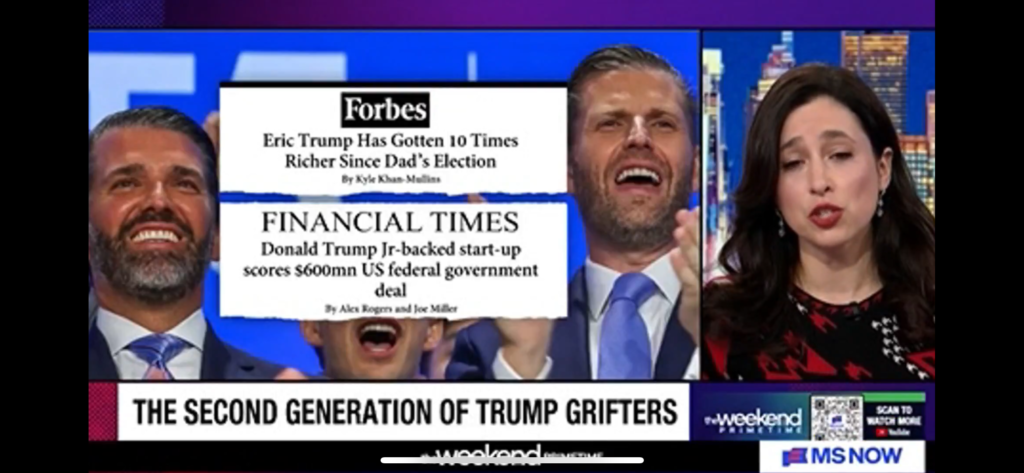
An interesting segment on MSNOW’s Weekend Primetime show delved into the staggering corruption emerging in Trump administration 2.0 — even coining the phrase “Grifting Nepo-Babies” to capture the growing concern about the financial windfalls reportedly enjoyed by the children of several senior Trump–era officials. Co-host Catherine Rampell laid out what she called a pattern of politically connected offspring cashing in during the second Trump presidency. According to the segment, Secretary of Commerce Howard Lutnick’s sons were among those observers have flagged as benefiting enormously from their father’s presence in government — and in their case, the benefits come via the Wall Street powerhouse their father built, Cantor Fitzgerald.

Specifically: when Lutnick stepped into the Cabinet, ownership and control of Cantor Fitzgerald were formally transferred to his two oldest sons, Brandon Lutnick (now Chairman & CEO) and Kyle Lutnick (Executive Vice-Chairman). Under their leadership, the firm is on track for a 2025 revenue haul that reportedly represents its most profitable year ever — a jump of more than a quarter over last year. Much of that windfall stems from Cantor’s aggressive crypto-investment banking, SPAC dealmaking, stablecoin custody and other high-risk, high-reward operations that the firm has doubled down on since the crypto boom took off. Critics argue that this close alignment between a senior Cabinet official and a high-performing Wall Street firm controlled by his children constitutes a textbook example of revolving-door conflicts of interest — especially given the firm’s deep involvement in sectors (like crypto) where regulatory and trade policy decisions may directly affect their bottom line. The optics are stark: a firm once headed by the Commerce Secretary is now raking in record profits under the leadership of his sons, just as policies that shape global trade and regulation are being decided by that same Secretary.

The segment also highlighted another striking example beyond the Lutnicks: Alex Witkoff, the son of Steve Witkoff — himself appointed by Trump as a Middle East envoy. According to multiple recent reports, Alex has aggressively pursued large-scale investments from sovereign‐wealth funds and Gulf-state investors. In 2024 he pitched a $4 billion U.S. real-estate credit fund to the Qatar Investment Authority, promising returns and sizeable management fees; while Qatar reportedly declined, sources say Alex continued courting investors from Qatar, the United Arab Emirates, and Kuwait through at least August 2025. As his father negotiated cease-fire and hostage-release deals across the Middle East under the auspices of the Trump administration, Alex was quietly soliciting money — a convergence of diplomacy and real-estate finance that ethics experts argue raises serious conflict-of-interest concerns. Indeed, GULF-state investment vehicles have already backed several properties owned or developed by the family firm (known as the Witkoff Group), including major assets in New York and Florida. While a spokesperson for the firm has since claimed the specific real-estate fund proposal was “preliminary” and will not move forward, critics maintain that even the attempt — coming alongside high-stakes diplomatic negotiations — exemplifies the growing problem of political power being leveraged for private enrichment.

Rampell then pivoted to Trump’s own children, where the accusations grow louder and the optics far more politically potent. She cited a Forbes report claiming Eric Trump’s wealth has increased dramatically since his father returned to office — with critics arguing that this level of enrichment while a parent is in the White House reflects the same ethical vulnerabilities that plagued Trump’s first term. She also referenced reporting about a startup associated with Donald Trump Jr. that has reportedly secured a major Pentagon-related deal — figures like the oft-circulated “$600 million” have fueled alarm among ethics experts and bipartisan government watchdogs who argue that such arrangements warrant far more transparency. And even Trump’s youngest son, Barron Trump — normally kept out of the political spotlight — was mentioned in the segment due to media chatter about alleged lucrative cryptocurrency-related ventures linked indirectly to his name, though these claims remain murky and largely unverified, further contributing to the perception of a sprawling and loosely monitored financial ecosystem orbiting around the Trump family.

Rampell also revisited the long-running controversies around Trump’s son-in-law Jared Kushner, whose massive financial gains following Trump’s first term — including high-profile investments from foreign sovereign funds — continue to be held up by critics as one of the most glaring examples of blurred ethical boundaries. His ongoing business expansions during Trump’s second presidency only reinforce concerns among ethics observers who argue that the revolving door between political power and personal enrichment is now swinging more freely than ever.

The larger point the MSNOW hosts made was that corruption — whether alleged, implied or documented — has quickly become a defining theme of Trump 2.0. Democrats are already gearing up to make it a core message for the 2026 midterms, framing the administration as a government increasingly captured by the financial ambitions of the president’s inner circle and their families. But what may pose a more immediate threat to Trump is that even portions of his MAGA base are beginning to grumble. Online circles that once defended every decision of the Trump family have begun to express frustration at what they see as blatant self-dealing — especially as the administration continues to sideline issues that energized Trump’s grassroots supporters in the first place: lower prices, avoiding new foreign conflicts, demands for release of the Epstein files, and promises of “draining the swamp.” For some longtime loyalists, the contrast between those unmet commitments and the constant headlines about politically connected children becoming wealthier has begun to feel impossible to ignore.

How this discontent evolves could have real consequences in the 2026 midterms. If the corruption narrative continues to grow, and if MAGA voters feel increasingly alienated or taken for granted, Republicans could find themselves facing a demoralized base at the very moment Democrats are preparing to campaign on a simple, sharp message: that Trump 2.0 has become a family business masquerading as a government. The question heading into 2026 is not just whether Democrats can capitalize on this narrative, but whether the erosion of enthusiasm among core Trump supporters will quietly do the job for them.

The Best Case For Jailing Trump Over The Hush Money Case

$upport via Cash App

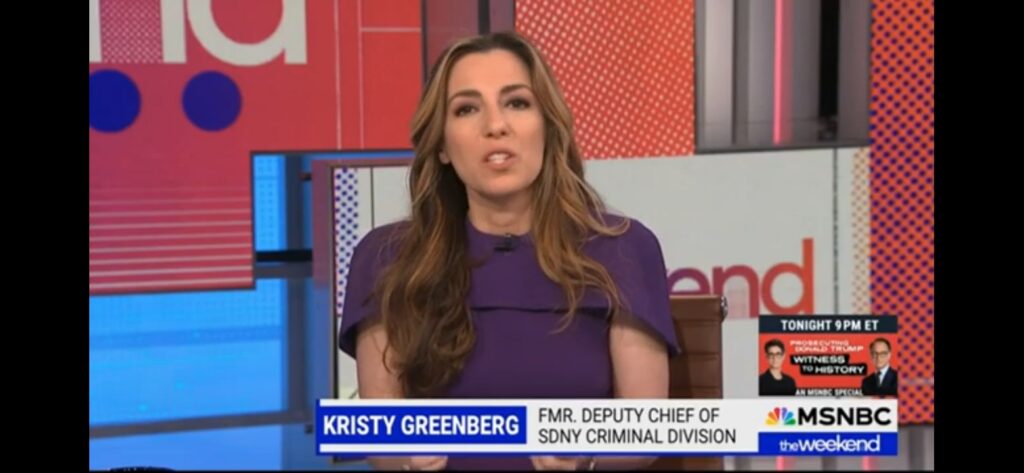
Kristy Greenberg, Former Deputy Chief at SDNY’s Criminal Division, appeared on MSNBC’s The Weekend show (06/09/24) where she made quite a compelling case as to why former President Trump should be imprisoned after being found guilty of 34 felony counts in the hush money case–the best case yet, as far as Yours Truly is concerned.

Kristi Greenberg: “I think that if you objectively look at all of the factors that are taken into account in sentencing, the prosecutors here should be seeking a jail sentence, and the judge should impose one. Look at the nature and the seriousness of the conduct…This was about the subversion of democracy. This was about depriving the voter of information that they would need when they go to the ballot box and decide who to vote for. What is more important than that?”

She also knocked down the argument one regularly hears on Fox News and other pro-Trump media outlets–that Trump should be accorded some deference and spared prison time, simply because he’s a former president. She argued instead that, because Trump wrote the hush money checks from the Oval Office, the judge should treat that as “an aggravating factor” for sentencing purposes.

In conclusion, she made the case that because Michael Cohen went to jail for the same conduct, Trump should likewise be imprisoned, especially given the fact that he was directing the criminal scheme–a slam dunk argument in my opinion. She specifically told the MSNBC hosts (1:09): “Michael Cohen went to jail for the same conduct, and he was less culpable than Donald Trump, who was directing him to do it. So if it’s serious enough for Michael Cohen to go to jail, it is certainly serious enough for Donald Trump to go to jail as well.”

For those of you very happy with @Emolclause’s activism don’t shy away from the “tip jar” below on your way out. You may also Cash App

Email author at admin@grassrootsdempolitics.com

Become an Octapharma Plasma donor. Make up to $200 in one week and help save lives too! Learn More